Table of Contents
Tina Turner did what we so often tell women to do.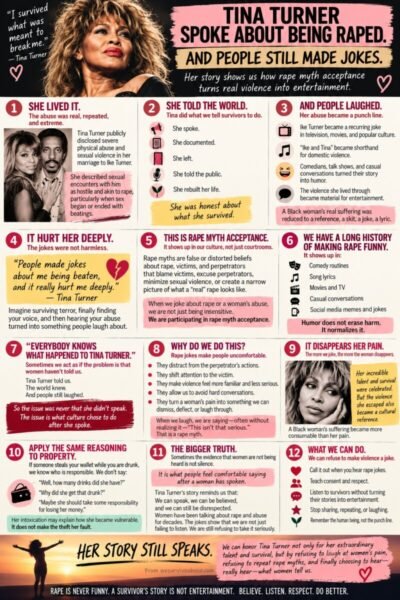
She spoke.
She told the truth about the violence in her marriage. She described beatings, coercive control, and sexual experiences with Ike Turner that she described as rape. She left. She wrote about it. She answered questions about it. She survived and built an extraordinary life beyond it.
And people still made jokes.
That part of Tina Turner’s story belongs in our conversations about rape myths because we have been laughing about rape, sexual assault, domestic violence, and women’s terror for a very long time.
Sometimes the joke tells us what a culture has decided it can live with.
1. 🎤 Tina Turner told us what happened.
This was not simply a story the public pieced together from rumors.
Tina spoke publicly about Ike Turner’s violence. She described being beaten and terrorized. She also described sexual encounters involving violence and coercion, including experiences she characterized as rape.
She gave us her story.
PATTERN TO RECOGNIZE
We often ask:
“Why didn’t she tell somebody?”
Tina Turner did.
Sometimes the question isn’t why women don’t speak.
Sometimes the question is what we do after they speak.
2. 😂 People turned “Ike and Tina” into a joke.
Over time, the violence became part of popular culture.
References to Ike beating Tina appeared in jokes, comedy, music, television and casual conversation. Ike Turner himself became a cultural shorthand for a man who beats women.
Think about what happened there.
A woman’s actual suffering became a reference people could make without even having to explain the reference.
Everybody already knew.
She survived it.
➡️ We learned about it.
➡️ We repeated it.
➡️ Eventually, some of us laughed about it.
That isn’t ignorance.
3. 💔 Tina said the jokes hurt.
This is the piece that should stop us.
For the person telling the joke, it might have lasted ten seconds.
For Tina Turner, the violence was something she had actually lived.
There is a tremendous difference between hearing about a woman being beaten and being the woman who remembers the beating.
Between hearing about rape and remembering being raped.
Between laughing at a reference and knowing that your terror is the reference.
THE HUMAN BEING INSIDE THE JOKE
Before “Ike and Tina” became shorthand, there was Tina.
A woman.
A wife.
A mother.
A human being trying to survive.
The joke can make her disappear.
4. 🔎 This is one way rape myths survive.
Rape myth acceptance is the acceptance of false or distorted beliefs about rape, victims and perpetrators. These beliefs can blame victims, excuse perpetrators, minimize sexual violence, or create rigid ideas about what “real rape” and a “real victim” supposedly look like.
But rape myths don’t always arrive sounding serious.
Sometimes they arrive laughing.
“She was drunk.”
“She shouldn’t have gone home with him.”
“She knew what she was doing.”
“She woke up and regretted it.”
“He couldn’t help himself.”
And sometimes sexual violence itself becomes the punch line.
Humor can make something horrific feel ordinary enough to repeat.
5. 🎭 “It’s just a joke” doesn’t answer the question.
People sometimes defend cruel humor by saying:
“It’s only a joke.”
But that tells us the form of the statement. It doesn’t tell us anything about what the joke communicates.
So ask another question:
What has to be funny for this joke to work?
Is the funny part a woman being terrified?
A woman being beaten?
A drunk woman being sexually exploited?
A man refusing to accept no?
A prison rape?
A husband forcing sex on his wife?
A woman saying she was assaulted and nobody believing her?
Once we remove the laughter, sometimes what remains is remarkably ugly.
6. 🍷 We joke about the vulnerable woman and then blame her for being vulnerable.
This connects directly to the way we talk about alcohol and sexual assault.
A woman becomes intoxicated.
Someone allegedly exploits her condition.
And somehow the conversation can become:
Why did SHE drink that much?
Why did SHE go there?
Why did SHE trust him?
Why didn’t SHE protect herself?
Watch what happened.
The person accused of exploiting vulnerability has almost disappeared from the conversation.
The vulnerable woman has become the problem.
🚨 PATTERN ALERT
Question 1: What did someone do to her while she was vulnerable?
Question 2: Why did she allow herself to become vulnerable?
Those are not interchangeable questions.
7. 👛 We don’t have this much confusion when somebody steals her purse.
Try the same reasoning with property.
A woman gets drunk.
She passes out.
Someone reaches into her purse and steals $500.
Do we say:
“Why did she drink so much?”
“She voluntarily became intoxicated.”
“She should have protected her purse better.”
“Maybe she bears some responsibility for him taking the money.”
We know better.
Her intoxication may explain why she was vulnerable to theft.
It does not explain why someone decided to steal from her.
THE PROPERTY TEST
She was drunk.
Still her wallet.
She was unconscious.
Still her money.
She trusted him.
Still her property.
She made bad decisions.
Still theft.
Now replace the wallet with her body.
Why should our understanding of responsibility suddenly disappear?
8. ⚠️ Vulnerability and permission are not synonyms.
This is such a simple distinction.
Someone can be vulnerable without giving anyone permission to exploit that vulnerability.
Sleeping creates vulnerability.
Illness creates vulnerability.
Disability can create vulnerability.
Intoxication can create vulnerability.
Being very young or very old can create vulnerability.
Trust creates vulnerability.
None of these conditions creates an entitlement for somebody else.
KEEP THESE WORDS SEPARATE:
VULNERABILITY = someone may have less ability to protect herself.
OPPORTUNITY = another person may have greater ability to exploit her.
PERMISSION = consent or authorization.
One does not magically become the other.
9. 🪞 Women can absorb these messages too.
Rape myths don’t only live inside people who blame Survivors.
Survivors hear them too.
A woman can wake up knowing something is wrong and immediately begin questioning herself.
But I was drinking.
But I kissed him.
But I went upstairs.
But I liked him.
But I didn’t fight.
But I can’t remember everything.
But I didn’t report it.
She can begin building the case against herself before anybody else gets the opportunity.
That is one reason the jokes aren’t harmless.
People are listening.
And some of the people listening have survived exactly what everybody else is laughing about.
10. 📣 “Speak up” is only half a promise.
We tell Survivors:
Tell somebody.
Report it.
Use your voice.
Don’t stay silent.
Tina Turner did.
So her story gives us another question.
What happens after she speaks?
Do we listen?
Do we investigate?
Do we believe her pain is worthy of seriousness?
Do we reduce her entire life to the worst things somebody did to her?
Do we turn her story into entertainment?
Do we repeat the joke because everybody else is laughing?
Speaking does not guarantee being heard.
Those are two different promises.
11. 🖤 There is another layer when the woman is Black.
Tina Turner was not an abstraction. She was a Black woman telling the world about extraordinary violence committed against her.
And Black women’s pain has its own history of being disbelieved, sexualized, exaggerated, minimized, mocked, or treated as something Black women are simply strong enough to withstand.
Even admiration can hide something.
We loved Tina’s strength.
We loved the comeback.
We loved the legs, the hair, the voice, the performances, the energy and the triumph.
But celebrating how magnificently a woman survived cannot become an excuse to forget what she had to survive.
Strength does not make suffering painless.
12. 🧭 Listen to what people feel comfortable joking about.
Sometimes we look for evidence that society takes violence against women seriously only in laws, policies and official statements.
Listen to the jokes too.
Listen to the casual references.
Listen to what becomes a meme.
Listen to what people say when they think everybody in the room will laugh.
Because sometimes the evidence that women are not being heard is not silence.
It is what people feel comfortable saying after a woman has spoken.
🌿 THE TRUTH TO CARRY WITH US
Tina Turner spoke.
People knew.
And people still laughed.
That tells us something bigger than the story of one extraordinary woman.
Women have been talking about rape and abuse for generations. Survivors have written books, testified, organized, called hotlines, spoken to police, told relatives, confronted institutions and stood before cameras.
The problem has never been only whether women will speak.
We also have to become people worthy of hearing them.
So when a woman tells us that she was raped, beaten, sexually exploited or terrorized, her suffering does not belong to the culture as raw material for a punch line.
Rape is not funny because the reference is familiar.
Abuse is not funny because everybody knows the story.
A Survivor’s pain does not become public property because she had the courage to tell us about it.
And perhaps Tina Turner leaves us with one more lesson.
She should never have had to survive the violence in the first place.
But once she found the courage to tell us about it, the very least the rest of us could have done was refuse to laugh.
Tina Turner Survived Through Hell and NOTHINg About That is Funny – WE Survive Abuse
25 Ways Society Sends Harmful Messages to Black Women About Our Safety and Worth – WE Survive Abuse
Shaming Survivors Is How You Build an Abuser’s Paradise – WE Survive Abuse
When the Mask Matters More Than the Truth, Survivors Are Pushed to Disappear – WE Survive Abuse
Humiliation Is an Abuse Tactic: When Someone Keeps Trying to Make You Feel Small – WE Survive Abuse
Public Humiliation Is Not Entertainment: How Shame Becomes a Tool of Control – WE Survive Abuse
Risk Doesn’t Rise by Accident—What Happens When Care is Uneven for Black Women – WE Survive Abuse