
Table of Contents
At first glance, the story of Marcia Johnson can produce a very simple conclusion.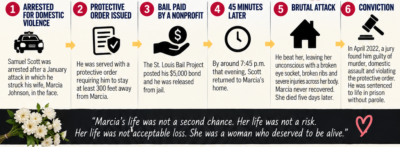
A nonprofit dedicated to helping poor people posted Samuel Scott’s $5,000 bail after he had been charged with domestic violence. He was released. That evening, he returned to Marcia. She was brutally attacked and died five days later.
It is understandable that people looked immediately at the Bail Project.
But once we follow the chain backward, the story becomes considerably more complicated.
Because the Bail Project did not decide that Samuel Scott could safely be released.
The system had already made that decision conditional upon somebody producing $5,000.
And suddenly this becomes a story about two groups our justice system has repeatedly struggled to serve well:
victims of domestic violence and people without money.
1. 🔎 Start with what happened to Marcia.
Samuel Scott had been accused of striking his wife, Marcia Johnson, in the face in January 2019, injuring her ear and cheekbone.
The probable-cause statement also alleged that when Marcia was going to contact police, Scott threatened that he might as well “finish what he started.” He was arrested in April and charged with misdemeanor domestic assault.
On April 9, the Bail Project posted his $5,000 cash bond.
That evening, Scott returned to Marcia’s home. She was subsequently found unconscious with devastating injuries and died five days later.
Scott was later convicted of her murder.
Those facts are horrifying.
But now let’s move backward through the chain.
2. 💵 The Bail Project paid the $5,000. It didn’t choose the $5,000.
This distinction changes the conversation.
The Bail Project’s mission was to assist people who remained incarcerated before trial because they couldn’t afford the bail a court had set.
So yes:
The Bail Project → supplied the money → Scott was released.
But before any of that could happen:
The justice system → established the conditions → under which Scott could be released.
That means there is an earlier question than:
“Why did the Bail Project bail him out?”
There is:
“Why could Samuel Scott obtain his freedom for $5,000?”
3. ⚖️ The Bail Project made a point we shouldn’t dismiss.
After Marcia’s killing, Bail Project executive director Robin Steinberg pointed out that if Scott had been wealthy enough to afford his bail himself, he could have obtained his pretrial freedom without the organization’s assistance.
Sit with that for a minute.
TWO SAMUEL SCOTTS
Samuel Scott A has $5,000.
He pays.
He leaves.
Samuel Scott B doesn’t have $5,000.
He remains incarcerated unless someone else pays.
Same allegations.
Same alleged victim.
Same possible danger.
Same human beings.
Different bank accounts.
🚨 PATTERN TO RECOGNIZE
If the thing supposedly protecting Marcia was Scott’s inability to afford $5,000, then Marcia was never being protected by a genuine determination that he was too dangerous to release.
She was being protected by his poverty.
Those are not the same thing.
4. 🏦 Wealth shouldn’t determine whether someone is dangerous.
This is where criticism of the Bail Project alone becomes inadequate.
Imagine that Scott had been wealthy.
No charity.
No activists.
No Bail Project.
No organization for the public to blame.
He writes the check.
And walks out.
WHAT CHANGED ABOUT HIS RISK?
Nothing.
His money did not make him less dangerous.
And poverty did not make him more dangerous.
Danger and wealth are two different questions.
That is the legitimate problem bail reformers were trying to confront.
5. 👩🏾 But Marcia’s safety was also a legitimate justice question.
This is where domestic-violence knowledge has to enter the room.
The answer to wealth-based injustice cannot be:
Ignore danger.
And the answer to danger cannot simply be:
Make bail so expensive that poor defendants remain incarcerated while wealthy defendants accused of identical conduct go home.
We need a system capable of holding two thoughts at once.
⚖️ JUSTICE REQUIRES BOTH
A person’s poverty should not determine whether he loses his freedom before conviction.
AND
A victim’s safety should not depend upon whether the person accused of harming her happens to be poor.
Those aren’t opposing values.
A competent justice system should be able to care about both.
6. 🚨 So go backward another step: Why $5,000?
Contemporary reporting asked this very question.
Courthouse News reported that Scott’s $5,000 bond was below a reported $25,000 median bond amount and noted questions about why his bond had been set at $5,000 given the alleged history of violence.
There was information in the case that should make anyone knowledgeable about domestic violence pay attention.
Alleged physical assault.
An intimate partner.
An alleged threat connected to her contacting police.
And, on the day of his release, an order of protection prohibited Scott from coming within 300 feet of Marcia or entering her home. Reporting differed over the exact sequence of the order and the Bail Project’s payment, and the organization said it didn’t know about the order when it posted bail.
But even without resolving that timing dispute, the underlying domestic-violence allegation already existed.
7. 🧩 And now the story changes again.
Look at the institutional chain:
FOLLOW THE CHAIN
Marcia reports violence
⬇️
An alleged threat about contacting police appears in the case
⬇️
Scott is charged with misdemeanor domestic assault
⬇️
The justice system permits release under specified conditions
⬇️
Cash bond is set at $5,000
⬇️
Scott doesn’t have the money
⬇️
The Bail Project supplies it
⬇️
Scott is released
⬇️
He returns to Marcia
⬇️
Marcia is fatally assaulted
When we look at the whole chain, blaming the organization that supplied the money does not tell us why money was the gatekeeper in the first place.
8. 🧠 And St. Louis’s bail system itself was under serious scrutiny.
This is an important part of the historical context.
A federal civil-rights lawsuit filed in January 2019 challenged St. Louis’s bail system. Plaintiffs alleged that bond recommendations were being made without adequately examining defendants’ ability to pay, flight risk, or danger to the public, and that some initial proceedings lasted only one or two minutes. These were allegations about the broader system, not findings about the particular judge or proceeding that produced Scott’s $5,000 bond.
There is an extraordinary additional detail in that litigation.
The plaintiffs later alleged that St. Louis judges sometimes set bonds at $5,000 or less specifically with the expectation that the Bail Project might pay them. One example described in the litigation involved an order explicitly directing a defendant to apply to the Bail Project. Again, that evidence does not establish that this happened in Scott’s particular case.
But it tells us something important about the environment.
The Bail Project wasn’t necessarily operating outside the justice system.
In some cases, the justice system itself was apparently incorporating the Bail Project into the way release worked.
That makes the simple villain story even harder to sustain.
9. 🛡️ Domestic violence requires something money cannot provide: risk assessment.
Here is where I keep coming back.
What did $5,000 actually do?
Did it assess Scott’s alleged threat?
No.
Did it monitor him?
No.
Did it physically protect Marcia?
No.
Did it determine whether he would obey the protective order?
No.
Did it tell us whether violence was escalating?
No.
Did it measure his ability to tolerate Marcia separating from him or contacting authorities?
No.
It was money.
💡 TRANSLATION
If someone is genuinely safe to release:
Being poor shouldn’t keep him incarcerated.
If someone presents a sufficiently serious danger that release cannot safely be managed:
Being rich shouldn’t buy his way around that danger.
That is where the conversation needs to go.
10. 📜 Missouri eventually changed its rules.
There is another important piece of context.
Missouri’s revised Rule 33.01, effective January 1, 2020, expressly requires courts considering pretrial release to consider “the safety of the community or other person,” including crime victims and witnesses. Courts are instructed to use the least restrictive conditions necessary and consider nonmonetary conditions first.
And there is a crucial provision:
If a court determines by clear and convincing evidence that no combination of monetary and nonmonetary conditions can protect another person or the community, the rule provides for pretrial detention.
Read what that framework attempts to separate:
MONEY
Can he afford release?
from
DANGER
Can he safely be released?
Those should never have been interchangeable questions.
11. 👩🏾⚖️ The prosecutor had criticism for the Bail Project too.
Following Marcia’s killing, St. Louis Circuit Attorney Kim Gardner urged the Bail Project to review court records before posting bail and to contact prosecutors before paying bail for people accused of crimes involving victims, including domestic violence.
Gardner said this would also allow victims and witnesses to be notified about a defendant’s release.
That’s a fair part of the chain to examine.
The Bail Project was not powerless.
Organizations making decisions that affect domestic-violence cases should understand domestic violence.
But accountability doesn’t require us to stop investigating the moment we find the first organization whose decision we dislike.
🔎 FOLLOW THE CHAIN
What information did the Bail Project review?
AND
What information did prosecutors provide?
AND
What did the court know?
AND
Who determined the conditions of release?
AND
Who assessed danger to Marcia?
AND
Who was responsible for notifying her?
AND
What mechanism existed to protect her once Scott was released?
Now we are asking systems questions.
12. 🖤 And yes, race and poverty belong in this story too.
This is where I think the story becomes especially uncomfortable.
On its face, it can look like advocates speaking about racial inequality and poverty made a terrible decision and a Black woman paid for it.
But if we stop there, we may miss another Black woman standing right in the middle of the justice question.
Marcia Johnson.
A system can fail poor defendants.
And that same system can fail victims of domestic violence.
Those populations are not neatly separated.
Poor women experience domestic violence.
Black women experience domestic violence.
Women accused of crimes experience domestic violence.
Women living in heavily policed communities experience domestic violence.
The Black community includes Marcia too.
Justice cannot require us to choose which vulnerable person counts.
13. 🔄 LOOK AT THE DIFFERENCE
The shallow version of the conversation becomes:
SIDE A
“The Bail Project released a dangerous man.”
versus
SIDE B
“Cash bail discriminates against poor people.”
But follow the chain and we reach something much more useful:
THE REAL SYSTEMS QUESTION
How do we build a pretrial system that does not imprison people merely because they are poor while also recognizing credible danger to victims before somebody is killed?
That question does not require sacrificing poor people.
It doesn’t require sacrificing defendants’ rights.
And it certainly doesn’t require sacrificing women.
14. 🚩 Domestic-violence expertise belongs inside justice reform.
This may be the largest lesson I take from Marcia’s case.
Domestic violence cannot be something we remember after designing criminal-justice reform.
People doing bail reform should understand it.
People doing sentencing reform should understand it.
Judges should understand it.
Prosecutors should understand it.
Defense attorneys should understand it.
Police should understand it.
Social-justice organizations should understand it.
Because domestic violence has its own dynamics.
Control.
Retaliation.
Escalation.
Stalking.
Separation.
Threats.
Boundary violations.
Punishment for seeking help.
If your model doesn’t know how to see those patterns, it can misunderstand what it is looking at.
15. 🌱 We don’t have to abandon one form of justice to recognize another.
This is where I land after following this case further.
The Bail Project’s argument about wealth should not be dismissed.
A wealthy Samuel Scott could have paid $5,000 himself.
That exposes a genuine problem.
But Marcia’s death exposes another.
BOTH CAN BE TRUE
Poverty should not function as a substitute for dangerousness.
Wealth should not function as a substitute for safety.
And:
Women should not have to die before institutions recognize that domestic violence can involve serious and escalating danger.
That is not asking us to choose between justice for poor people and justice for victims.
It is asking our systems to become sophisticated enough to provide both.
🌿 THE TRUTH TO CARRY WITH US
The easiest place to stop this story is with the Bail Project.
They paid the money.
Scott walked out.
Marcia died.
But following the chain changes the question.
The Bail Project did not decide that $5,000 was the appropriate threshold between Scott’s detention and release.
The system did.
And if Samuel Scott had possessed more money, the Bail Project would never have entered this story at all.
So perhaps the question isn’t:
“Why did somebody help a poor man make bail?”
Perhaps it is:
“Why was Marcia Johnson’s safety dependent upon whether that man could come up with $5,000?”
A justice system should not confuse poverty with dangerousness.
It should not confuse wealth with safety.
And when a woman reports violence, threats, fear, stalking, coercion, or escalating behavior, her safety cannot be the concern we discover only after every other principle has had its turn.
Marcia belonged inside the justice conversation from the beginning.
Any reform worthy of the word justice has to be able to see her too.