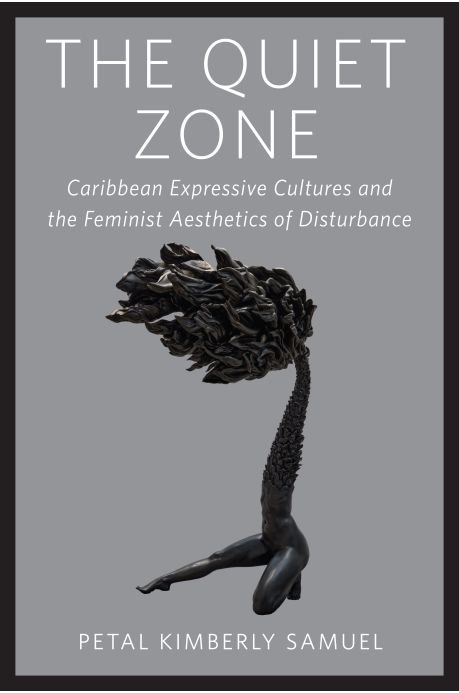
The Quiet Zone authored by Petal Kimberly SamuelThere is a kind of quiet that feels like freedom.The house after everyone has gone to sleep. S
The Quiet Zone authored by Petal Kimberly Samuel
There is a kind of quiet that feels like freedom.
The house after everyone has gone to sleep. Sitting in the car for five extra minutes before going inside. A Survivor finally closing the door on chaos and realizing nobody is coming through it tonight.
That quiet belongs to you. But there is another kind of quiet.
The quiet other people require from you so that they can remain comfortable.
Petal Kimberly Samuel’s The Quiet Zone: Caribbean Expressive Cultures and the Feminist Aesthetics of Disturbance made me think deeply about the difference.
Samuel studies Caribbean culture and its diasporas through sound, silence, race, gender, class, tourism and power. One of the fascinating questions running through her work is what happens when “quiet” becomes associated with refinement, respectability and desirable spaces while Black expression becomes characterized as noise, disturbance or disorder.
It raises a deceptively simple question:
Who gets to make sound without being judged for it?
Sometimes “loud” really means loud. But sometimes it means assertive. Sometimes it means disagreeing. Sometimes it means asking an inconvenient question. Sometimes it means saying, “That isn’t what happened.”
And sometimes a woman doesn’t have to raise her voice at all before somebody decides she is angry.
That old “loud Black woman” stereotype has always been particularly effective because it can move attention away from what a woman is saying and place it onto how she is saying it.
She reports unfair treatment.
“Why are you so angry?”
She establishes a boundary.
“You don’t have to be aggressive.”
She challenges a decision.
“Your tone is inappropriate.”
She reports harm.
“Let’s calm down.”
Before long, everyone is discussing her delivery, and nobody is discussing what happened.
Survivors know this territory intimately.
We tell women to speak up. Tell someone. Break the silence. Find your voice.
Then a woman finds it.
She names the respected man. She reports the supervisor. She says what happened inside the family. She tells somebody what happened to her child. She says she doesn’t feel safe.
Suddenly people become very interested in quiet.
Could she handle this privately?
Does everybody need to know?
What about his reputation?
What about the family?
What about the organization?
What about forgiveness?
And there it is.
Sometimes people love the idea of women finding their voices more than they love hearing what women have to say.
Black girls learn versions of this lesson early.
One girl is confident. Another is “bossy.”
One child is energetic. Another is “disruptive.”
One student is assertive. Another is “aggressive.”
A girl says, “Stop touching me,” and somehow the conversation becomes about the way she said it.
Adults hold tremendous power over the words used to describe children. Those words can become expectations, discipline records and eventually part of the child’s understanding of herself.
Sometimes the child doesn’t need to become quieter.
Sometimes the adults need to listen better.
There is a long Black American history underneath this too.
Many of us were raised with instructions about how to move through the world safely. Dress properly. Speak properly. Don’t embarrass yourself. Don’t give anybody a reason. Much of that came from love. Black parents understood that their children were entering institutions where ordinary mistakes could receive extraordinary consequences.
But survival lessons become dangerous when we begin believing Black people must perform perfection to deserve ordinary humanity.
And Black women can spend entire lives trying not to become somebody else’s stereotype.
Not too angry.
Not too loud.
Not too sexual.
Not too demanding.
Not too confident.
Not too difficult.
Eventually you have to ask, “At what volume am I permitted to be fully human?”
Samuel’s work is especially interesting because the answer isn’t simply “be louder.”
Quiet can also be precious.
Black people deserve quiet.
Survivors deserve quiet.
Women deserve privacy.
We should not have to constantly explain, educate, debate, disclose trauma, defend our boundaries, or transform our pain into public testimony.
A Survivor telling her story deserves protection.
So does the Survivor who says, “My story belongs to me.”
A woman choosing silence is not the same as a woman being silenced.
A woman choosing privacy is not the same as an institution hiding what happened to her.
A woman enjoying peace is not the same as someone demanding that she make herself smaller.
Choice changes the meaning of quiet.
So perhaps the next time somebody is called loud, difficult, aggressive, disruptive or disturbing, we should become a little more curious.
What actually happened?
Was someone harmed?
Was a boundary crossed?
Or did somebody simply become uncomfortable?
Would the same behavior be described differently coming from someone else?
And who benefits if this person becomes quieter?
Because sometimes freedom sounds like a woman finally telling the truth.
Sometimes it sounds like Black children laughing loudly.
Sometimes it sounds like music coming through an open window.
Sometimes it sounds like a woman saying no without providing a five-paragraph explanation.
And sometimes freedom sounds like absolutely nothing.
A closed door.
A quiet room.
A woman sitting peacefully inside it.
Nobody demanding anything from her.
Nobody asking her to explain herself.
Nobody telling her to lower her voice.
Because this time, the quiet belongs to her.
Inspired by themes explored in Petal Kimberly Samuel’s 2026 book, The Quiet Zone: Caribbean Expressive Cultures and the Feminist Aesthetics of Disturbance. Samuel’s scholarship focuses on the Caribbean and its diasporas; the applications to Black American women and girls, Survivors, schools and workplaces in this essay are my own reflections.
About the Book
The Quiet Zone: Caribbean Expressive Cultures and the Feminist Aesthetics of Disturbance by Petal Kimberly Samuel was published by Rutgers University Press in 2026 as part of its Critical Caribbean Studies series. The 220-page book examines quiet, noise, sonic surveillance, Black expression and the Caribbean and its diasporas. Rutgers also identifies the title as available through Open Access.
Read more about The Quiet Zone at Rutgers University Press
This essay is an independent reflection inspired by themes in Samuel’s scholarship and extends those ideas into questions concerning Black American women and girls, Survivor advocacy, schools and workplaces. Those applications are the author’s analysis and should not be attributed directly to Samuel.
Please support independent booksellers like Harriet’s bookstore.
Buy books. Read books. Share books. Give books as gifts.