We love movies like 'Avengers' when beings from different walks of life come together to fight together against one common enemy. Transformers. Fantas
We love movies like ‘Avengers’ when beings from different walks of life come together to fight together against one common enemy. Transformers. Fantastic Four. Off-screen that isn’t always possible.
Not everyone who wants “justice” is walking toward the same destination.
Not everyone who speaks the language of protection is protecting the same people.
Not everyone who uses the word rights is holding the same vision of human dignity.
So sometimes…everyone cannot fight the entire war together.
Not because one side hates safety.
But because:
- they center different lives,
- they define harm differently,
- they protect different boundaries,
- and they are willing to sacrifice different people along the way.
This is critically important.
Protection for women and girls is a grounding center.
When that center disappears, everything destabilizes.
Because women’s and girls’ safety is not a political accessory.
It is a civilizational anchor.
When movements lose that anchor:
- boundaries become negotiable
- harm becomes abstract
- vulnerable bodies become theoretical
- and real-world violence gets treated like an inconvenience to ideology
That loss alone is enough to make many people emotionally withdraw, even if they cannot yet explain why.
Movements fracture when:
- women’s bodies become negotiable,
- girls’ safety becomes “complicated,”
- questions become betrayal or “hateful”
- and power becomes more important than care.
At that point, unity becomes a performance.
And forced unity is not peace.
It is quiet violence.
There is wisdom in knowing when a shared banner no longer shelters the same hearts.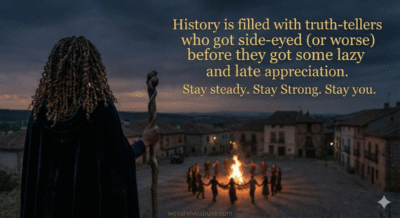
Sometimes the most ethical act is not to keep marching side by side…
…but to stop, tell the truth about what you see, and refuse to offer your silence as glue.
That is not division for ego.
That is discernment.
And history shows:
Real protection has always been built by smaller groups of people who were willing to say,
“This far. No further. Not over women. Not over children. Not over the vulnerable.”
There is a difference between alliance and alignment.
That kind of clarity is lonely sometimes.
But it is how lasting safety is born.