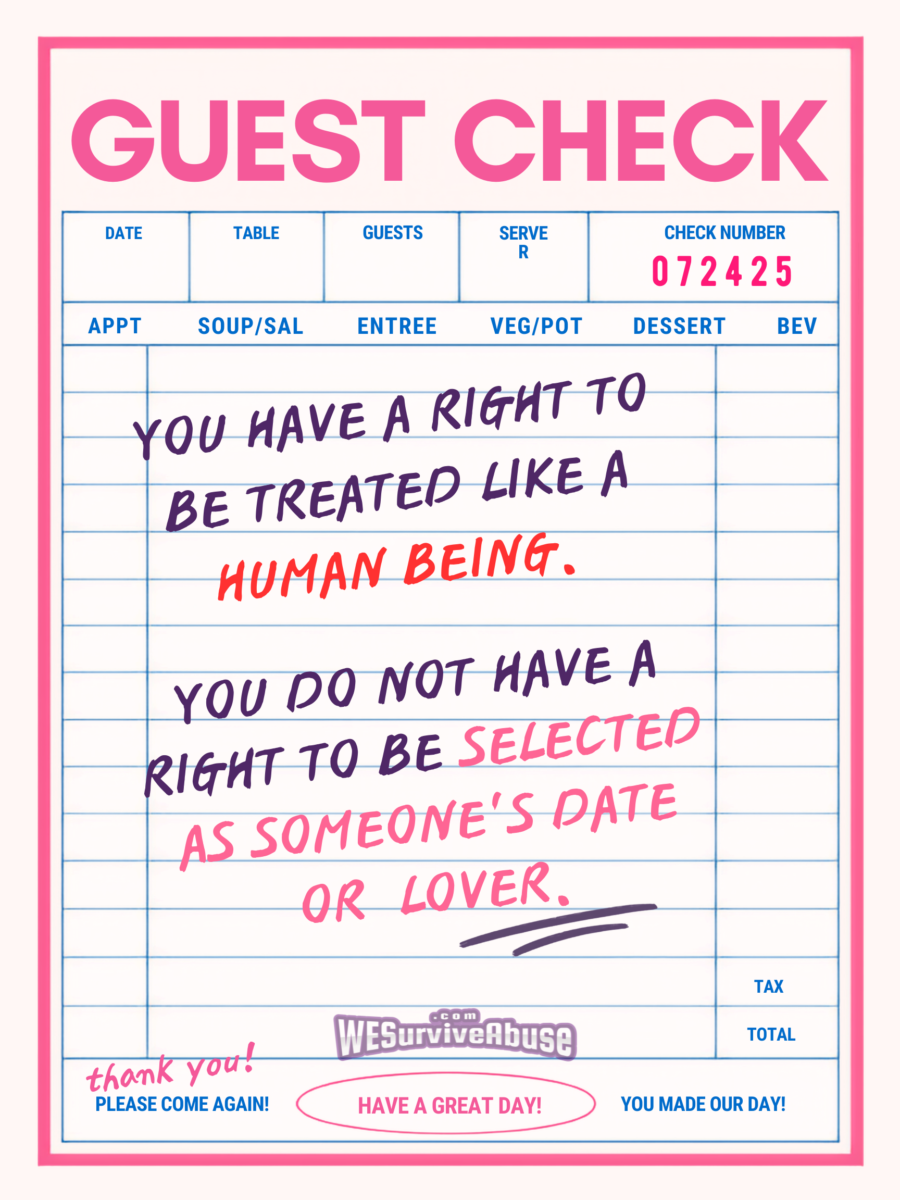
Human dignity should be universal. Sexual access should never be. We reached the part of this discourse where Rosa Parks was invoked to infer that wo
Human dignity should be universal. Sexual access should never be.
We reached the part of this discourse where Rosa Parks was invoked to infer that women are like white supremacists for not dating men or something? Using painful history to coerce your way into women’s private lives is low, dudes.
Defining “bigot” first is important because the word is doing work in these arguments that it was never meant to do.
A bigot is generally a person who is obstinately or unreasonably prejudiced against, intolerant of, or antagonistic toward people because they belong to a particular group. Bigotry concerns how we regard and treat other human beings in social life.
But dating and sex operate under a different ethical principle: individual consent.
A woman can believe another person deserves employment, housing, safety, medical care, friendship, legal equality, courtesy, and freedom from harassment while simultaneously saying:
“I do not want to date you.”
Those ideas do not contradict each other.
1. Consent is necessarily selective.
If a woman must be willing to consider everyone in order to prove she isn’t prejudiced, she doesn’t actually possess meaningful sexual consent. Consent includes choosing who, not merely choosing whether sex happens.
I refuse the idea that women’s boundaries become suspicious whenever somebody feels excluded by them. Every boundary excludes something. That is what makes it a boundary.
2. Civil equality does not create romantic entitlement.
Equal human dignity means people deserve equal protection under the law. It does not mean everyone receives equal access to another person’s body, affection, home, marriage, or intimate life. My dating life does not have an equal-opportunity requirement. Attraction is personal, intimacy is selective, and consent belongs to the person giving it. I am allowed to choose.
3. Dating is not public accommodation.
A restaurant cannot ordinarily decide that an entire protected class may not eat there. A woman’s dating life is not a restaurant. Her bedroom isn’t a public facility. She is a person making profoundly private decisions. I am allowed to know what I want without putting my boundaries through an appeals process. You may disagree with my reasons. You still do not get a vote.
4. Nobody is owed an audition.
Women don’t have to date somebody once, kiss somebody once, sleep with somebody once, or “give them a chance” before determining that they aren’t interested. Requiring an intimate trial period before a woman’s no becomes legitimate would itself undermine consent. I do not have to prove that someone is “good” or “bad” before I decide they are not for me. Dating is not a courtroom. My lack of desire is enough information to leave the door closed.
Nobody gets an audition with my body or my time. I do not have to “try it once,” “give him a chance,” or gather additional evidence. No is allowed to arrive before experience.
5. Attraction cannot be distributed according to fairness rules.
People don’t experience sexual attraction in mathematically equal portions across humanity. Sexual orientation itself makes that obvious. Attraction can involve sex, appearance, personality, chemistry, age, lifestyle, religion, fertility desires, family plans and countless other factors. Rejection is not oppression. Sometimes another human being simply does not choose you. I will not surrender the meaning of consent to make rejection easier for someone else to bear.
6. A boundary doesn’t require an accusation.
This one is especially important. A woman doesn’t have to establish that somebody is dangerous, immoral, unattractive, or defective before declining them. “I don’t want this relationship” is enough. No prosecution is required because nobody is on trial.
7. Declining intimacy isn’t the same thing as denying somebody rights.
There is an enormous moral difference between you cannot have a job because of what you are and you cannot have sex with me because I don’t consent. Treating those as equivalent quietly transforms another person’s body into something people can claim equal access to.
8. Women are allowed to consider compatibility.
Marriage, dating and sex can involve pregnancy, disease exposure, finances, caregiving, children, housing, emotional vulnerability and physical safety. Women are permitted to make decisions about whom they share those risks and responsibilities with.
I do not owe anyone a date to demonstrate my kindness. I do not owe anyone a kiss to demonstrate my open-mindedness. And I certainly do not owe anyone sex to prove that I am a good person.
9. Nobody has to justify a no sufficiently for the rejected person.
This is where interrogation can become its own pressure system: Why not? What if I changed this? Isn’t that discriminatory? Have you ever tried? How do you know? A woman may explain herself if she wants. Explanation is not the admission price for bodily autonomy. I can examine my beliefs, question my assumptions, listen carefully, learn something new and still say no. Reflection does not obligate me to produce a different answer.
10. Respecting someone’s humanity does not require desiring them.
Perhaps this is the cleanest distinction of all. We owe other human beings dignity. We do not owe them desire. I can respect your humanity without offering you intimacy. Those are two entirely different things. My respect for you does not require romantic or sexual access to me.
You don’t have to prove that your preferences are philosophically perfect before you’re allowed to say no.
Human beings carry histories, cultures, experiences, attractions, fears, hopes and sometimes contradictions into intimate relationships. We can examine our assumptions. We can reconsider prejudices. We can grow. We CAN if we want to.
And still after all that examination, the answer can still be no.
That is where the distinction between challenging prejudice and challenging consent becomes crucial. Someone may invite you to think about your beliefs. They cannot make access to your romantic or sexual life the test of whether you’ve thought correctly. You can say no to that too.
A society committed to equality should be capable of holding two principles at once: people should not be mistreated because of who they are, and nobody should be required to date or have sex with anybody they do not choose.
Those principles aren’t enemies. The second is part of the first.
Someone else’s disappointment can be real without becoming my obligation. I can have compassion for hurt feelings while leaving my decision exactly where I put it.
Equality asks me to recognize your humanity. Consent allows me to decide your proximity. We should never confuse the two.
Rosa Parks: A Stealth Strategist Against Deceit, Manipulation, and Violence – WE Survive Abuse
Her No Is a Complete Sentence – WE Survive Abuse
NO ONE Can Assert a Right to Be in Your Dating Pool – WE Survive Abuse
Love Doesn’t Mean Lying: I Can Respect You and Still Speak the Truth – WE Survive Abuse
Respect Without Surrender: When Rights Don’t Mean Access – WE Survive Abuse
Male Access Supremacy: When Entitlement Disguises Itself as Equality – WE Survive Abuse
How People Prompt or Lure Women to Prove Their Worth – WE Survive Abuse
He Wants It. But Why Does She Owe It? – WE Survive Abuse
“Say the Right Words and Walk Right In” Was Always Stupid AF – WE Survive Abuse