There is something missing from a great deal of our modern conversation about men, women, loneliness, relationships and belonging.We rarely acknow
 There is something missing from a great deal of our modern conversation about men, women, loneliness, relationships and belonging.
We rarely acknowledge just how much access to women men already have.
Not necessarily access to a particular woman. I mean access to women’s presence.
A man can open his phone before his feet touch the bedroom floor and see women. He can hear women speak. Watch women dance. Listen to women teach. Follow women’s daily lives. Look at women’s photographs. Enter women’s comment sections. Send messages to women he has never met. Watch women perform sexually. Join communities where women are talking. Follow hundreds or thousands of women across social media.
A century ago, a man’s social world was constrained enormously by geography, transportation, class, community and simple physical distance.
The internet blew holes through those walls.
Yet listen carefully to some of our conversations about men today and you could come away believing we are living through an unprecedented famine of female availability.
Men are lonely.
Men aren’t dating enough.
Men aren’t having enough sex.
Men aren’t receiving enough attention from women.
Men feel excluded from certain female communities.
Men need women to validate how they feel.
Meanwhile, let society tell it….
Women have become too selective.
Women aren’t marrying enough.
Women aren’t giving enough men a chance.
Women are establishing boundaries men dislike.
Women aren’t interrogating their preferences so that the men who desire access can get in.
And once again, here comes that old question dressed in new clothes:
What can women give them?
I think we need another question entirely.
Why is more access to women being proposed as the answer? Because we have tried an awful lot of access.
We Should Be Able to Notice the Contradiction
Never before has technology made it this easy for an ordinary person to reach into the lives of people who would once have been complete strangers.
Women are not hidden away. Women are everywhere.
Our voices, faces, photographs, opinions, performances, businesses, bodies, writing and everyday lives travel around the world in seconds.
And still, when some men say the access available to them is insufficient, society has a peculiar instinct to turn toward women and ask what else can be opened.
More opportunities to approach us.
More pressure to reconsider our dating preferences.
More criticism of women who choose to remain single.
More questioning of female boundaries.
More demands that women explain why we want some spaces for ourselves.
More suspicion directed toward women who say, simply, I don’t want this.
At some point we have to notice what we are doing. We keep treating women’s boundaries as the adjustable part of the equation.
Meanwhile, Women Are Still Being Killed
This is where the conversation becomes much more serious.
- In the United States, the Violence Policy Center found that 2,381 females were killed by males in single-victim/single-offender homicides in 2024. Where the relationship between victim and killer was known, women were far more likely to have been killed by a man they knew than by a stranger.
- Worldwide, approximately 50,000 women and girls were killed by intimate partners or other family members in 2024, according to UNODC estimates. That works out to roughly 137 women and girls every day.
- An investigation found that family annihilations were occurring in the United States, on average, about once every five days. At least 754 people were killed in 227 incidents identified from 2020 through the investigation in 2023.
- The CDC estimates that about one in five American women has experienced completed or attempted rape in her lifetime. And FBI estimates for 2024 amount to a reported rape roughly every four minutes.
So when women establish boundaries, our first social instinct should not be to ask how those boundaries can be loosened to give men greater access. Women are already living alongside extraordinary levels of male violence. More access to women is not, by itself, a violence-prevention strategy.
Because women are frequently told that knowing men makes us safer.
Give him a chance.
Get to know him.
Don’t be afraid.
Don’t be suspicious.
Don’t be so guarded.
Open up.
Trust.
And yet the terrible truth running through homicide data is that many women who are killed by men are killed by men who already had access. He was allowed in. He got what he wanted.
He knew her.
He dated her.
He married her.
He lived with her.
He had children with her.
He knew where she slept.
That should change the way we talk about access to women. Because we keep discussing it as the solution to what ails men from all walks of life.
Access Is Not Prevention
This is the mistake. We keep talking as though satisfying male desires will eventually produce enough contentment to make women safer.
Where is the evidence for that?
A woman cannot date enough men to solve male loneliness.
Women cannot provide enough sex to cure male violence.
Women cannot become agreeable enough to eliminate male resentment.
Women cannot open enough doors to prevent men from becoming angry about the doors that remain closed.
And women certainly cannot surrender enough boundaries to teach somebody to respect boundaries.
If a man responds poorly to women’s boundaries, giving him fewer opportunities to encounter boundaries cannot be our grand social solution.
He has to learn to encounter a boundary. He has to learn that another human being possesses authority he cannot override.
He has to learn: She said no.
And nothing else happens. No fighting. No interrogating. No attacking. Nothing.
Find something else to do elsewhere.
No Is Part of Living Among Other People
We have made women’s no far too complicated.
Sometimes she doesn’t want a second date.
No.
She doesn’t want him touching her.
No.
She doesn’t want him in that gathering.
No.
She doesn’t want to marry.
No.
She doesn’t want to explain herself.
Still no.
There does not always need to be an entire symposium and trial afterward. Adults, healthy adults, live in a world filled with things we cannot have.
Jobs reject us. Friendships end. Invitations don’t come. People fall out of love. Somebody we find beautiful does not find us attractive. Someone we hoped would choose us chooses somebody else.
That is life among free people. Women cannot become the exception.
We Need to Stop Building Policy Around the Idea That Male Want Creates Female Obligation
This deserves scrutiny anywhere it appears.
Before changing a rule, opening a space, removing a boundary or creating another expectation for women, we should ask who is being required to absorb the consequences.
What does this require from women?
Does it reduce women’s ability to say no?
Does it weaken women’s privacy?
Does it compromise women’s safety?
Does it turn women’s personal choices into public obligations?
And perhaps most importantly:
Are we responding to an actual injustice, or are we responding to the fact that some men dislike being denied something they want? Those are profoundly different problems.
A free society should address discrimination and genuine injustice.
A free society cannot guarantee that every person receives the relationships, attention, intimacy, affirmation or access they desire from other human beings.
That isn’t equality. That would require commandeering somebody else’s freedom.
There Is Another Direction
Instead of asking women to become increasingly accessible, we can expect more from men.
Men can build deeper friendships with other men.
Men can create community.
Men can organize.
Men can mentor boys.
Men can challenge male violence.
Men can intervene when other men are behaving dangerously.
Men can build organizations, networks, activities and spaces that address isolation without treating women as the missing social infrastructure.
Men can learn to survive rejection without converting disappointment into grievance.
And men can teach one another something women have been trying to communicate for generations:
You will sometimes hear no.
You are still responsible for what you do next. That is not cruelty. That is adulthood.
Women Are Not the Infinite Resource
There has to be a stopping place.
Because there will always be another want.
Another argument.
Another reason women should reconsider.
Another boundary somebody finds inconvenient.
Another explanation for why this particular accommodation is supposedly small enough that women shouldn’t mind.
But women’s freedom cannot survive if every boundary remains permanently available for renegotiation.
And women’s safety cannot be built upon the assumption that sufficiently accommodating men will eventually make male violence disappear. The numbers give us no reason for that kind of faith.
Maybe we have been staring at the wrong side of the equation. The question is not how much more access women can provide.
The question is whether we are willing to build communities where men understand that women are separate human beings, not resources distributed according to male need.
Because there is something we should have learned by now.
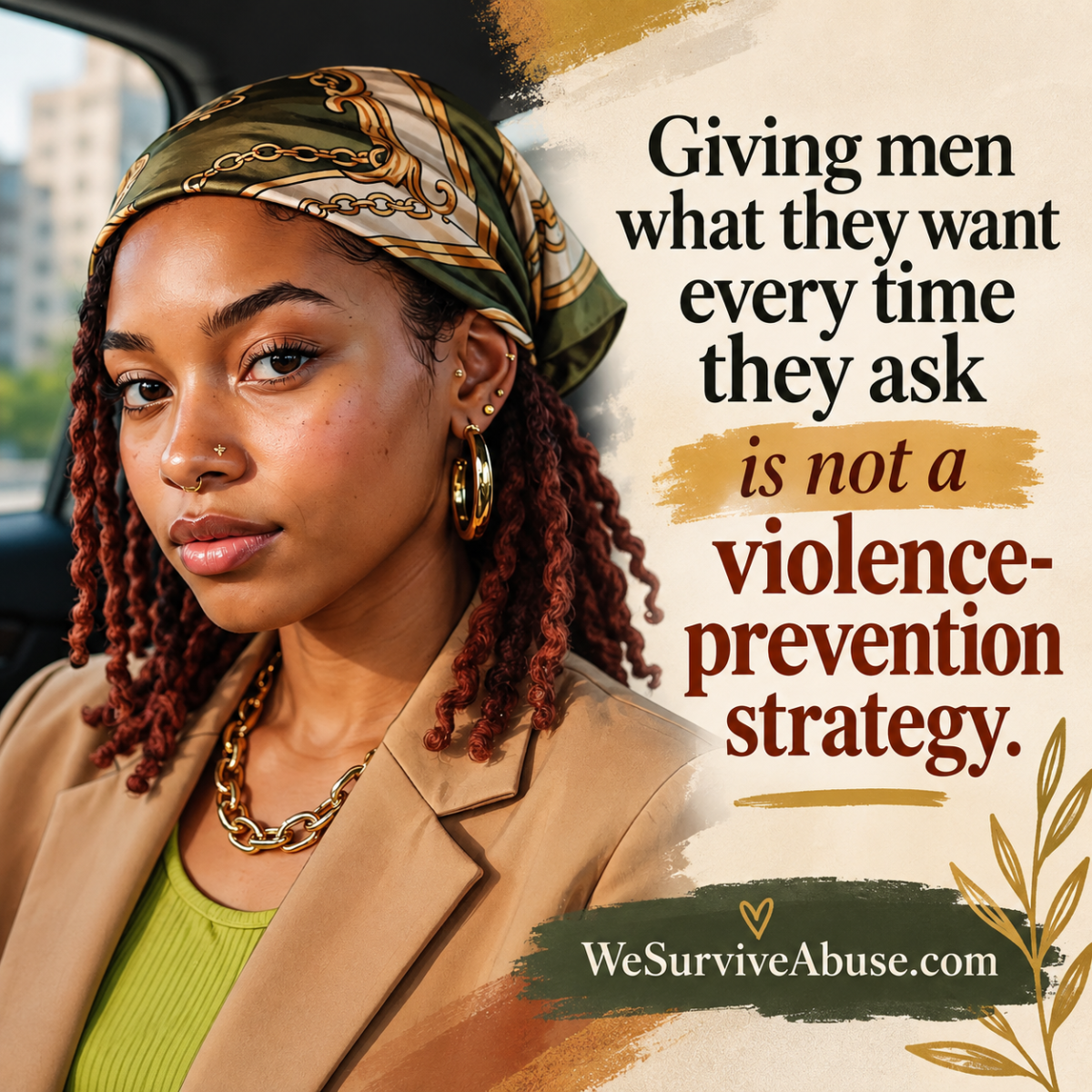
Giving men what they want every time they ask is not a violence-prevention strategy.
Sometimes prevention begins much earlier.
With a boy learning that girls can walk away.
With a young man learning that rejection is survivable.
With friends refusing to feed another man’s grievance against a woman who said no.
With communities taking threats, stalking and coercive control seriously.
With men understanding that love does not confer ownership.
And with society finally becoming comfortable saying something women have had to fight generations for the right to say:
No. You cannot have that.
Women Have Been Violently Punished for Telling the Truth for Centuries – WE Survive Abuse