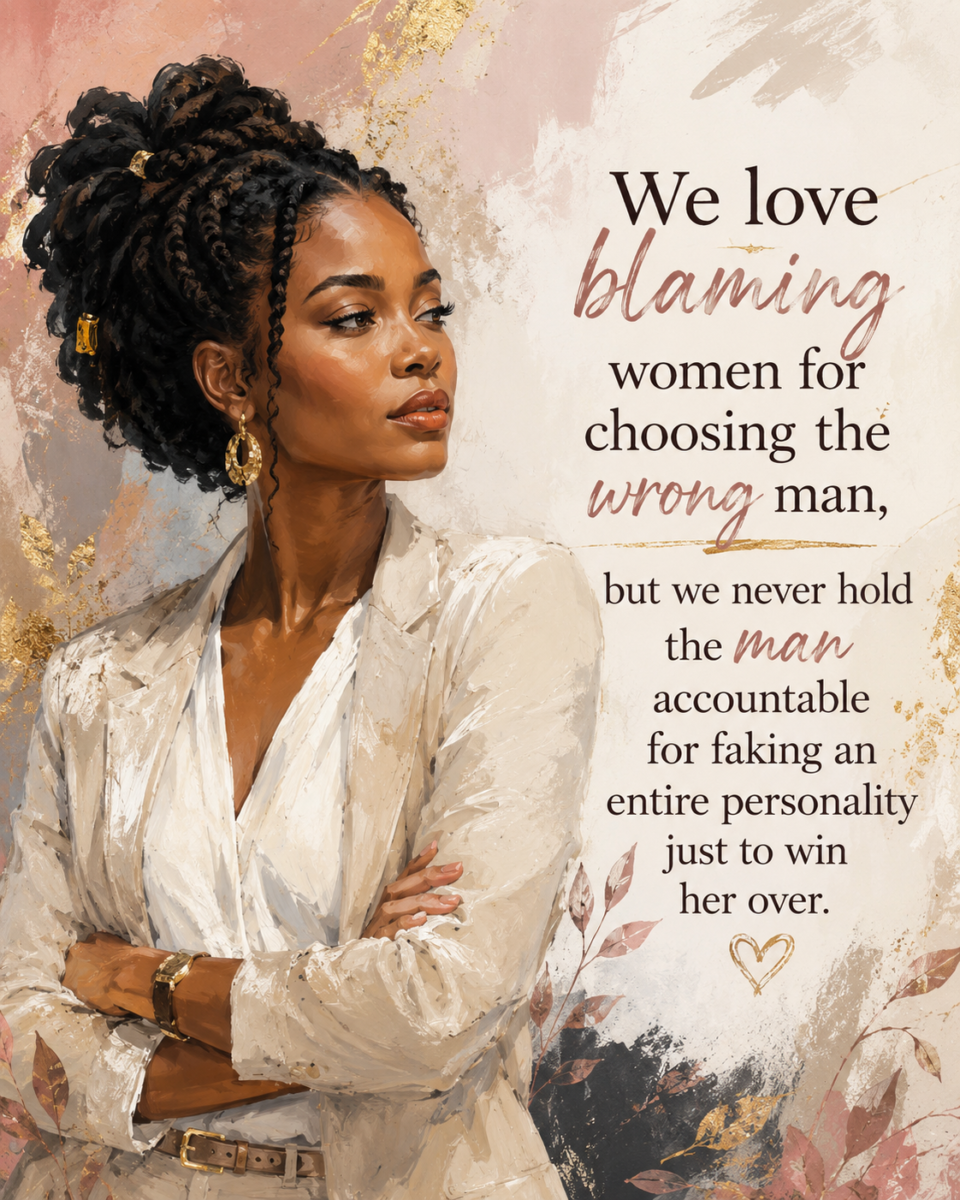
Some people judge Black women as if influence comes with a lifetime warranty on another person's integrity... This is not a defense of Oprah specific
Some people judge Black women as if influence comes with a lifetime warranty on another person’s integrity…
This is not a defense of Oprah specifically, but there’s a pattern here that reveals some things about how we see women.
In a season where the Black community continues to deal with a lot of “mysterious deaths,” Amber Rose went on a podcast to liken “victimhood” to protection. Amber Rose is the former muse and relationship partner of Kanye West.
But the larger point is this. Where are the people to blame Kanye like they blame Oprah? We are in the habit of holding women responsible for the future choices of grown adults, while men are praised for discovering talent and rarely blamed for what that talent becomes. This is not the first time that Amber Rose has said things about and to the Black community that were disparaging, tone-deaf, and disrespectful.
True, Kanye West seems to hold a very similar view, but most people do not bring him up every time Amber Rose has something to say at the Black community.
Affirmation: I refuse to carry responsibility for choices I did not make.
A culture that expects women to supervise grown adults has confused wisdom with motherhood
Some people judge Black women as if influence comes with a lifetime warranty on another person’s integrity.
This is not a defense of Oprah specifically. It is an observation about a pattern that reveals something deeper about how we see women, especially Black women.
Recently, Amber Rose appeared on a podcast and spoke about rejecting what she described as a “victim mentality.” She suggested she does not teach her sons to think of themselves as victims because they are Black.
I will leave most of that debate to others. I will simply say this:
There is a distinction that was flattened.
You can teach a child that the road may be unfair without teaching them that they are powerless on it.
Black families have done exactly that for generations. Preparing children for reality is not the same as teaching them hopelessness.
Yet something else caught my attention.
Amber Rose was once closely associated with Kanye West. Where are the people insisting that Kanye answer for every statement she makes today?
That question reveals a much larger story.
Affirmation: I am not another adult’s lifelong keeper.
There is a difference between opening a door and walking another person’s path.
We have developed a habit of holding women responsible for the future choices of grown adults.
Men are often celebrated for discovering talent.
Women are expected to guarantee character.
This is not the first time Amber Rose has made comments that many Black Americans have considered dismissive, tone-deaf, or disrespectful.
Yet very few people immediately ask:
“What does this say about Kanye?”
Instead, we often witness something different when the person doing the introducing is a woman.
A Black woman’s introduction is treated like a lifelong endorsement.
A man’s introduction is treated like a moment in culture.
Affirmation: I reject impossible standards disguised as wisdom.
When a Black woman opens a door, some people expect her to police every room that person enters afterward.
Almost as though she has become their mother.
Consider Oprah.
People routinely revisit every controversial guest, expert, author, or celebrity she ever introduced to the public. Years later, when someone disappoints society, many immediately return to Oprah’s doorstep asking why she didn’t know.
As though influence comes with supernatural foresight.
As though success requires omniscience.
As though women should be able to predict the future.
Affirmation: I honor accountability without accepting ownership of another person’s choices.
Kanye West has unquestionably influenced music, fashion, celebrity culture, and public conversation.
Yet society rarely asks him to answer for every person connected to his career.
He is criticized for his own decisions.
He is far less frequently expected to supervise everyone else’s.
That difference matters because it exposes the expectations we quietly place on women.
Black women are often expected to vet. To nurture. To protect. To predict. To mother.
To morally supervise every adult who passes through their orbit.
That is not influence.
That is an impossible assignment.
When women are expected to predict every future betrayal, accountability quietly disappears from everyone else.
Affirmation: My wisdom is not measured by my ability to predict betrayal.
One of the quietest forms of sexism is expecting women to carry responsibility without granting them control.
Our culture often asks women to predict character with perfect accuracy while excusing men from the very same impossible assignment.
It is a pattern many women recognize long before celebrity enters the conversation.
“Why were you there?”
“Why that time of night?”
“Why didn’t you know?”
As though only one person was present.
As though only one person possessed agency.
We rarely ask whether the man should have known better.
We routinely ask why the woman didn’t.
The expectation that women foresee every future betrayal says far more about our expectations of women than it does about women themselves.
Affirmation: I will not confuse opportunity with ownership.
History reminds us that manipulative people are often extraordinarily convincing.
Some have deceived spouses.
Families.
Churches.
Corporations.
Entire industries.
Communities.
Yet when one of those people once crossed paths with Oprah, the question somehow becomes:
“How did Oprah not know?”
Perhaps a better question is:
“How did this individual deceive so many people?”
There is a profound difference between giving someone an opportunity and guaranteeing their character for life.
Affirmation: Every adult owns their own decisions.
Black women are too often assigned the work of cultural motherhood.
Expected to nurture wisely.
Protect perfectly.
Answer endlessly.
Clean up continually.
The burden placed on Black women is not merely to succeed.
It is to ensure that everyone they have ever encouraged succeeds ethically forever.
No human being can carry that burden. Nor should they.
Accountability deserves boundaries.
Every platform should be questioned. Every influential person should exercise discernment.
But introducing an adult to the public is not the same thing as creating that adult’s future behavior. Black women deserve the freedom to influence without being sentenced to permanent responsibility for every life they touch.
**Reminder: People withdrew their support of RnB singer Chrisette Michelle after one performance we did not agree with. ONE.
*** We can say that we can hold them both accountable, but the pattern is clear. One person gets years and years of grace while the other is scolded regularly and with immediacy. Women are mothers to the children that they choose to mother, not the entire world.
Affirmation: Wisdom teaches me to judge the whole story, not just the folded-down chapter.
But I knew what time it was when, during that era, you would visit some Black churches, and they would admonish women in the church for watching the show. She had power and influence, and they resented it. This isn’t in defense of her, but it was my early warning sign of how a people or persons may perceive a Black woman with that much power and influence. I ignored it once or twice until I learned the lesson. Your achievements or upward movements will be judged the same way. I naively believed that how they felt about her would have no bearing on me.
This is the one that often bites Black women the hardest. You can do a multitude of innovative works at your place of employment. Do things in a way that people have never even considered possible. Upgrade the entire place. BUT it is the few things people don’t like that they spend the most time speaking about.
Such conversations rarely include the millions of people introduced to:
Toni Morrison, Maya Angelou, Alice Walker, and countless other Black writers.
Books that many Americans would never have encountered otherwise. (Some of my favorite books came from her recommendations, including Cane River.)
Television films that centered Black families, Black history, women’s lives, and difficult moral questions. (miniseries like The Women of Brewster Place, The Greenleaf series and others)
Conversations about childhood abuse, domestic violence, sexual assault, grief, healing, spirituality, and forgiveness that were rarely given daytime television space.
Philanthropic efforts supporting education and literacy.
Experts, therapists, physicians, and advocates whose work reached audiences they otherwise never would have. (No one ever names the Black doctors we were introduced to. One of my doctors once told me about how women were coming in with new language and understanding because of her show.)
That doesn’t mean every recommendation was perfect. No public figure with a decades-long career has a perfect record. But if we’re talking about influence, we should measure all of it.
What strikes me is that we rarely apply this standard to men.
A male producer can launch an actor who later becomes controversial. A male executive can mentor a musician who later self-destructs. A male coach can develop an athlete who later commits crimes. We generally recognize that adults make their own choices.
With women, particularly highly visible women, there can be a tendency to extend maternal responsibility indefinitely. The logic becomes:
“You introduced this person, therefore you remain responsible for who they become. Forever.”
That is a much heavier standard than simply acknowledging influence.
There’s also another layer that gets lost.
Oprah wasn’t merely presenting celebrities. She was building a cultural ecosystem. Book clubs changed publishing. Television movies elevated stories that mainstream networks often overlooked. Authors found national audiences. Black women writers, in particular, reached readers who might never have discovered them otherwise. Survivors heard experiences spoken aloud that had long been hidden in silence.
If we’re asking what she “gave” the culture, that list is substantial.
“What body of work did Oprah place before the public over forty years, and how should that entire body of work be weighed?”
That’s a more historically grounded way to evaluate influence than tracing the later decisions of individual adults back to the woman who once gave them a platform. A long time ago. (Which was no guarantee of anything. Employers hire people every day that turn out to be extremely disappointing. And what about the people that they hired who used the opportunity to do amazing things?
I don’t bring this forth to support Oprah, but seeing this helped me in my pursuit of healing in the area of self-worth and self-abandonment. It sharpened my discernment around looking at how others speak to certain women who have power and influence.
Before, I might have dismissed subtle signals. Someone repeatedly minimizing a woman’s expertise. Becoming visibly irritated when she leads. Calling her “too much” while accepting the same behavior from a man. Treating influence as acceptable only until a woman actually exercises it.
Then experience taught me those signals weren’t always harmless, and sometimes it was foreshadowing. Sometimes, a person just didn’t like one person in particular. That’s human.
Still, I no longer ignore discomfort around women’s leadership. I pay attention, gather information, and let patterns teach me what words alone cannot. I do not have to wait for disrespect to become undeniable before I honor what I am observing.
- I release every burden that was never mine to carry.
- I honor my influence without claiming ownership over another person’s character.
- I refuse impossible expectations dressed up as responsibility.
- My discernment is valuable, but it is not supernatural.
- I will not apologize for doors I opened in good faith.
- Every adult is accountable for their own choices.
- I deserve the same grace society so often extends to others.
- I reject the myth that Black women must be perfect before we are respected.
- I can lead without becoming everyone’s caretaker.
- My humanity is enough.
Journal Prompts
- Where have I accepted responsibility for another adult’s choices?
- Have I ever expected perfection from a woman while extending grace to a man?
- What expectations do I place on Black women that I rarely place on anyone else?
- Where have I confused influence with ownership?
- What does healthy accountability look like in my own life?
- How can I honor discernment without expecting omniscience?
🛑 12 Reasons “She Should’ve Known Better” Does Nothing to Keep Women Safe – WE Survive Abuse