Table of Contents
There is something missing from a great deal of our modern conversation about men, women, loneliness, relationships, and belonging.
We rarely acknowledge just how much access to women’s presence men already have.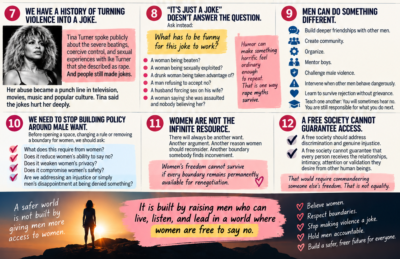
Not access to one particular woman. No individual woman is owed to anybody. I mean access to women’s voices, faces, thoughts, work, sexuality, conversation, creativity, attention, and everyday lives.
A man can wake up, reach for his phone, and encounter more women before breakfast than many of his ancestors could have encountered in months.
And somehow, we are still being asked:
What more can women give?
Let’s look at that.
1. 📱 Men have extraordinary access to women’s presence.
A century ago, geography placed enormous limits on a person’s social world.
Today, a man can open his phone and:
👁️ See women.
🎧 Hear women.
💬 Talk to women.
📸 Look at women’s photographs.
🎥 Watch women’s videos.
📚 Learn from women.
💃 Watch women perform.
❤️ Follow women’s relationships and personal lives.
🔞 Watch women perform sexually.
📨 Message women he has never met.
🌎 Follow women living thousands of miles away.
👥 Enter communities where women are talking to one another.
Technology blew holes through the old walls of geography, distance, class, transportation, and community.
We are not living through a famine of female visibility.
2. 🤔 Yet listen to how the problem is described.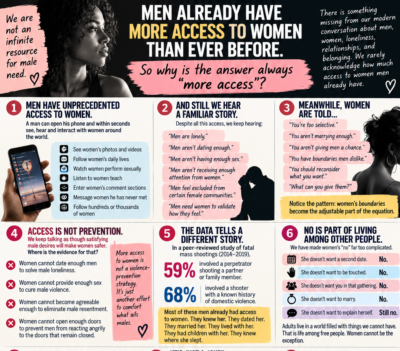
We hear:
Men are lonely.
Men aren’t dating enough.
Men aren’t having enough sex.
Men aren’t receiving enough attention from women.
Men feel excluded from female communities.
Men aren’t being sufficiently validated.
There are real conversations to have about loneliness, friendship, belonging, purpose, community, and mental well-being.
But watch what happens next.
3. 👩🏾 Somehow, women become the adjustable part.
The conversation turns.
Women are too selective.
Women aren’t marrying enough.
Women aren’t giving enough men a chance.
Women need to interrogate their dating preferences.
Women shouldn’t be so guarded.
Women shouldn’t exclude men.
Women should reconsider their boundaries.
🔎 PATTERN TO RECOGNIZE
Male dissatisfaction enters the conversation.
⬇️
Female behavior goes on trial.
⬇️
The proposed solution becomes greater female availability.
And there is that old question dressed in new clothes:
What can women give them?
I think we need another question.
Why is more access to women being proposed as the answer?
Because we have tried an awful lot of access.
4. 🚪 Women are constantly encouraged to open another door.
Give him a chance.
Get to know him.
Don’t be afraid.
Don’t be suspicious.
Don’t be so guarded.
Open up.
Trust.
Maybe he’s just lonely.
Some of those statements can be harmless in the right circumstances.
Together, however, they reveal something worth examining.
We keep treating women’s boundaries as the negotiable part of the equation.
5. ⚠️ Access to women is not a violence-prevention strategy.
This is where the conversation becomes much more serious.
We sometimes talk as though satisfying enough male desires will eventually produce enough male contentment to make women safer.
But many women harmed or killed by men were not harmed by strangers who lacked access to women.
The man already had access.
He knew her.
He dated her.
He married her.
He lived with her.
He had children with her.
He knew her routines.
He knew where she slept.
Domestic violence is also deeply intertwined with some forms of mass violence. That should make us very careful about casually treating greater access to women as a remedy for male grievance.
🚨 THE QUESTION
If access itself prevented violence, why does so much violence occur inside relationships where access has already been granted?
6. 🧩 Let’s separate three things we keep blending together.
LONELINESS
“I want human connection.”
That is a human need deserving compassion.
DESIRE
“I want this woman.”
That is a feeling.
ENTITLEMENT
“Therefore, she should make herself available to me.”
That is something entirely different.
Loneliness deserves humane responses.
Desire is part of being human.
Neither creates an obligation for another human being to provide intimacy.
7. 🛑 “No” is part of living among free people.
We have made women’s no far too complicated.
She doesn’t want a second date.
No.
She doesn’t want to be touched.
No.
She doesn’t want him in that gathering.
No.
She doesn’t want to marry.
No.
She doesn’t want to explain herself.
Still no.
No symposium required.
No interrogation.
No accusation that she needs to examine her biases before her boundary can be honored.
Sometimes another human being simply does not want what you want.
8. 🌎 Adults live with “no” every day.
Think about how much rejection ordinary life contains.
💼 You don’t get the job.
🏠 Someone else gets the apartment.
🎉 You aren’t invited.
💔 Somebody ends the relationship.
🤝 A friendship changes.
❤️ Someone you desire doesn’t desire you.
💍 Someone you love doesn’t want to marry you.
We survive disappointment because other human beings are allowed to make choices that disappoint us.
That is life among free people.
Women cannot become the exception.
9. 🧠 Rejection is not an emergency.
This may be one of the most useful things we can teach boys.
A girl can reject you.
You may feel embarrassed.
You may feel hurt.
You may go home angry.
You may think she made a terrible decision.
You may even believe she misunderstood you completely.
And still:
Nothing happens to her.
You do not threaten her.
You do not stalk her.
You do not humiliate her.
You do not punish her.
You do not recruit your friends to harass her.
You do not keep demanding another hearing.
You feel your feelings.
You find something else to do elsewhere.
Rejection is survivable.
10. 🔄 Watch for the endless renegotiation of women’s boundaries.
This pattern appears in more places than dating.
A woman establishes a boundary.
⬇️
Someone dislikes it.
⬇️
She is asked to explain it.
⬇️
Her explanation is examined.
⬇️
Her motives are questioned.
⬇️
Exceptions are proposed.
⬇️
She is asked to compromise.
⬇️
Her refusal to compromise becomes the new problem.
At some point, the process itself begins to tell women something:
Your “no” is merely the opening position in a negotiation.
But a boundary that another person can require you to renegotiate until he likes the answer isn’t much of a boundary.
11. 🏛️ We should recognize the same pattern in policy.
Before opening a space, changing a rule, removing a boundary, or creating another social expectation for women, ask:
🔎 THE WOMAN TEST
What does this require from women?
Does it reduce women’s ability to say no?
Does it weaken women’s privacy?
Does it compromise women’s safety?
Does it transform a personal choice into a public obligation?
And one more:
Are we correcting an actual injustice, or responding to someone’s disappointment at being denied something he wants?
Those are profoundly different problems.
A free society should address discrimination and genuine injustice.
A free society cannot guarantee every human being the relationships, sex, affection, attention, affirmation, or intimacy he desires from somebody else.
That would require commandeering another person’s freedom.
12. 🧱 More access cannot teach respect for boundaries.
Think about the contradiction.
If someone has difficulty accepting women’s boundaries, the solution cannot always be:
Give him fewer boundaries to encounter.
At some point he has to encounter one.
And learn:
She said no.
Nothing catastrophic happened.
He heard it.
He survived it.
Life continued.
That is a skill.
And we should expect adult men to possess it.
13. 👥 There are solutions to male loneliness that don’t require female availability.
This is where I think our expectations of men have sometimes become strangely small.
Men can:
🤝 Build deeper friendships with other men.
🏘️ Create community.
🧑🏾🏫 Mentor boys.
⚽ Build clubs, teams, hobbies, and organizations.
📞 Check on isolated friends.
👨👦 Strengthen relationships with sons, fathers, brothers, and elders.
🛡️ Challenge male violence.
🚨 Intervene when another man becomes threatening.
🗣️ Refuse to feed a friend’s grievance against a woman who rejected him.
❤️ Learn how to give and receive emotional support outside romantic relationships.
Men have built nations, institutions, churches, unions, businesses, armies, political movements, sports leagues, fraternities, mutual-aid societies, and civilizations.
Surely men can build friendship.
Women do not have to become the missing social infrastructure.
14. 🚫 Women cannot provide enough to cure male violence.
Let’s actually follow the argument to its end.
Can women date enough men to eliminate male loneliness?
No.
Can women provide enough sex to eliminate male violence?
No.
Can women become agreeable enough to eliminate male resentment?
No.
Can women open enough spaces to ensure no man ever feels excluded?
No.
Can women surrender enough boundaries to teach somebody to respect boundaries?
Certainly not.
📌 TRANSLATION
If the proposed solution requires women to keep giving until men stop wanting more, there is no stopping point.
There will always be another want.
15. ♾️ Women are not the infinite resource.
Another want.
Another argument.
Another reason she should reconsider.
Another boundary someone finds inconvenient.
Another accommodation described as so small that women supposedly shouldn’t mind.
Another explanation for why this time she should say yes.
But women’s freedom cannot survive if every boundary remains permanently available for renegotiation.
A woman’s humanity includes the authority to disappoint other people.
That includes men.
16. 🧭 Maybe we have been staring at the wrong side of the equation.
Instead of:
How do we make women more accessible?
Try:
How do we raise men who can live peacefully among women who are free?
Men who can love women without possessing them.
Men who can desire women without believing desire creates obligation.
Men who can hear no without turning disappointment into grievance.
Men who can build meaningful relationships with other men.
Men who intervene when their friends become threatening.
Men who understand that another person’s boundary is not an attack.
Men who know that being denied something you want is sometimes simply part of living among other human beings.
That is a much bigger project.
It also asks something of men.
🌿 THE TRUTH TO CARRY WITH US
Women are not medicine for male loneliness.
Women are not a violence-prevention program.
Women are not an unlimited supply of intimacy, sex, attention, affirmation, emotional care, companionship, or access.
And a man’s desire for something from a woman does not automatically create a social problem when she refuses to provide it.
We can care about lonely men.
We can care about alienation.
We can care about boys growing into healthy adulthood.
We can build stronger communities.
We can do all of that without turning women’s freedom into the resource used to solve those problems.
Sometimes prevention begins much earlier.
👦 A boy learns that girls can walk away.
💔 A young man learns that rejection is survivable.
🤝 His friends refuse to feed his grievance against the woman who rejected him.
🚨 Communities take stalking, threats, coercive control, and violence seriously.
❤️ Men learn that love does not confer ownership.
🛑 And society becomes comfortable telling a man something women have fought generations for the freedom to say:
No. You cannot have that.
Because giving men what they want every time they ask is not a violence-prevention strategy.
Teaching people how to live peacefully alongside women who are free might be.
Meanwhile, Women Are Still Being Killed
This is where the conversation becomes much more serious.
-
- In the United States, the Violence Policy Center found that 2,381 females were killed by males in single-victim/single-offender homicides in 2024. Where the relationship between victim and killer was known, women were far more likely to have been killed by a man they knew than by a stranger.
- Worldwide, approximately 50,000 women and girls were killed by intimate partners or other family members in 2024, according to UNODC estimates. That works out to roughly 137 women and girls every day.
- An investigation found that family annihilations were occurring in the United States, on average, about once every five days. At least 754 people were killed in 227 incidents identified from 2020 through the investigation in 2023.
- The CDC estimates that about one in five American women has experienced completed or attempted rape in her lifetime. And FBI estimates for 2024 amount to a reported rape roughly every four minutes.
- In one study of fatal U.S. mass shootings, more than two-thirds involved either violence against a partner or family member during the shooting or a perpetrator with a history of domestic violence.
- Everytown found that in at least 53% of mass shootings from 2009–2020, the shooter killed a current/former intimate partner or family member during the attack. Those domestic-violence-related shootings killed at least 632 people. Nearly three-quarters of the children and teens killed in mass shootings in that analysis died in incidents connected to intimate-partner or family violence.
Women Have Been Violently Punished for Telling the Truth for Centuries – WE Survive Abuse
The Cost of Agreeability: How We Uphold the Barriers We Think We Are Fighting – WE Survive Abuse
I’m Not Explaining Myself Anymore—You Were Just Never Listening – WE Survive Abuse
Not All Submission Looks Like Sunday School – WE Survive Abuse
Source Sheet: Male Violence, Femicide, Family Annihilation, Rape & Mass Shootings
1. Females killed by males in the United States
In 2024, 2,381 females were killed by males in single-victim/single-offender homicides in the United States. The rate was 1.4 per 100,000 females. The rate had been 1.2 in 2019, rose to 1.4 by 2022, and remained at 1.4 in 2023 and 2024.
There is an especially important Black-woman statistic here: 704 Black females were killed by males in these incidents in 2024. Their homicide rate was 2.9 per 100,000, compared with 1.2 for white females. Black females represented 14.1% of the U.S. female population but 30.3% of the female victims in cases where race was known.
Source: Violence Policy Center, When Men Murder Women: An Analysis of 2024 Homicide Data. Read the VPC report
2. Women and girls killed by partners or family members worldwide
“Worldwide, an estimated 137 women and girls a day were killed by intimate partners or other family members in 2024.”
UNODC and UN Women estimate that nearly 50,000 women and girls were killed by intimate partners or other family members worldwide in 2024.
That represented about 60% of the approximately 83,000 women and girls intentionally killed that year, and works out to approximately 137 women and girls every day.
One caution is important. The 2024 estimate is lower than the 51,100 estimated for 2023, but UNODC explicitly says this should not be interpreted as an actual decrease, because differences in country-level data availability affected the estimate.
3. Family annihilation in the United States
The Indianapolis Star/USA TODAY Network examined family annihilations occurring between January 1, 2020 and April 30, 2023. Investigators identified at least 227 cases resulting in 754 deaths, averaging approximately one family annihilation every five days.
Their investigation also found that perpetrators were almost always male. Unfortunately, there is no comprehensive national government database for family annihilation and no universally accepted definition, which is why this statistic should always remain attributed to the investigation rather than presented as an official federal count.
The Gun Violence Data Hub now maintains a dataset of gun-related murder-suicides and family annihilations from 2014 onward, sourced from Gun Violence Archive. It reports nearly 700 combined murder-suicides and family annihilations in 2025.
4. Rape and attempted rape of women
The CDC’s latest public sexual-violence summary reports that more than 1 in 5 U.S. women have experienced completed or attempted rape during their lifetimes.
CDC’s National Intimate Partner and Sexual Violence Survey measures rape more broadly than simply police-reported offenses, which is one reason it is useful for discussing prevalence.
CDC sexual-violence statistics
5. How frequently rape appears in FBI crime estimates
The FBI’s 2024 national crime estimates say that a rape occurred on average every 4.1 minutes in the United States in 2024. More than 16,000 agencies covering 95.6% of the U.S. population submitted crime data to the FBI program underlying the release.
FBI 2024 Reported Crimes in the Nation
6. Fatal mass shootings directly involving domestic violence
This is one of the strongest findings in the collection.
A peer-reviewed Injury Epidemiology study examined fatal U.S. mass shootings from 2014 through 2019, defining a fatal mass shooting as an incident in which four or more people were killed by gunfire, excluding the perpetrator.
After its exclusions, researchers analyzed 110 shootings.
In 59.1%, at least one person shot was a dating partner or family member of the perpetrator.
7. Mass shootings when a perpetrator’s prior domestic violence is included
The same researchers asked a broader question.
What happens if we count both shootings involving partners/family members and mass shooters with a known history of domestic violence?
The proportion rose to 68.2%. Specifically, 75 of the 110 fatal mass shootings fell into this combined category.
This is where the “more than two-thirds” statistic comes from.
8. Everytown’s domestic-violence mass-shooting finding
Everytown used its own mass-shooting dataset and found that in at least 53% of mass shootings between 2009 and 2020, the perpetrator shot a current or former intimate partner or family member during the attack.
Those domestic-violence-related mass shootings resulted in at least 632 people killed and 106 wounded.
Everytown’s Mass Shootings in America research
9. Why another study says only 11.1%
A 2023 JAMA Network Open study examined 4,011 mass shootings from 2014–2022. It classified 11.1% as domestic-violence related.
That doesn’t necessarily contradict the 59% finding.
The studies are measuring substantially different universes of shootings. The Injury Epidemiology study examined fatal mass shootings with four or more people killed. The JAMA study used Gun Violence Archive data encompassing the much larger universe of incidents involving four or more people shot.
That definition difference changes the denominator enormously: 110 analyzed fatal mass shootings versus 4,011 mass-shooting incidents.
10. Domestic-violence histories among public mass shooters
The National Institute of Justice-supported Violence Project database examined public mass shootings, yet another narrower category.
Among the 172 perpetrators covered in the database, 97.7% were male, 62.8% had a history of violence, and 27.9% had a history of domestic violence.
National Institute of Justice mass-shooting database overview