
I went to grade school with a girl who might put you on the mind of the loveliness of Nina Simone or Victoria Santa Cruz. People were extremely cruel to her at times. Her response was typically quiet or actually stoic. Though I did see tears streaming once as her eyes remained fixed on the chalkboard ahead. They were harsh. Mean.
Years later……when Facebook came out, and I slowly got around to giving it a chance, it gave me great joy to see that she had grown into her splendor. Her aura was telling. Now you could get a read her thoughts. “Y’all can’t tell me nothing now.” So true.
Her features didn’t really change. But you could tell that SHE loved her features now. Confidence, joy, and contentment.
So now what?! Ha!
There is a special kind of freedom in realizing that the features you were taught to question were never waiting for correction.
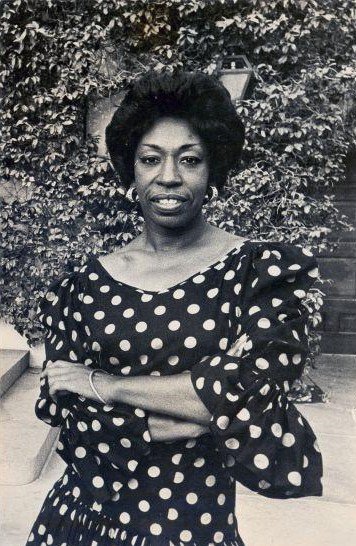
https://commons.wikimedia.org/wiki/Category:Victoria_Santa_Cruz
There are women whose work becomes more meaningful when you understand what they were fighting against.
Victoria Santa Cruz was one of them.
Born in Lima, Peru, in 1922, Santa Cruz became an acclaimed Afro-Peruvian choreographer, composer, educator, performer, and cultural thinker. But for women and girls across the African diaspora, one of the most enduring pieces of her legacy begins with something painfully ordinary:
A Black girl was made to feel ashamed of being Black.
Santa Cruz captured that experience in her extraordinary performance-poem Me gritaron negra, commonly translated as They Shouted Black at Me.
The poem remembers childhood. She describes being surrounded by other children and suddenly having her Blackness turned into an accusation.
That experience changed the way she saw herself.
This is one reason Santa Cruz belongs in conversations about women’s dignity and rights, even though she may not always appear on conventional lists of “women’s rights activists.”
Her work understood something we still struggle to explain today: oppression does not only operate through laws. It can enter through mirrors.
It can teach a girl to dislike her hair. Her nose. Her skin. Her ancestry. Her reflection.
A Black girl deserves more than tolerance for her appearance. She deserves the uncomplicated pleasure of finding herself beautiful.
Long before a Black girl knows words such as racism, colorism or misogynoir, she can already understand that somebody has decided there is something wrong with the way she arrived in this world.
Santa Cruz eventually turned the insult around.
In Me gritaron negra, the word that had once wounded the child becomes something the grown woman claims with increasing strength.
Negra. Black.
Claimed. Embraced. Proudly.
I am allowed to find myself beautiful
The child who was taught to shrink from the word Black can become the woman who says it with her whole chest.
That journey makes Santa Cruz especially meaningful when we talk about Black women and girls because racial oppression has often carried particular expectations for Black females. Across different societies of the African diaspora, Black women have encountered stereotypes about our beauty, sexuality, femininity, temperament and bodies.
The details are not identical everywhere. African American history is not Afro-Peruvian history, and we should never flatten the African diaspora into one experience. But sometimes we recognize one another.
A Black girl in Peru being taught that her features make her undesirable can speak across generations and oceans to Black girls elsewhere who were taught something painfully similar.
There Is an Even Older Story Here
There is another piece of Afro-Peruvian women’s history worth knowing.
Long before anybody would have called them “women’s rights activists,” enslaved and formerly enslaved Black women in colonial Peru sometimes used the institutions available to them to fight for themselves and their families.
They petitioned. They negotiated. They went before courts. They pursued freedom. They fought over family relationships, labor, enslavement and the conditions governing their lives.
That history complicates the way we sometimes tell the story of women’s rights. Women’s resistance did not begin when somebody created an organization and printed a banner.
Sometimes it began when a woman whom society considered property stood before people with considerably more power than she possessed and insisted that something being done to her was wrong. Sometimes women’s history is hidden because historians were looking for movements when they should also have been looking for women refusing.
That is particularly important when recovering the history of Black women.
My features carry history without owing anyone an apology. I release standards that require me to disappear before I can be considered beautiful.
Victoria Santa Cruz Gave Blackness Back to the Girl
Santa Cruz eventually became one of the most important figures in the revival and preservation of Afro-Peruvian culture. She studied theatre and choreography, directed cultural institutions and carried Afro-Peruvian artistic traditions onto international stages.
But there is something beautifully circular about returning to that little girl. Someone tried to teach her that Blackness diminished her. She grew into a woman who made Blackness impossible to ignore.
Through rhythm, movement, poetry, scholarship, and performance, Victoria Santa Cruz helped preserve a cultural inheritance that racism had spent generations pushing toward the margins.
That is more than artistic achievement. For people whose histories have been suppressed, remembering can itself become resistance.
And for Black women, defining ourselves has always carried particular weight. Because somebody is forever arriving with a definition already prepared for us.
Santa Cruz offers another possibility.
A Black woman can hear what the world calls her, examine what it has taught her about herself, reject the shame attached to it and decide:
I will tell you who I am.
I am more than my appearance, and I am still allowed to enjoy being beautiful. My kind of uniquely and divinely created beautiful.
That lesson belongs to Peru. It belongs to the entire African diaspora. And somewhere, a Black girl still needs to hear it.
You do not have to spend your life apologizing for the features your ancestors gave you. You are allowed to grow all the way into yourself, until the skin, hair, face, body, and Blackness you were once taught to question become things you can look upon with tenderness, pride, and joy.
And perhaps one of the sweetest freedoms is this: the girl who was once taught to search the mirror for what was wrong with her can grow into a woman who looks into that same mirror and sees just how beautiful she has always been.