It may be noticed when specific groups build their own healing spaces but nearly everyone builds their own healing spaces where people who live, s
It may be noticed when specific groups build their own
healing spaces but nearly everyone builds their own healing spaces
where people who live, speak, cry, die, and sing like them feel welcome.
They say, “Healing is for everyone.”
But not every healing space is built for everyone.
For so many of us—especially those who’ve been ignored, erased, or ridiculed—healing requires more than being invited into a room. It requires trust. It requires safety. And it requires the freedom to speak without being studied.
That’s why people often gravitate to healing spaces created by, for, and with people who look like them. Who live like them. Who carry the same songs in their bones and the same stories in their memory.
Because healing groups require you to speak.
And speaking requires trust.
But what happens when the moment you speak, someone tilts their head and says,
“Now that sounds like a cult.”
“Why are you bringing up ancestors?”
“That’s not healing; that’s just ideology.”
“Lived experience? I am so tired of hearing that.”
“Is that what your grandmothers did? I don’t think they really took domestic violence seriously” (I kid you not.)
“Talk normal” (True story that I will save for another time. It wasn’t said to me. One older woman said it to a much younger woman because she was talking…well,…. she was talking like southern Black American folks do. And she wasn’t southern Black American.)
Or when you share your soul deep feelings and grief over a missing Black child and the other person -who you’ve seen go hard on other issues-stares at you with a familiar blank eyes and north pole coldness.
Some of us tried to heal in mainstream spaces.
We gave it a shot.
We softened our voice. Shortened our stories. Translated our pain.
But over time we noticed:
Our grief was graded.
Our faith was mocked.
Our history was flattened.
Our language was twisted and used against us.
What they were doing—whether they knew it or not—had names:
Weaponized Code-Switching: learning our words only to turn them into insults.
Gaslighting by Cultural Delegitimization: calling our truth “too emotional” or “unrealistic.”
Concept Creep via Dog-Whistling: turning survivor words like “triggered,” “boundaries,” or “safe space” into jokes.
Moral Panic Framing: labeling our sacred practices as dangerous, irrational, or un-American.
And all of this while we were just trying to heal.
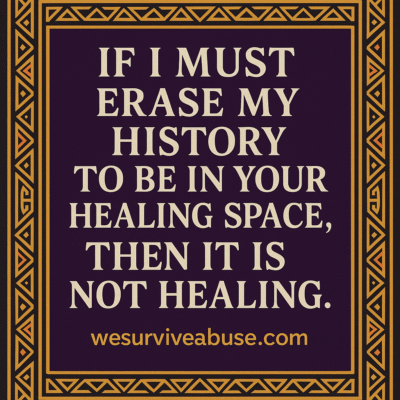 We don’t build our own spaces out of hate.
We build them out of necessity.
Because we need places where we can:
Speak without being studied.
Grieve without being graded.
Heal without having to defend the legitimacy of our pain.
Talk about the harm and the hope.
Cry with our faith, our culture, our grandmother’s wisdom, and our music still in the room.
So when someone says, “Why do you need your own space?”
The answer is simple:
Because we deserve to heal whole.
Not in pieces.
Not in translation.
Not under a microscope.
We deserve to heal surrounded by those who know—
without us having to explain a single thing.
Affirmation
I am not too much. I am whole. And I will not apologize for needing a space that sees all of me.
It may be noticed when specific groups build their own
healing spaces but nearly everyone builds their own healing spaces
where people who live, speak, cry, die, and sing like them feel welcome.
Creating Healing Spaces for Black Girls: A Life-Affirming Necessity