How we slowly surrender our boundaries, judgment, and needs, and what it means to begin returning to ourselves.There is something about Nina Simon
How we slowly surrender our boundaries, judgment, and needs, and what it means to begin returning to ourselves.
There is something about Nina Simone singing I Wish I Knew How It Would Feel to Be Free that makes you think about the many ways human beings long for freedom.
Not every prison has bars. Some of the restrictions we live under are enforced through guilt, fear, obligation, and the possibility of losing someone’s affection.
Imagine a woman sitting in her car after another exhausting family gathering. She has spent the afternoon smiling through remarks that hurt her feelings, agreeing to things she didn’t want to do, and reassuring everybody that she was fine.
She is tired. Not simply from the gathering, but from the work of managing everybody else’s comfort while neglecting her own.
Nobody at the gathering would describe her as someone who struggles with boundaries. They would probably call her dependable, thoughtful, patient, and easy to get along with.
And perhaps she is all those things.
But sitting alone in her car, she begins to wonder when being a good person started requiring her to be so unkind to herself.
This is one of the quiet ways self-abandonment can enter a person’s life.
It does not always look like low self-esteem. Sometimes it looks like loyalty, generosity, patience, forgiveness, or being the person everyone can depend on.
Self-abandonment happens when we repeatedly set aside our own needs, judgment, values, or well-being to preserve relationships, avoid rejection, or satisfy expectations.
It can happen so gradually that we hardly recognize what we have surrendered.
Here are twelve hallmarks worth recognizing.
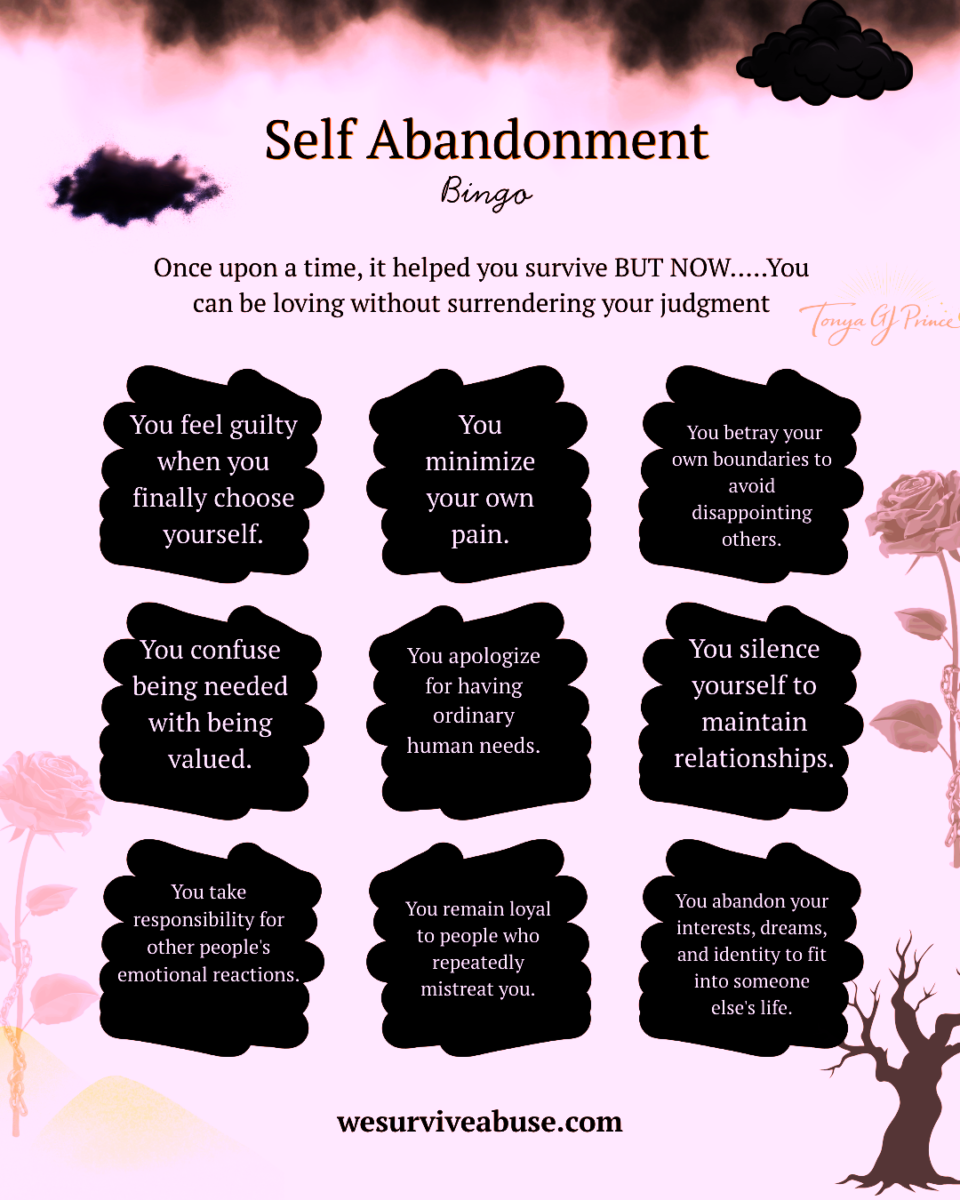
1. 🌿 You betray your own boundaries to avoid disappointing others.
You know what makes you uncomfortable, but you agree anyway. You have become more concerned about how someone will respond to your boundaries than what happens to you when those boundaries are crossed.
You may even find yourself rehearsing explanations for decisions that should require little more than a simple no.
Something to consider: When was the last time you respected your own refusal without seeking permission?
2. 🌿 You constantly seek permission to trust your own judgment.
Even when you have enough information to make a decision, you look for someone else to validate it. You begin treating other people’s confidence as more reliable than your own experience.
There is nothing wrong with seeking advice. The concern begins when advice becomes a requirement before you feel entitled to trust yourself.
3. 🌿 You minimize what hurts you.
You tell yourself it wasn’t that serious, other people have it worse, or perhaps you’re being too sensitive.
Over time, you become skilled at explaining away experiences that deserve your attention. You may even defend the behavior of people who have never taken responsibility for hurting you.
Remember: You do not have to prove that your suffering is worse than someone else’s before you are allowed to address it.
4. 🌿 You confuse being needed with being valued.
You feel most secure in relationships when you are helping, rescuing, sacrificing, or solving problems.
You may struggle to believe someone would appreciate your company without receiving something from you.
This can be particularly difficult for people who grew up receiving praise primarily for being helpful, mature, undemanding, or responsible.
Being useful is not the price of being worthy.
5. 🌿 You apologize for having ordinary human needs.
Rest, privacy, affection, safety, solitude, and consideration begin to feel like unreasonable requests.
You find yourself explaining why you deserve things that should not require an elaborate defense.
There is a difference between negotiating shared responsibilities and feeling ashamed for having needs at all.
6. 🌿 You silence yourself to maintain relationships.
You have opinions, concerns, and objections, but you keep them to yourself because honesty might change how someone treats you.
Eventually, people become familiar with the agreeable version of you while knowing very little about what you actually think.
And there is a particular loneliness in being surrounded by people who say they love you while feeling that you cannot safely let them know you.
7. 🌿 You take responsibility for other people’s emotional reactions.
Someone becomes angry, disappointed, jealous, or uncomfortable, and you immediately begin searching for what you should have done differently.
Their feelings become your assignment, even when you have done nothing wrong.
Compassion is a beautiful quality. But compassion does not require you to manage every emotion another adult experiences.
Someone can be disappointed in your decision without your decision being wrong.
8. 🌿 You remain loyal to people who repeatedly mistreat you.
You keep remembering their potential, their struggles, or the kindness they showed you years ago.
Meanwhile, their present behavior keeps telling you something you do not want to accept.
You may find yourself extending understanding to someone who consistently refuses to extend consideration to you.
Loyalty deserves to be accompanied by discernment.
9. 🌿 You abandon your interests, dreams, and identity to fit into someone else’s life.
Your hobbies disappear. Your friendships fade. Your ambitions become negotiable.
You gradually organize your life around another person’s preferences until you struggle to remember what you once wanted for yourself.
Sometimes the loss is so gradual that it does not feel like a sacrifice until someone asks what you enjoy doing, and you have difficulty answering.
10. 🌿 You mistake endurance for emotional strength.
You pride yourself on how much you can tolerate.
Instead of asking whether a situation is healthy, you measure your strength by how long you can remain in it.
There is genuine strength in endurance, particularly when circumstances leave us with few choices. But surviving something does not mean we are obligated to continue experiencing it when other options become available.
Strength also includes recognizing when enough is enough.
11. 🌿 You distrust your discomfort when other people appear comfortable.
Everyone else seems fine with a situation, so you assume something must be wrong with your reaction.
You ignore your uneasiness rather than examining what it may be telling you.
Discomfort is not always proof of danger. Sometimes it reflects unfamiliarity, anxiety, or past experiences. But it is still information worthy of consideration.
You are allowed to ask questions, seek clarity, and make decisions about your own participation.
12. 🌿 You feel guilty when you finally choose yourself.
Saying no, leaving an unhealthy relationship, asking for fairness, or prioritizing your well-being brings guilt instead of relief.
You have become so accustomed to accommodating others that ordinary self-respect can feel like selfishness.
Sometimes guilt simply means you are doing something unfamiliar. It does not necessarily mean you are doing something wrong.
You can acknowledge the feeling without allowing it to make every decision for you.
Sometimes Self-Abandonment Begins as Survival
There is something important we must understand before turning self-abandonment into another reason to criticize ourselves.
For some people, these patterns began long before adulthood.
A child learns that disagreement brings punishment. A woman learns that refusing a demand leads to intimidation. Someone living with an abusive person learns to anticipate moods and surrender preferences to reduce danger.
What looks like people-pleasing from the outside may have developed as a way to survive. We should be careful about judging people for the adjustments they made while trying to remain safe.
And we should be equally careful about suggesting that every person can simply speak up, walk away, or enforce boundaries without consequences. Some people need safety planning, resources, and support before they can exercise those choices freely.
Survival is not a character flaw. Neither is wanting more for yourself once you have the opportunity to pursue it.
Returning to Yourself Does Not Require Becoming Someone Else
Sometimes we imagine healing as a dramatic transformation. We picture ourselves becoming outspoken, fearless, independent, and completely unmoved by anyone else’s opinion.
But returning to yourself may be much quieter.
You begin making small decisions without apologizing. You revisit something you once loved doing. You stop volunteering for responsibilities you cannot reasonably carry. You become more selective about whose advice you seek.
Perhaps you discover that you enjoy your own company. Perhaps you begin to recognize how much of your exhaustion came from constantly anticipating other people’s reactions.
You may still be generous. You may still be patient, forgiving, and deeply devoted to the people you love.
The difference is that your kindness no longer requires your disappearance.
You are a human being with a life of your own. Your relationships are part of that life, but they are not the entirety of your existence.
And you do not have to become less loving to become more protective of yourself.
A Final Thought: You Deserve Your Own Loyalty, Too
There is a beautiful possibility waiting on the other side of self-abandonment.
You can begin to know yourself again.
Not simply the person others expect you to be, or the person you became while trying to survive difficult circumstances. You can become reacquainted with your preferences, convictions, curiosities, pleasures, and hopes.
You can learn to hear your own voice without immediately asking whether someone else approves of what it says.
You can be kind without becoming unprotected. You can love without surrendering your judgment. You can give without leaving yourself empty.
And when you think about that Nina Simone song again, perhaps you will hear another possibility in its longing for freedom.
The freedom to live without continually asking others for permission to be yourself.
You have spent enough of your life learning how to show up for everybody else. You deserve to experience what it feels like when you show up for yourself, too.
Survivor Affirmation
I am allowed to be a whole person in my relationships.
I can love others without neglecting myself. I can consider their feelings without surrendering my judgment. I can honor my responsibilities without accepting every demand.
My boundaries do not require unanimous approval.
I deserve my own loyalty, too.