updated from June 22, 2025 Nina Simone's song, “Four Women," is powerful because each woman has been made into someone else’s story. Au
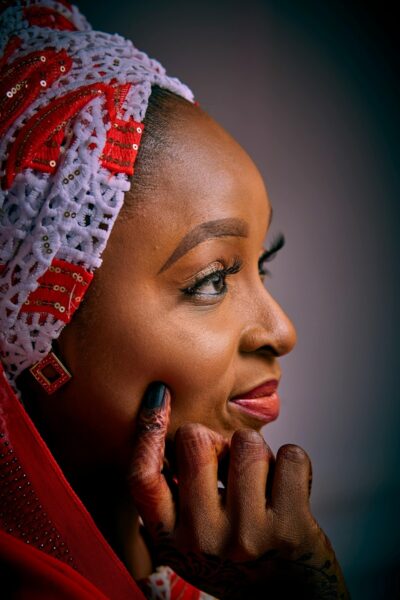
Photo by Arthur A/Unsplash
updated from June 22, 2025
Nina Simone’s song, “Four Women,” is powerful because each woman has been made into someone else’s story.
Aunt Sarah is expected to carry pain. Saffronia carries the violence of racial history. Sweet Thing carries male projection. Peaches carries the fury that comes when a woman is done being used as the room where everyone else gets comfortable.
“Four Women” shows how Black women are forced into roles before they are allowed to be people: the mule, the wound, the fantasy, the rage.
✋🏽Men Wanting to Define Womanhood Isn’t New – WESurviveAbuse
Men all over the world have worn garments that could be read, from the outside, as “dresses.”
Scottish men wear kilts.
Greek Evzones wear the fustanella.
Men in parts of the Middle East wear the thobe or dishdasha.
Men in North Africa may wear the djellaba.
Men in South Asia wear the lungi, dhoti, or kurta-style garments.
Men in Southeast Asia wear the sarong.
Men in Japan have worn hakama.
Clergy wear robes. Judges wear robes. Men in the choir wear robes.
Kings, elders, priests, mighty Samoan and African warriors, and ceremonial leaders have worn flowing garments across history.
So the issue has never simply been “a man wearing fabric that drapes.” Because many of the men who dress this way are widely admired and respected today.
The issue is this:
Why does one man wearing a dress suddenly become a social command for women to move over, be quiet, surrender language, surrender privacy, surrender boundaries, surrender scholarships, surrender sports, surrender shelters, surrender awards, surrender safety, and surrender the right to name our own reality?
A garment is not the problem.
The problem is the demand.
There seems to be something extremely confusing to some people about that draped fabric. No matter who wears it, a dress does not mean that women owe you a yes.
Males demanding that the world stop, shift, and reshape itself—laws, policies, language, protections—all so more men can be “listened to,”
even if they’re dressed differently…. this time?
That’s not radical.
That’s not new.
That’s the oldest story on Earth.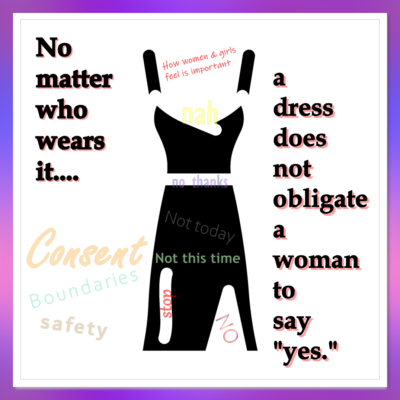
When a man wears a dress, many people still read him through the lens of maleness first. Depending on the setting, he may be mocked, targeted, fetishized, or punished for crossing gender expectations. That can be dangerous, and it should not be dismissed.
Still the world will allow him to maintain his maleness in all other ways. Society often treats maleness as portable power.
His voice may still be treated as more authoritative.
Even in a dress, he may still be listened to as someone with the right to define the room, explain the issue, correct women, and set the terms of the conversation. As he does this, on television, of course, people look at him like he discovered a cure to a disease.
When Parties Tell Women What to Want Instead of Listening – WESurviveAbuse
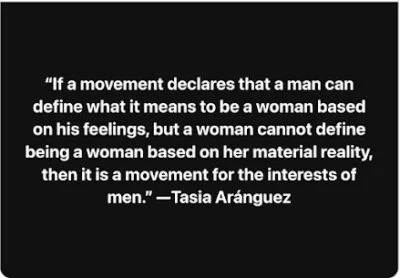
2.His discomfort may become everyone’s assignment.
If he feels excluded, embarrassed, challenged, or unseen, the room may rush to repair that feeling. Consider the viral online video.
In the middle of a church service, a young woman confronts the minister at the altar for harming her when she was much younger. Instantly, the minister confesses and asks God for forgiveness. He begins to cry. The church members leave the pews and run to hug and comfort him. The harmed young woman is left exactly where she started. Harmed and alone.
Women’s discomfort is often treated as ordinary background noise.
3. His boundaries may be honored more quickly than women’s.
When he says, “This makes me uncomfortable,” people may respond with urgency. When women say the same thing, they may be called dramatic, hateful, paranoid, bitter, or difficult. On her, discomfort is “attitude.” On him, it is a command that he be comforted immediately, if not sooner.
4. His identity may be centered as the main story.
Instead of asking how women are affected, the conversation can shift toward his courage, his expression, his pain, his journey, his rejection, his right to belong. The message to women and girls can be that unless they comply with consent violation and silencing, they do not belong. For women and girls, belonging is conditional.
You Can Be Inclusive Without Abandoning Girls, Women, or Survivors – WESurviveAbuse
5. His presence may override women’s need for privacy.
Women may be told to adjust, accept, move over, be kinder, or “educate themselves,” even in spaces created because female privacy, trauma, religion, culture, disability, age, or safety needs matter.
6. He may still benefit from male social confidence.
Many males are trained from childhood to take up space, speak over others, challenge rules, expect access, and assume their needs belong at the center. Clothing choices do not automatically remove that training. More of us understand this when someone is wearing a men’s suit, for instance.
It is not the clothes; it is the behavior choices. Still, it can be a lot more difficult for a woman to make a compelling enough argument for safety, protection, and/or wellness if she happens to be the target of a man who wears a men’s suit. Remember when #MeToo brought to light that a lot of men known for wearing expensive men’s suits were causing bodily harm? The aftershocks are still being felt.
7. He may be seen as complex while women are seen as cruel.
His needs may be described with nuance. Women’s boundaries may be flattened into bigotry, fear, ignorance, or meanness. Even in cases of murder-suicide, when a male spouse murders his wife, the headlines blame her decision to divorce for “pushing him to it.” After the murder of Dr. Celina Wanker Fairfax one news headline said that she was “sticking it to him” in the divorce.
The headlines and friends who say that they were her friend to her too, will defend his actions, ignoring the fact that the woman is gone. Her life was taken. Pretty powerful that such social privilege follows him to the grave even after committing a horrific crime with long standing implications.
8. His pain may be treated as more politically urgent than women’s fear.

People may organize quickly around his hurt feelings while asking women to provide evidence, statistics, patience, compassion, and perfect language before their fears are taken seriously.
🛑 Women’s Safety Is Not Up for Debate: On Pressure, Autonomy, and Male Violence – WESurviveAbuse
Male Predators Are Male: Why Language Matters for Survivor Justice – WESurviveAbuse
9. He may be allowed anger without losing credibility.
If he is angry, it may be framed as righteous, wounded, or understandable. If women are angry, especially Black women, they may be stereotyped as aggressive, irrational, jealous, hateful, or unstable.
20 Common Misconceptions About When and Why Survivors “Should Be Over the Pain” – WESurviveAbuse
10. He may still be protected by male solidarity.
Other men may defend him, not necessarily because they understand him, but because they recognize a male person being challenged and instinctively resist women setting boundaries.
When Women Are Violated by Men, Don’t Police Our Tone — Restore Our Safety – WESurviveAbuse
11. Women may be pressured to prove they are not hateful before they are allowed to speak.
That is a trap. It turns women’s safety concerns into a character trial against women.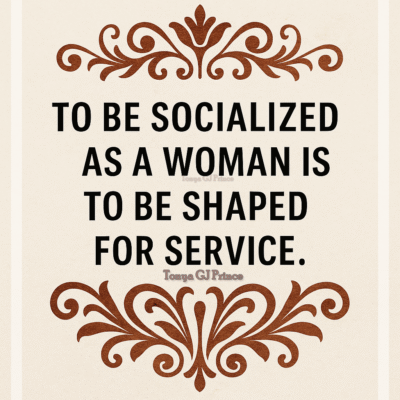
I recall as a court advocate, serving a woman whose family turned against her because she dared to speak about the documented violence and abuse. To her family the fact that the person abusing her was her husband, the father of her children, and had been married to her for, I believe it was two decades…was all the proof that they needed that he was a “good man.” Her experience with him and the children’s experiences with him did not matter. They were furious with her for ‘making a big deal’ out of “marital troubles.”
12. His access may be treated as justice, while women’s separation is treated as discrimination.
The moral frame gets flipped. A male person’s access becomes the highest good, and women’s boundaries become the problem to be solved. This is where danger increases for women. When people feel entitled to connection.
Why Are Women Told to Stay Calm About Things That Should Horrify Everyone? – WESurviveAbuse
13. Female socialization may still be used against women.
Women are often trained to be polite, accommodating, emotionally available, and afraid of being seen as unkind. That training can be exploited to make women surrender space.
Some who misunderstand power and control imbalances can be quick to jump to the traditional “solution.” Women/woman must comply and remain quiet. And be nice about it too.
14. Women’s lived knowledge may be dismissed as prejudice.
Women often know the difference between abstract inclusion language and the real-world patterns of male entitlement, intimidation, sexual threat, and boundary-testing. But that knowledge may be treated as backward instead of protective.
15. The room may still organize itself around male consequence.
People may ask, “What will happen to him if women say no?” long before they ask, “What has already happened to women when they were not allowed to say no?” You know us women. We are master storytellers. So, we tell the story. The true story. Because we are women, the story is dismissed.
16. He may be granted individuality while women are treated as a class to be managed.
He is one person with a story so all hands on deck. Women become a crowd that needs correcting, training, softening, or disciplining.
17. His vulnerability may be believed more than women’s vulnerability.
This is especially bitter because women and girls are often expected to disclose wounds, explain trauma, and expose private histories just to have basic boundaries respected.
18. Women may be asked to carry his belonging.
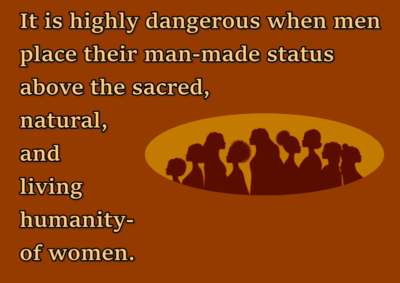
Instead of institutions creating thoughtful policies, -because that would be authentic inclusion- women are told to absorb the tension personally: be welcoming, be quiet, be flexible, be kind, be brave, and be less afraid even when nothing has been put in place to enhance her safety. Thoughts and prayers. Hers will have to do because no one else will offer.
19. He may still get the benefit of public sympathy.
Women’s caution may be treated as cruelty. His distress may be treated as moral evidence.
20. The deeper message is that maleness still travels with him.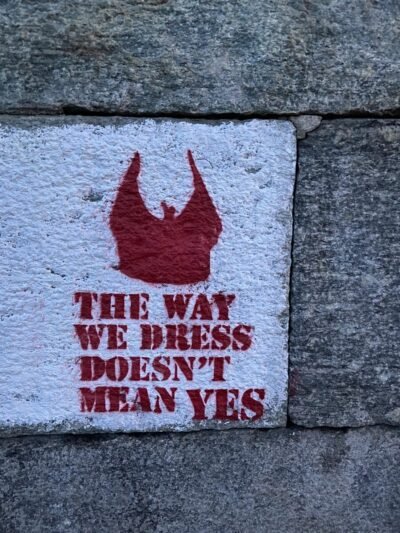
The dress changes the presentation. It does not automatically erase the social training, social power, physical threat potential, or cultural habit of centering male people.
A Checklist for Anyone Claiming to Care About Women and Children’s Safety – WESurviveAbuse
A kilt does not ask women to rename themselves.
A thobe does not require women to step out of female-only spaces.
A robe does not tell women their discomfort is hatred.
A sarong does not erase the history of female oppression.
A fustanella does not turn women’s boundaries into bigotry.
Men have always participated in clothing traditions.
That is not new.
What is new, and deeply troubling, is the expectation that women must treat one man’s self-presentation as more important than women’s collective history, language, privacy, and hard-won protections.
When a woman wears a dress, especially in a world shaped by male entitlement, she is often read through the lens of female availability, vulnerability, beauty standards, sexual access, and “you should have known better” blame.
This is the biggest difference of all. She will be blamed, shamed, and perhaps slurred. They routinely set misogyny to music now….and not just the music created by Black people.
There will be no rescue for women that the other women in society don’t labor for. HARD.
There may be a small circle, but there will not be large protests to support her. And that is because she is a “her.”
Maybe her family will push for a new law that should have been the law a long time ago, but there will not be a revolution or call for change.
A woman in a dress may be treated as:
sexually available
responsible for men’s thoughts
easier to follow, corner, touch, or shame
at fault if the dress is judged “too short,” “too tight,” “too feminine,” “too grown,” or “too noticeable”
public property for commentary
something to be managed, covered, moved, watched, corrected, or controlled
- someone to conquer, dominate, and control.
And for Black women and girls, this can become even more dangerous because racist stereotypes often add another layer: assumptions that they are more “grown,” more sexual, less innocent, less vulnerable, less worthy of protection, or somehow responsible for the aggression directed at them.
Systems bending over backward to center male voices—whether clothed in suits, softness, or slogans—has never been revolutionary. It’s just a remix of the same power grab from women we’ve seen for centuries.
🗣️ You want to do something new?
Try listening to women.
Truly listening.
Not extracting, performing, copying, or reshaping our words into costumes.
But hearing us.
Following our lead.
Letting us speak without interruption, without fear, without being overwritten.
That would be new. Fresh.
That would be just. Fair.
That would be historic. Forward.
The question is not whether fabric can change meaning. The question is why women are STILL expected to surrender reality whenever male feelings enter the room.
🔥 Because the truth is this:
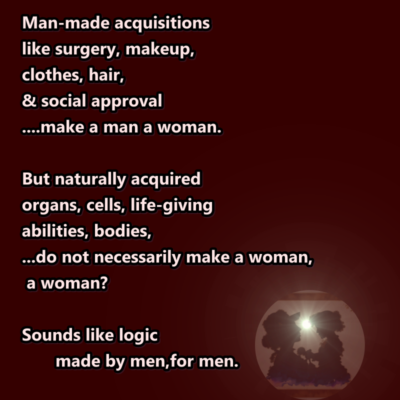
Women have been speaking.
Women have been grieving, writing, building, bleeding, surviving.
Women have been telling the truth long before the world deemed it fashionable.
But the world keeps asking:
“Can we hear from men on this?” You already have. Over and over and over.
What you haven’t done is listen to the women who never had the stage.
And that, right there, is the real revolution.
When did a man’s clothing become a warrant to reorganize women’s lives?
Because women are not furniture.
We are not scenery.
We are not a hospitality committee assigned to affirm every male reinvention of himself.
Women can be kind. Women can be fair. Women can respect difference. But kindness is not the same as surrender.
And no fabric on a male body should become a social order telling women:
“Move over. Make room. Be quiet. Call it progress.”
A man wearing a dress is clothing.
A man using that dress to demand access, authority, language, validation, and obedience from women is power.
And women are allowed to name the difference.
P.S. Consider letting go of the lie that people are disenchanted about “a few little lies” or “a few little lost opportunities”. We are smarter than that even if you don’t think that we are.
Women’s autonomy means a woman is not a supporting character in a man’s emotional weather.
Telling us more lies will not inspire us to put our trust in you.
You want the truth? Listen to the voices of more women. The more regionally, racially, and socio-economically diverse, the better.
Society is ever so slowly learning the difference between protecting all people from cruelty and requiring women to surrender consent.
Additional Reading
‘Four Women’: The Nina Simone song that inspired generations of artists
The Impact of Four Women’ by Nina Simone – Women Wheel
Why Are Women Told to Stay Calm About Things That Should Horrify Everyone? – WESurviveAbuse
WESurviveAbuseAffirmations for Cutting Through the “Devil” Dodge – Survivor Affirmations
Male Predators Are Male: Why Language Matters for Survivor Justice – WESurviveAbuse
65 Beliefs Some Men Hold About Women: Control, Boundaries, and the Fight for Choice – WESurviveAbuse