There is a name for what happens when Black women are pressured to abandon our Blackness in order to be accepted as “real” women. Racial Gatekeeping
There is a name for what happens when Black women are pressured to abandon our Blackness in order to be accepted as “real” women.
Racial Gatekeeping of Womanhood.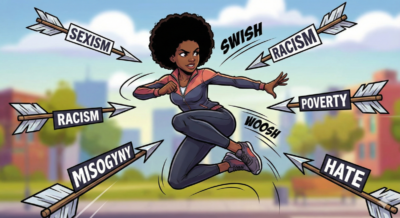
It shows up when white women—explicitly or subtly—decide that womanhood has a single center, a single priority, and a single voice.
And that voice is not ours.
The Demand to Choose
Many Black women have been told, directly or indirectly:
“Why bring race into this?”
“Can’t we focus on women first?” (Like we ain’t)
“You’re dividing the movement.”
“Misogyny is older than racism.”
What’s being asked is not unity.
What’s being asked is erasure.
Black women are pushed to amputate a part of ourselves—to show up as only women, stripped of race, history, and reality—so others can feel morally comfortable.
That is not solidarity.
That is submission.
“Older” Does Not Mean “More Intense”
Yes, misogyny is an ancient oppression.
That does not mean racism is lighter, secondary, or optional.
Here’s a comparison that makes this plain:
Poverty is older than cancer.
That does not make cancer less deadly.Gravity is older than electricity.
That does not mean electricity can’t kill.Childhood is older than disability.
That does not make disability easier to live with.
History
One of the most specific, documented, and tragic cases of a female victim killed under King Leopold II’s regime (an estimated 10- 15 million were murdered) in the Congo Free State is Boali.
While millions of women were killed, starved, or worked to death, their individual names were rarely recorded by colonial administrators. Boali is “known” to history primarily because of a famous and devastating photograph taken in 1904 by English missionary Alice Seeley Harris.
The Story of Boali:
Identity: She was the five-year-old daughter of a Congolese man named Nsala.
The Atrocity: Nsala arrived at a mission station clutching a bundle that contained the severed hand and foot of his daughter. He told the missionaries that sentries from the Anglo-Belgian India Rubber Company (ABIR)—who enforced Leopold’s rubber quotas—had attacked his village.
Her Fate: Nsala testified that the sentries had killed his wife and daughter (Boali), cut them up, cooked them, and eaten them. They had presented Nsala with the severed parts as a form of terror to enforce rubber collection quotas.
The Photograph: The image of Nsala gazing mournfully at his daughter’s small hand and foot became one of the most enduring and potent symbols of the atrocities in the Congo, used widely by reformers like E.D. Morel to turn international opinion against King Leopold II.
Why few “known” names exist: Unlike European history where victims of royal purges were often noblewomen with recorded lineages, the genocide in the Congo was an industrial-scale colonial erasure. The victims were dehumanized, often recorded only as “wives” or “villagers” in Belgian logs. Boali’s name survives only because missionaries documented her father’s specific testimony.
So while misogyny may be indeed be an “older” form of oppression, like Mary Turner, her spouse, and her unborn child.……Boali and her mother were murdered by racism. In both cases, on two different continents there was a lethal disregard for the entire family’s humanity. This is what today’s Black women and girls still face today. The possibility of encountering danger from various sides of oppression and hate.
Age does not determine impact.
Oppressions do not politely take turns.
They stack.
They compound.
They collide inside human bodies.
Living With More Than One Weight
Black women live inside at least two structural oppressions—race and sex—often alongside others: class, disability, age, faith, geography.
That is not theoretical.
That is daily life.
Living with multiple oppressions is like living with multiple disabilities.
And for those of us who actually live that reality:
If you asked which one is harder, the honest answer is often—
I couldn’t tell you.
Because they don’t arrive separately.
They do not announce themselves.
They work together.
The Arrogance of “Educate Yourselves”
It is especially infuriating to hear white women say to Black women:
“Educate yourselves.”
Cut it out.
Black women read by necessity, not trend.
We read because:
We are rarely centered in mainstream narratives
Our histories are omitted or distorted
Our contributions are minimized or stolen
Our pain is doubted unless footnoted
Black women know our history.
And yes—we know yours too.
We have had to.
What This Gatekeeping Really Is
Racial Gatekeeping of Womanhood is:
Deciding which women are “too much”
Treating Black women’s truth as disloyalty
Calling accountability “division”
Protecting comfort instead of confronting harm
Expecting Black women to shrink so others can feel whole
It is not feminism.
It is hierarchy wearing feminist language.
Black Women Are Not Required to Choose
We do not have to choose:
Blackness or womanhood
Truth or belonging
Reality or unity
We are not fragments.
We are whole human beings living whole lives under compounded pressure.
Any feminism that requires Black women to disappear—
even temporarily—
is not a liberation movement.
It is a gate.
And we see it clearly now.