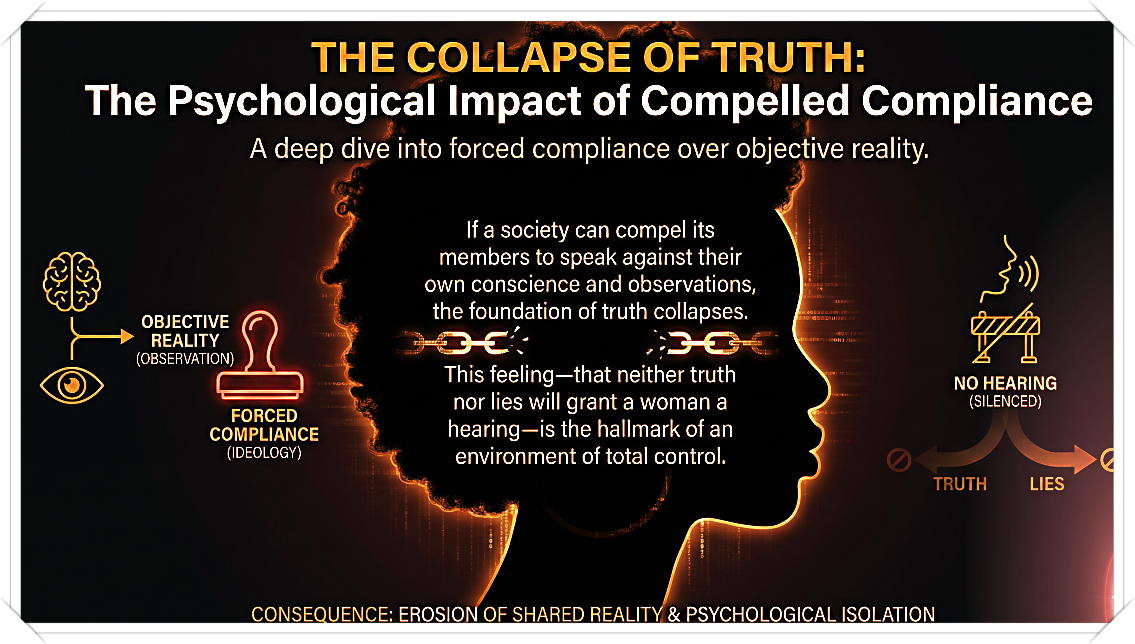
For some of us who have worked with Survivors of abuse and violence, among them the least likely to be believed, we have strong concerns. For many wom
For some of us who have worked with Survivors of abuse and violence, among them the least likely to be believed, we have strong concerns. For many women, particularly those who have worked in the fields of abuse survival or womanist advocacy, the “material reality” of the female body is not just an abstract idea; it is the ground of their experience.
The Deterioration of Trust: We worry that people who believe that we are building it, may not see how we are tearing it down. Because, if you are forced to say something you know is not true, it creates a sense of alienation. You stop trusting your own senses, AND you stop trusting the people around you, because you know they are also “playing along” out of fear. So who do you talk to about the real deal? Who do you speak truth to?
If you have ever worked in workplace where everyone was trying to keep their job in the midst of sexual harassment and dysfunction, you know that that is an extremely unhealthy space to work in.
Words stop being tools for description and truth. Instead, they become tools for allegiance and signs of loyalty. Using a “the right words” becomes a “badge” of belonging to a certain group rather than an accurate description of the person in front of you. Meanwhile, telling the truth about pain, abuse, and violation is like driving through thick morning fog.
Intentional Acts
In the study of coercive systems, forcing someone to speak a “non-fact” is a known tactic for breaking down individual resistance. Sometimes this is referred to as “compelled assent”.
The Goal: The goal is not usually to make you believe the lie. The goal is to make you submit to the authority that is demanding the lie.
The Psychological Toll: Forcing a person to say something that goes against their values—especially something as fundamental as the reality of sex, the reality of harm, violence, harassment, and abuse, —is a form of moral injury. It requires a person to choose between their integrity and their career or livelihood.
When a society reaches a point where people are required to speak words they believe are false, it moves from a system of shared reality to a system of ideological compliance. This is precisely why many philosophers, survivors of authoritarianism, and advocates for women’s rights are calling this out as a form of coercion.
Many are currently fighting for “Conscientious Objection”—the right to remain silent or to use neutral language (like a person’s name when it comes to pronouns) rather than being forced to speak a “non-fact.” This is seen as a way to respect the dignity of others without sacrificing one’s own integrity. But I don’t go along with this. I have seen how society does.
Because if a person figures out that keeping silent may have done more internal harm than good, then here comes society with: “But, why now?”
The idea of “silent neutrality” or “playing along for now” assumes that the only thing at stake is a person’s individual conscience. And I have both seen this and been the one that has struggled with insomnia, chronic pain, and other side effects when I should have just taken the liberty of turning over tables and chairs in the first place.
Nope. The stakes are much higher for women and children because of the long-term consequences of normalizing any and all non-facts. Go talk to the people in juvenile detention and prison. They will tell you that suppressing other people’s pain, anger, wickedness, and secrets set them on the path to where they landed. More dangerous than being in the room inhaling second hand smoke for years.
When rights are in direct conflict, a “neutral” option often isn’t an option at all because it still allows the non-fact to stand unchallenged. For women and children, this “silence” can lead to the loss of physical safety, legal standing, and psychological clarity.
Think back to every sexual violence scandal you can think of. It flourished on secrets and lies. If society agrees to speak a non-fact today, it creates a “false foundation” that makes it nearly impossible for people—especially victims of abuse or medical regret—to speak up later. By compelling current speech, institutions are effectively “editing” the future.
If we can’t speak accurately about biological reality, violence, and abuse now, we lose the language required to describe the damage later.
I’ve now lived through enough of these to know that people will follow all victims with: “Well it was different then” all the way to your death at your own hands. And as long as who they wanted to see “protected” was protected they will not care.
I’ve been told and heard other victims told with my own ears:
“Back then it wasn’t really rape/abuse”
“It wasn’t rape rape”
“We didn’t know any better then.”
“We were just trying to do our best.”
So after years of sorry excuses. I want people to take their time. Think things through as if it matters. Get this right. Women and children are not in need of anymore force fed bs. We need solutions that center safety, well being, health, and opportunities.
We need more love in this world yes. We need the kind of love for people that doesn’t require others to forfeit their right to the truth. Not “their truth”. THE truth.
When “nothing is true,” the most vulnerable people—children—are the most at risk.