The Shadow of the Incident: When Blame Outlives the Act There is a specific kind of cruelty that exists when a perpetrator not only destroys a pe
The Shadow of the Incident: When Blame Outlives the Act
There is a specific kind of cruelty that exists when a perpetrator not only destroys a person’s body but then hands them the bill for the damage.
In one of the most chilling documented cases of domestic violence, a man used his vehicle as a weapon, pinning his partner against a wall until she suffered an eventual double amputation. In the immediate aftermath, as she lay in the wreckage of her life, he didn’t offer a hand. Instead, he offered a sentence: “Look what you made me do.”
The Secondary Trauma: A Family Divided
Physical recovery is an uphill battle, but the psychological warfare that followed was perhaps even more grueling. This case serves as a haunting reminder of how “victim-blaming” isn’t always a distant, societal issue—sometimes, it comes from inside the home.
The Burden on the Survivor:In a heartbreaking turn, the children of the family began struggled to make sense of the trauma of their childhood. One of the children stated that at times, she struggled not to blame her mother. Not because they were “mean” or hated their mother. They were trying to reckon with a lot of questions about the impact this ongoing violence had on their lives. Children in homes where there is domestic violence are victims. Often they too, can benefit from therapy and other healthy methods of intentional healing.
The Weight of Forgiveness: Under the crushing weight of family pressure and a misplaced sense of duty, the victim eventually vocalized “forgiveness.” But in cases like this, “forgiveness” is often a survival mechanism—a way to keep the remaining pieces of a shattered family together.
A Life Lived in the Aftermath
She survived that day, but she lived the next 25 years in a wheelchair, navigating a world that was no longer built for her. Her life became a daily confrontation with the physical and emotional scars of a single moment of rage. (Note: Her estranged husband served just five years in prison.)
This story isn’t just about a horrific act of violence; it’s a study in the systemic ways we fail survivors:
By allowing perpetrators to weaponize guilt.
By failing to educate the next generation on the reality of abuse.
By prioritizing “family unity” over the safety and dignity of the person who was harmed.
Often, when society looks at a survivor of such extreme violence, they see only the “victim” or the “disability,” forgetting that the person is still navigating the full, messy spectrum of the human experience.
People with disabilities are not defined solely by their ailments. Beyond the specialized medical care and the daily navigation of an inaccessible world, they continue to face the same human struggles we all do—financial stress, emotional highs and lows, and the need for purpose and autonomy. When we focus only on the “tragedy” of the disability, we risk stripping the individual of their personhood, forgetting that they are navigating a full life, not just a medical condition.
As a trauma Survivor, this victim needed so much mental and emotional care. Understanding that she lived her entire life trying to keep broken pieces taped together.
Moving Forward
We must challenge the narrative that a survivor is responsible for “keeping the peace.” Peace was broken the moment the violence began. True healing requires us to place the responsibility squarely on the person who chose to cause harm—never on the person left to pick up the pieces.
National & Global Prevalence (2025-2026 Data)
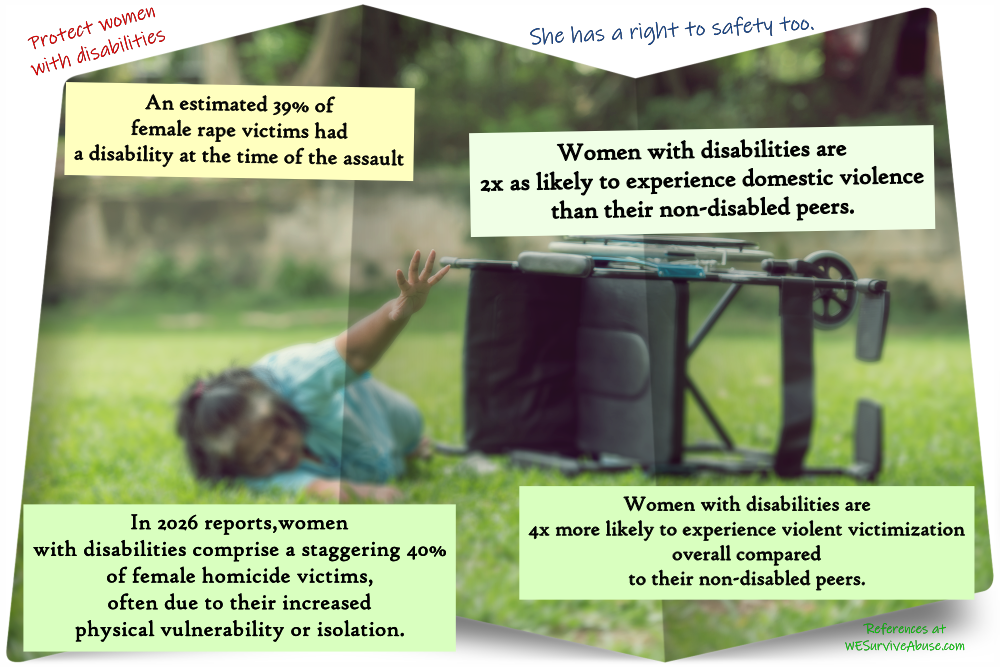
Heightened Risk: Women with disabilities are twice as likely to experience domestic violence, and four times more likely to experience violent victimization overall compared to their non-disabled peers.
Sexual Violence: An estimated 39% of female rape victims had a disability at the time of the assault. Globally, sexual violence comprises approximately 25% of all reported abuses against disabled women.
Lethal Outcomes: In 2026 reports, women with disabilities comprise a staggering 40% of female homicide victims, often due to their increased physical vulnerability or isolation.
The Deaf Community: Women in the Deaf community report intimate partner violence at rates 50% higher than hearing women, often complicated by a lack of accessible communication for emergency services.
The Nature of the Abuse
Abuse against women with disabilities often includes “disability-specific” tactics that perpetrators use to maintain control:
Caregiver Exploitation: Intimate partners or family members—who often act as caregivers—are responsible for 90% of the abuse against disabled women.
Weaponizing Independence: Perpetrators may withhold or damage essential equipment (wheelchairs, hearing aids), deny access to medication, or use “overmedication” as a form of chemical restraint.
Financial Abuse: Roughly 20% of disabled adults over the age of 60 experience financial exploitation, often tied to their disability benefits or inheritance.
Barriers to Justice and Safety
Reporting Gaps: Only 1 in 10 cases of disability abuse are reported to the police. For sexual abuse specifically, underreporting is estimated to be as high as 90% due to fear of losing a caregiver or not being believed.
Shelter Inaccessibility: Alarmingly, up to 50% of domestic violence shelters still turn away disabled victims because they lack the proper modifications or staff training to accommodate physical or intellectual needs.
Conviction Rates: The conviction rate for crimes against people with disabilities remains low, at approximately 5%, often due to perceived “victim incapacity” or lack of forensic evidence that accounts for physical limitations.
Economic and Social Impact
The Cost of Survival: The lifetime economic burden for a female survivor of intimate partner violence—including medical care and lost wages—is over $103,700. For women with disabilities, this cost is often compounded by the need for specialized housing or assistive technology.
Housing Stability: Only 15% of reports lead to successful protective orders, and the lack of accessible, safe housing remains the #1 reason survivors with disabilities are unable to leave an abusive situation.
References