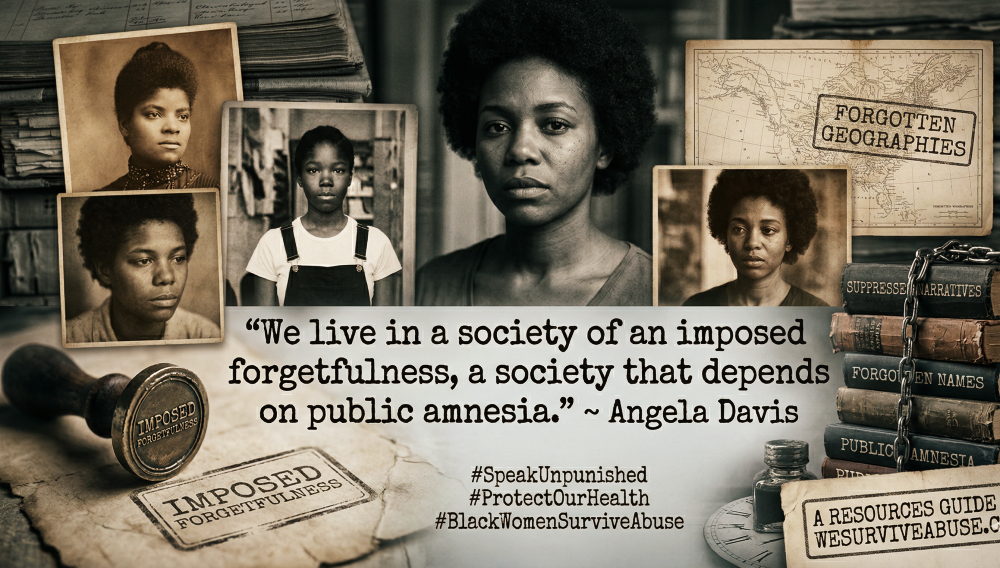
There is no clean ending to something that was never fully confronted. Ending violence, abuse, and harm requires us to tell the truth without dilutio
There is no clean ending to something that was never fully confronted. Ending violence, abuse, and harm requires us to tell the truth without dilution.
Generational harm requires intentional repair, not passive hope.
Slavery did not just extract labor. It rewired how a nation decided who counted as human. That kind of damage does not expire on its own. It mutates. It adapts. It learns how to survive in new language, new laws, new systems.
First it was ownership. Then it became control.’
Lynching was not history. It was a warning that echoed forward.
After slavery, terror became a tool of enforcement. Lynching was not random violence. It was public spectacle. It sent a message without needing a courtroom. It told Black communities, clearly and brutally, that their lives could be taken without consequence. That fear was policy, even when it was not written down.
There is no expiration date on unaddressed harm.
Then Jim Crow stepped in to formalize what terror had already enforced. Segregation was not just about separation. It was about hierarchy. It was about making sure one group moved through the world with dignity, while another was forced to navigate humiliation as a daily condition of life.
Society has a responsibility to repair, not just acknowledge.
Redlining followed. No chains. No burning crosses. Just maps. Policies. Decisions made behind desks that quietly determined who could build wealth and who would be locked out of it. Neighborhoods were not just shaped. Futures were.
We have a responsibility to examine systems, not just individuals.
And then came mass incarceration. A system that does not need to say what it is doing out loud because the outcomes speak clearly enough. Entire communities over-policed, over-sentenced, and under-protected. Lives interrupted. Families fractured. Generations rerouted.
Policing without trust is control, not safety
Policing, in too many places, reflects this same pattern. Not as protection, but as pressure. Not as service, but as surveillance. Communities are told they are being kept safe while simultaneously being treated as a threat. That contradiction is not confusion. It is design.
Justice delayed across generations becomes injustice normalized
This is not a timeline with a finish line. It is a pattern.
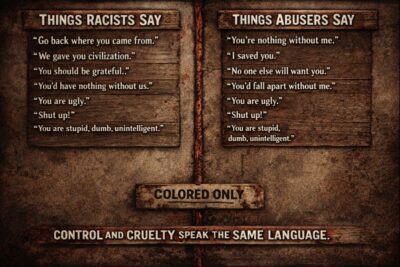
Dehumanization is not always loud. Sometimes it looks like neglect. Sometimes it looks like indifference. Sometimes it hides behind policy that claims neutrality while producing predictable harm.
What started as a justification for slavery became a lens. And that lens still influences who is seen as dangerous, who is seen as disposable, and who is given the benefit of the doubt.
If you want to understand impact, do not just look at history. Look at outcomes.
Look at who is more likely to be stopped, searched, denied, underfunded, displaced, or disbelieved.
Look at how often pain is questioned instead of addressed.
Look at how systems respond differently depending on who is standing in front of them.
This is not accidental. It is inherited.
And inheritance, if left unchallenged, becomes identity.
Here is the truth many people try to soften: harm that is not repaired does not disappear. It compounds.
It shows up in health disparities. In wealth gaps. In education access. In housing instability. In the constant, quiet calculation of safety that some people must make every day.
Dehumanization is not just about what was done. It is about what continues to be allowed.
So the question is not whether slavery ended. The question is whether the logic that sustained it ever truly did. Without confrontation, dehumanization evolves. It does not retire.
Because healing does not come from pretending something is over. It comes from deciding, collectively and consistently, that it will not be allowed to continue.
@ashleytheebarroness I’m glad they said it. I am. But the ones that couldn’t even bring themselves to say it? …yeah. that’s doing something to me. #unitednations #crime #slavery #historytok #fyp ♬ original sound – Ashley
 violence, abuse, and harm requires us to tell the truth without dilution.