The issue is not that women are unknowable to the state. It’s that women are often known only in fragments that are usef
The issue is not that women are unknowable to the state. It’s that women are often known only in fragments that are useful for administration—risk, dependency, vulnerability, compliance—while the full humanity that would require different design is not what the system is built to prioritize.
On Southern plantations, Black women were sometimes held in spaces that were not separate from men, because captivity did not prioritize separation. Commerce did not pause for dignity. The need for young Black bodies was high.
Records from the 18th and 19th centuries describe enslaved women confined in shared quarters during transport and sale, their bodies listed alongside men in inventories that treated distinction as optional when profit required efficiency.
In some regions, forced labor camps after slavery blurred those boundaries again, especially where Black women were incarcerated in county chain gangs alongside men under vagrancy laws.
The logic was not called “co-ed.” It was called necessity.
But the effect landed the same way in the body: exposure without consent, structure without protection.
In a different city …..today, a policy meeting unfolded behind a conference table that looked too polished for the subject being discussed.
A state official flipped through a binder.
“We’re not assigning based solely on sex classification anymore,” she said.
Across from her, a legal advocate adjusted her glasses. “What are we assigning based on then?”
“Risk assessments,” someone replied.
Another voice added, “Safety factors.”
A pause followed.
The advocate tapped her pen once against the table.
“And women’s facilities?”
No one answered quickly.
Because any answer chosen too quickly would expose something else underneath the system: how easily categories shift when institutions decide they must.
Later, in a break room that smelled like burnt coffee and detergent, two staff members talked while microwaving food that would never taste like anything but reheated exhaustion.
“You think it’s getting co-ed?” one asked.
The other shrugged. “Depends who you ask.”
A third voice, from the corner, added quietly, “It already is. In ways people don’t want to name.”
Historical memory doesn’t always arrive as history.
Sometimes it arrives as pattern recognition.
Black women in the United States have long been placed in carceral or carceral-adjacent systems where separation from men was inconsistent, especially during slavery and its aftermath. In some county jails and work camps after Reconstruction, Black women were incarcerated under the same punitive labor systems as men, often with little regard for safety or privacy. Their confinement was shaped less by gender protection and more by labor extraction and control.
The system never even considered whether vulnerability was distributed fairly.
Inside male prisons, risk doesn’t fall evenly across “men” as a single category.
One of the most consistently vulnerable groups are younger incarcerated men, especially those in their late teens and early twenties. They are still learning the unspoken rules of the environment. They tend to have less social protection, fewer alliances, and less understanding of how quickly small mistakes become permanent reputations. In many facilities, age itself becomes a kind of exposure.
Then there are men with mental illness or cognitive disabilities. They are often visible in subtle ways: slower responses, difficulty reading social cues, confusion under pressure, or vulnerability to manipulation. Inside prison economies built on leverage, that vulnerability becomes currency for others. They are more likely to be isolated, disciplined for behavior tied to symptoms, or drawn into conflicts they don’t fully understand.
Physically smaller men, or those who arrive already physically weakened due to disability or illness, also tend to be at higher risk. Prison violence is often not random; it is hierarchical. Size, perceived strength, and ability to retaliate all shape how others calculate safety and target selection. In that environment, physical difference becomes social positioning.
Sexual violence risk clusters around several groups, and it is important not to oversimplify this. Men who are openly gay, bisexual, or gender nonconforming are at significantly higher risk of harassment and assault in many facilities, particularly where prison culture enforces rigid masculinity norms.
Men convicted of certain types of offenses, especially sexual offenses or crimes involving children, are also frequently targeted. In many prisons, informal hierarchies assign stigma to these charges, and that stigma translates into violence, isolation, or forced segregation. Even when the legal system considers them fully equal in custody, prison social structure does not.
Informants, or those perceived to be informants, occupy another high-risk category. In environments where trust is scarce and surveillance is constant, the label alone—sometimes accurate, sometimes rumor—is enough to make someone unsafe. Protection can become conditional, and sometimes temporary.
Elderly incarcerated men form another vulnerable group. Aging bodies struggle with the physical demands of prison life: bunk access, long standing periods, cold environments, limited medical responsiveness. They are less able to physically defend themselves and more likely to be overlooked in fast-moving institutional decisions.
There are also men who are vulnerable because they lack institutional “belonging” inside prison culture. Not being affiliated with a gang or protective group can matter more than the charge itself in some settings. Without affiliation, there is no informal shield, no negotiated safety, no internal mediation.
On paper, prisons rely on risk assessments, medical flags, and behavioral records. In practice, day-to-day safety is often governed by inmate culture, informal hierarchies, staffing levels, and the physical design of the facility.
What most women in prison are there for
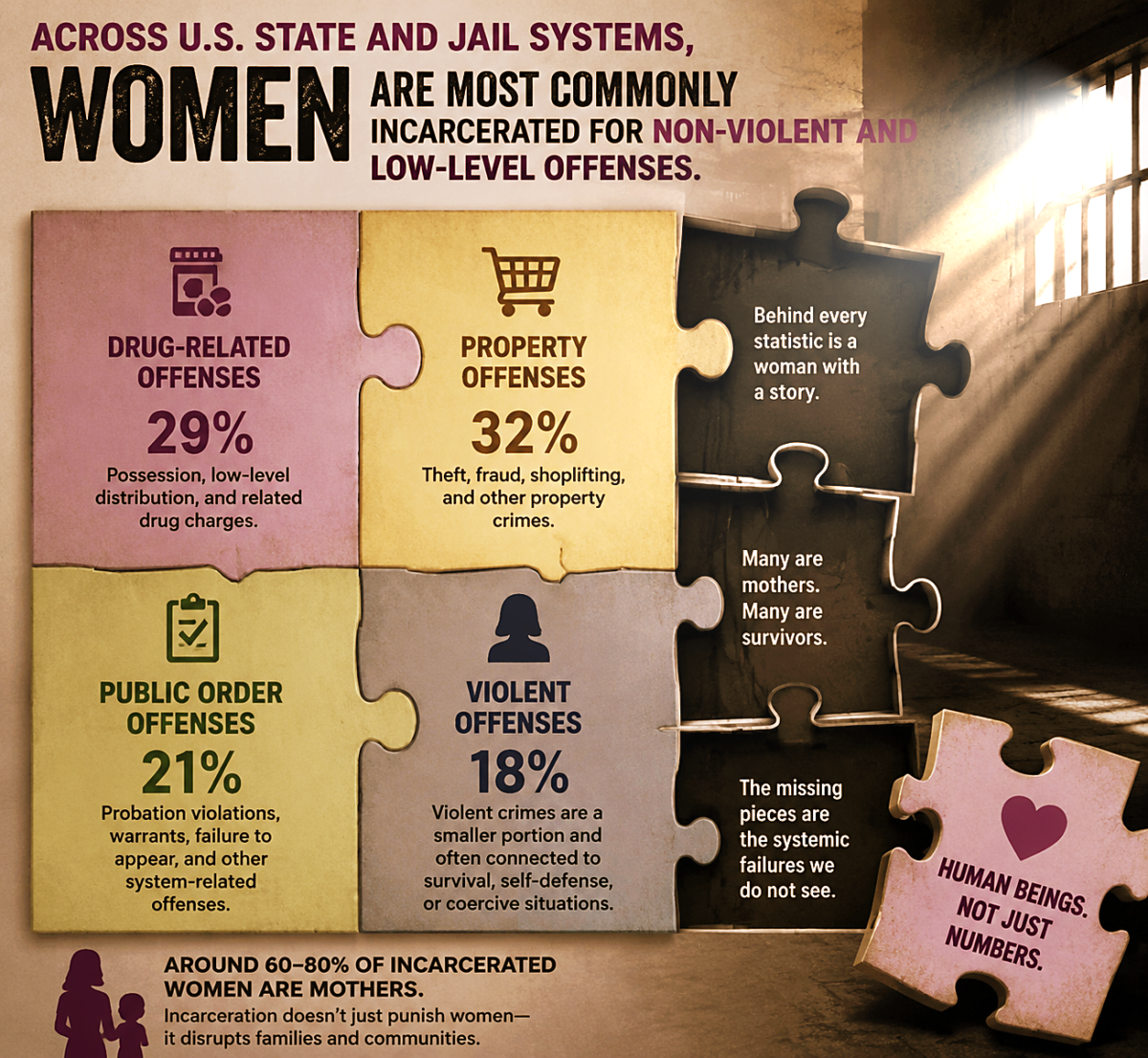
Across U.S. state and jail systems, women are most commonly incarcerated for non-violent and low-level offenses.
The breakdown typically looks like this:
- Drug-related offenses (possession, low-level distribution)
- Property offenses (theft, fraud, shoplifting)
- Public order offenses (probation violations, warrants, “failure to appear”)
- Smaller but present category: violent offenses (often tied to survival contexts like domestic violence, self-defense, or coercive relationships in a significant share of cases)
For example, a major national snapshot of women in jail found:
- ~32% property offenses
- ~29% drug offenses
- ~21% public order offenses
- The vast majority overall are not incarcerated for serious violent crime
This is one of the most consistent findings across decades of data: women’s incarceration is largely driven by poverty-linked survival crimes, substance use, and system violations rather than predatory violence.
Another consistent trend: many women are mothers. Around 60–80% of incarcerated women have minor children, meaning incarceration is also a family disruption system, not just a punishment system .
What the data shows about abuse histories
Across studies of incarcerated women:
- ~53–70% report childhood physical or sexual abuse
- ~70–80% report intimate partner violence as adults
- ~68% or more report a history of physical or sexual abuse in prison samples
- Some jail studies report up to 86% reporting sexual assault in their lifetime
- One large synthesis finds 77–90% report extensive histories of emotional, physical, or sexual abuse
And when mental health and trauma are combined:
- About 73% of women in state prisons have a mental health issue, compared to 55% of men
- PTSD rates in incarcerated women have been estimated at ~53%, far above the general population
A clearer picture emerges from the numbers
When you lay it out without commentary, the pattern is almost visible on its own:
- Most incarcerated women are not there for high-level violent crime
- Most are connected to poverty, drugs, survival economies, or system violations
- A majority carry histories of violence before they ever enter custody
- Mental health conditions are significantly higher than in the general population
This is why many researchers describe women’s incarceration not just as punishment, but as a downstream response to long-term exposure to violence, economic instability, and coercive relationships.
How many men. How many women.
Nobody answered it in the visiting room.
Not because there was agreement.
Because everyone had learned, in their own way, that institutions rarely speak in answers.
They speak in what gets built next to meet their intentions and mission, stated and/or unstated.
Women often absorb the unintended consequences of systems that were never built with them as the priority subject. That is the structural truth. Women’s safety in custody is not optional.
The logic was not called “co-ed.” It was called necessity. Incarcerated men’s vulnerability is also real. And the state is the central actor deciding how all of this gets distributed. Prisons are a managed violence environment where the state distributes risk rather than eliminating it.
On auction blocks in the American South, Black women were sometimes sold alongside men without separation that modern systems would later describe as “classification.” There was no protective sorting logic in those spaces. Only inventory. Only labor potential. Only the blunt arithmetic of bodies moved together under coercion. In some post-emancipation convict leasing systems, Black women were again placed into mixed labor camps under punishment regimes that cared little for gendered separation when extraction required shared containment.
Those records are not metaphor. They are structure remembered through paper.
I use this metaphor not because Black women are criminals; of course, Black women have historically been over-policed, under-protected, and mismanaged by institutions that often don’t know how to hold their safety, labor, or vulnerability at the same time. That history shows up in prisons, hospitals, welfare systems, and courts in different ways. Not because Black women are inherently linked to crime, but because systems have repeatedly struggled to relate to Black women as fully protected subjects rather than managed populations.
Women are often treated as administratively “difficult” subjects in systems designed around male default assumptions. Not necessarily because anyone openly says “we don’t know what to do with women,” but because women’s needs—pregnancy, caregiving roles, trauma histories, vulnerability to violence, medical specificity, and safety concerns—don’t fit cleanly into structures built around uniform bodies and standardized risk models.
The issue is not that women are unknowable to the state. It’s that women are often known only in fragments that are useful for administration—risk, dependency, vulnerability, compliance—while the full humanity that would require different design is not what the system is built to prioritize.
Institutional systems often fail to build structures that fully center women’s safety, specificity, and dignity, and instead rely on blunt categories
The system is built to manage risk, not to uplift a sense of dignity, and certainly not to honor it.
And structure has a way of echoing even when vocabulary changes.
But the effect landed the same way in the body: exposure without consent, structure without protection.
📚 Sources on Women’s Incarceration Offenses (U.S.)
Core offense breakdown (most cited national dataset):
- Vera Institute of Justice – Overlooked: Women and Jails
https://www.vera.org/publications/overlooked-women-and-jails-report
Key data:- ~32% property offenses
- ~29% drug offenses
- ~21% public order offenses
- Majority are non-violent overall
- Sentencing Project – Incarcerated Women and Girls
https://www.sentencingproject.org/fact-sheet/incarcerated-women-and-girls/
Key data:- Women are more likely than men to be incarcerated for drug/property offenses
- Drug offenses for women in prison: ~26% vs 12% for men
- GUINN Center (summary of national correctional trends)
https://www.guinncenter.org/articles/new-study-sheds-light-on-challenges-for-women-behind-bars
Confirms:- Property (~32%), drug (~29%), public order (~21%) distribution
🧠 Sources on Abuse & Trauma Histories
A history of abuse:
- Council on Criminal Justice – Women’s Justice Assessment
https://counciloncj.org/womens-justice-a-preliminary-assessment-of-the-criminal-justice-system/
Key finding:- 70%+ of incarcerated women report intimate partner violence history
- Vera Institute – Women’s incarceration & trauma overview
https://www.vera.org/news/womens-incarceration-rates-are-skyrocketing
Key findings:- 86% report lifetime sexual violence exposure
- 77% report intimate partner violence history
- PREA Resource Center (sexual violence prevalence)
https://www.prearesourcecenter.org/resource/86-percent-women-jail-are-sexual-violence-survivors
Key finding:- 86% of women in jail are survivors of sexual violence
- National synthesis studies (PMC / peer-reviewed summaries)
https://pmc.ncbi.nlm.nih.gov/articles/PMC1586137/
Key range:- 77–90% of incarcerated women report major abuse histories
🏛️ System-Level Context Sources
- Prison Policy Initiative – Women’s Mass Incarceration (2024)
https://www.prisonpolicy.org/reports/pie2024women.html
Key insights:- Women are disproportionately held in jails vs prisons
- Many are pretrial (not convicted yet)
- Vera Institute – Incarceration Trends
https://trends.vera.org/
Key insight:- Women’s incarceration has increased more than 10x since 1970
- Time Magazine – Domestic violence + incarceration link
https://time.com/4960309/domestic-violence-women-prison-history/
Key framing:
The Burden of Blindness: How Systems Force Us to Ignore Our Own Reality – WE Survive Abuse
You Deserve Safety—Even When You’re Just Trying to Keep Going – WE Survive Abuse
The Illusion of Progress: Why Women Don’t Have “Spare Rights” to Burn – WE Survive Abuse
The Costliest Mistake We Make When Women Speak About Safety – WE Survive Abuse
Beyond The Handmaid’s Tale: Understanding Lateral Betrayal – WE Survive Abuse
Della Reese, Medical Racism, and Why Black Patients Fight to Be Heard – WE Survive Abuse
Deanna’s Law: 12 Systemic Failures That Changed 911 Response – WE Survive Abuse