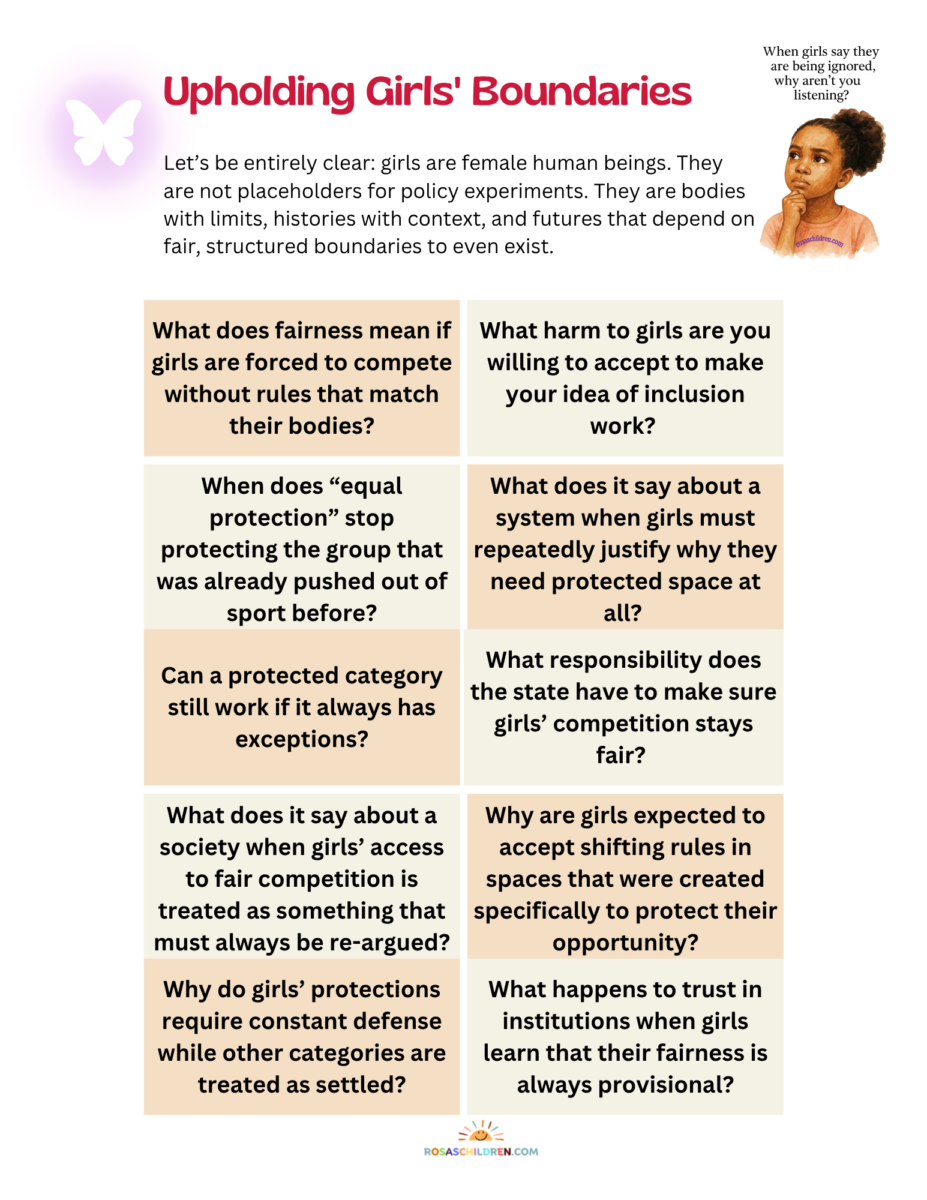
Either non-verifiable gender ID reigns, and men are advantaged (AGAIN) while women are displaced(AGAIN), or verifi
Supreme Court’s latest ruling on Title IX:
Some states have passed laws that define school sports teams as sex-separated (girls vs boys) and restrict participation based on biological sex. Those laws have been challenged in lower courts on constitutional grounds, especially under equal protection and Title IX arguments. In some instances, the Supreme Court has allowed those state laws to remain in effect temporarily or declined to immediately block them, which is often interpreted publicly as the Court “upholding” or “allowing” the policy, even when the final constitutional question is still being litigated.
So what changes on the ground is not always a final national rule, but whether states are permitted to enforce their own approach while lawsuits continue. In some states, the boys will play with the boys, and the girls will play with the girls. This is fair for the girls. We knew this decades ago. We’ve known for a long time that girls need their own spaces, sports, and opportunities for growth.
BUT, every time that boys say that “they want”…..we act all confused about that. We suddenly forget all about girls’ needs.
The key point underneath all of this is simpler than the legal language:
There is an active legal and political conflict in the U.S. over how sex-based categories in school sports should be defined and protected under civil rights law. A most unnecessary conflict fueled by misogyny and sexism. States are taking different approaches. Courts are being asked to decide whether those approaches violate constitutional protections or federal law. And the Supreme Court is often stepping in not to fully resolve the issue, but to decide whether lower court restrictions should stand while the full case is still being decided.
The ruling is fine. It was obviously the right call. But the 6-3 dissent has me feeling a kind of way.
But here is the thing….a right that is constantly re-litigated does not land culturally as secure, even if it is legally upheld in a given moment. Some on the left pointed out the other day that Justice Amy Coney Barrett made a ruling that negatively impacts Haitian immigrants, even as she herself is the adopted mother of two Haitian children. Alright. I have questions around that too.
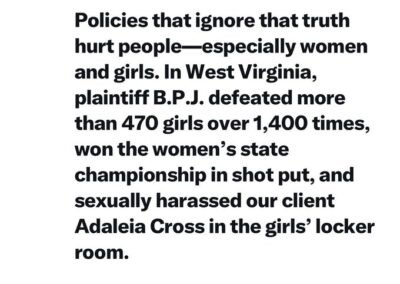
according to Adaleia Cross
Three of the justices who dissented in this case were all women. That means they were once girls.
A dissent is not just “disagreement.” It is a written statement:
“I would have decided this case differently.”
Those justices did not join the majority in locking in one clear, unified message about how strongly the law protects girls’ sports under this framework. They did not vote for the majority outcome that keeps those sex-based sports rules in place in those states.
We have GOT to stop letting people who choose not to defend girls run and circle around the ring. Such folks have a lot of time to throw slurs, threats, name-calling, and such. Interrupt that. Disrupt that. These people need to tell the class why they believe girls deserve less. Ask questions.
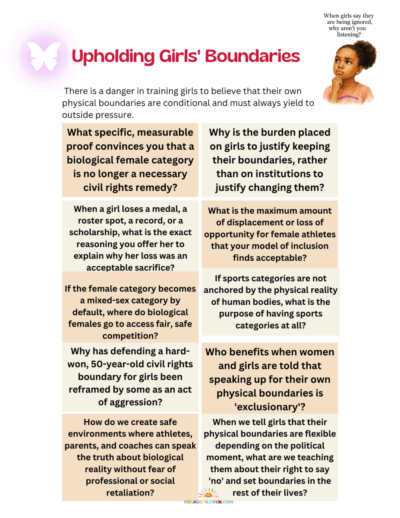
What does fairness mean if girls are asked to compete without boundaries that reflect their sex-based reality?
What specific harm to girls did you find acceptable in order to prioritize your interpretation of inclusion?
If girls’ categories are repeatedly revised or weakened, what remains of the original civil rights remedy meant to create those spaces?
What responsibility do you believe the state has to preserve competitive fairness for female athletes as a protected class?
What does fairness mean if girls are forced to compete without rules that match their bodies?
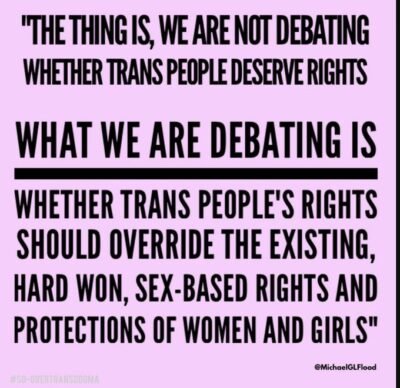
Girls are human beings too. They do not deserve to be stepped over. When you say “inclusion,” you must demonstrate how you include these human beings’ rights too.
What harm to girls are you willing to accept to make your idea of inclusion work?
When does “equal protection” stop protecting the group that was already pushed out of sport before?
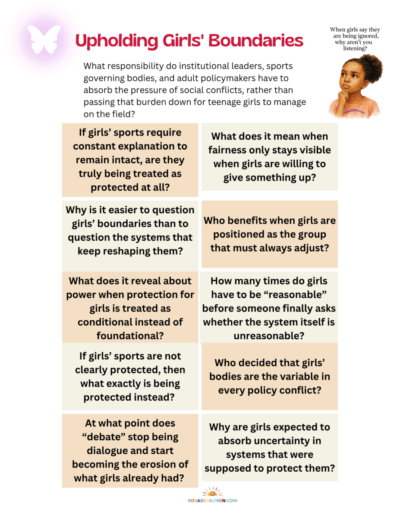
If girls’ sports rules keep getting changed or weakened, what is left of the reason they were created in the first place?
What responsibility does the state have to make sure girls’ competition stays fair?
When girls lose medals, records, scholarships, or chances, how does your reasoning deal with that outcome?
What proof would convince you that girls need firm, sex-based categories in sports?
Can a protected category still work if it always has exceptions?
Who pays the price when two rights claims collide in girls’ sports?
And the core question:
If girls’ sports are not clearly protected, then what exactly is being protected instead?
There are moments in history when a society is forced to look at what it has been quietly normalizing.
The Supreme Court decision on girls’ sports is one of those moments.
Not because the issue is new. But because it reveals, again, how easily girls’ protections become the thing everyone else is asked to renegotiate.
And we need to say this plainly: girls deserve their own spaces. Their own categories. Their own developmental pathways that are not constantly re-litigated in real time while they are still trying to grow inside them.
This is not a fringe idea. It is the foundation of fairness in sport. Girls’ categories exist because without them, girls do not compete on equal footing. That is not ideology. That is history, biology, and the record of every time female participation had to be carved out of systems that were not designed with them in mind.
But something else is also being asked of us in this moment.
Not only to examine institutions. Not only to examine men. But to also examine women who participate in upholding unfairness against girls, even when the language used is “inclusion,” “progress,” or “neutrality.”
Because systems do not sustain themselves alone. They are maintained by agreement, repetition, and sometimes by the quiet willingness to let girls absorb the cost of competing priorities.
And this is where the reckoning is uncomfortable.
Girls cannot continue to be the default adjustment group for every social tension. Every policy conflict. Every attempt to smooth over disagreement. When something becomes difficult, it should not automatically become girls’ burden to absorb the solution.
Girls are not the designated social scapegoats.
That pattern is older than this moment. It shows up in different forms across time: whenever female needs are treated as flexible, secondary, or negotiable compared to what is assumed to be the standard. And over time, that erodes something essential—not just fairness in sport, but the idea that girls’ realities are real enough to anchor systems around.
We have to grow into a more honest understanding.
Fairness is not abstract. It is structured. And structure always has a reference point. The question is whether girls are part of that foundation—or whether they are endlessly repositioned to accommodate everything else. If women and girls are treated as a secondary layer that must constantly justify itself against a presumed default, they become easier to question, reshape, or dilute.
Even when women dissent in legal spaces, even when they raise concern, the larger cultural machine still behaves as if girls’ protections must be constantly re-argued, re-justified, and re-earned. As if female space were not foundational, but conditional.
This is a turning point in how we think about worth.
Because protecting girls’ spaces is not about exclusion. It is about recognition. Recognition that female development, safety, and opportunity require their own integrity if they are going to mean anything at all.
And here is the part that cannot be softened without losing the truth: girls are often told that raising these concerns is exclusionary. That is a reversal that should be named plainly. It reframes female self-protection as harm, and reframes female boundaries as aggression. That inversion is how systems slowly train people to stop defending what they already earned.
When girls’ spaces are treated as optional, flexible, or negotiable, what is actually being tested is not inclusion. It is whether female boundaries are real boundaries at all.
And calling this out does not require hostility. It requires clarity.
Girls are female human beings. They are not placeholders for policy experiments. They are not abstract categories to be stretched, blurred, or redefined depending on the political moment. They are bodies with limits, histories with context, and futures that depend on fair structure to even exist.
We cannot build fairness on a model where girls are always the adjustment layer.
At some point, girls have to be the standard the system is built to protect.
Major media is united in making certain that women and girls aren’t a focus. Protecting girls is not going to come down to political leaders, big organizations, corporations, or even schools…it is going to come down to the average everyday Americans. We are the frontlines for protecting ALL of the children. We seem to be the only ones who have a clear understanding that protecting children isn’t a competitive sport. You can protect the rights of all of the children at the same time.