This post is dedicated to James Ransone, who died by suicide two weeks after this was written. James spoke openly about being violated by a tutor in
This post is dedicated to James Ransone, who died by suicide two weeks after this was written.
James spoke openly about being violated by a tutor in Baltimore at the age of twelve. Naming that truth required immense strength. When he was able, he reported the abuse—to the police and to the school—doing what survivors are so often urged to do, even when the response falls short.
He was a brilliant actor, and he lived his life with a courage many will never be asked to summon. His honesty, his work, and his persistence mattered.
Having served victims in the Baltimore area, I wrote this with people like James in mind—with those who carry profound harm and are still expected to move through the world as if nothing happened.
We have a habit of calling the cruel “strong,” while overlooking the real strength it takes to survive violations like these. The truth is simple: strength lives with those who endure, who tell the truth, and who keep going.
James Ransone did remarkable things for a long time.
May he now find peace in his rest—
and may we take it from here.
Our sincere condolences to his wife, his children, friends, family, colleagues, and all who loved him.
There is something deeply cruel happening in our conversations about sexual violence — and far too few are naming it.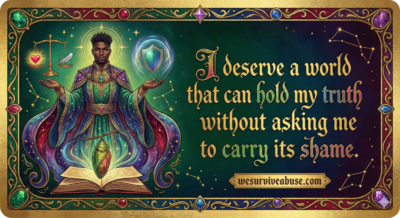
A male Survivor who was violated by another man often discovers that even his truth comes with rules.
He can describe the assault, but he must tiptoe around the identity of the person who harmed him. He can speak about pain, but not about context. He can say what happened, but not who the perpetrator was.
The victim is telling his truth, and you’re over there auditioning for a TED Talk nobody asked you to give. Let him speak.
We can still get details from both parties who were alleged to have been present. And only those who were present.
Somehow, the one who endured the violence is expected to protect the reputation of the community his rapist belongs to.
Read that again.
This is backwards.
Who the perpetrator is matters.
Not because identity causes harm — but because identity shapes how the harm is received, understood, and responded to.
If a man was raped by a man, he should be able to say so without being told:
“That’s not relevant.”
“You’re stereotyping.”
“That label hurts the community.”
Do you hear it?
His body was violated, yet the correction is aimed at his language — not the offender’s actions.
We don’t do this when the roles are reversed:
No one rushes to protect heterosexual identity when women are assaulted by men.
No one says, “Don’t call him straight — that’s damaging.”
No one demands softer language to protect a group image.
But when a male victim says, “A man raped me,” suddenly people get nervous. Suddenly the conversation is no longer about the crime. Now it’s about optics, image, and discomfort.
And the victim is once again expected to disappear behind someone else’s feelings.
This is not justice.
This is not compassion.
This is not equality.
A Survivor has the right to name their reality accurately.
If the person who harmed them is a man, that matters.
If that man was sexually attracted to males, that matters.
If the offender’s identity shaped the victim’s confusion, fear, or self-perception, that matters.
It matters because:
Silence distorts healing.
Correcting someone’s truth erases their experience.
Forced neutrality protects perpetrators, not victims.
Nobody is saying that gay men are rapists.
What we are saying is this:
A rapist does not get a new identity simply because we don’t like how the truth sounds.
Because here’s the secret that makes people uncomfortable:
It’s not the identity that’s the problem.
It’s the protectiveness around identity that silences victims.
Victims don’t traumatize communities by telling the truth.
Victims expose the rot communities didn’t want to smell.
Victims should not have to translate their trauma into a politically approved dialect.
They should not have to protect the very categories that failed to protect them.
They should be allowed to speak plainly:
“This is what happened.
This is who did it.
This is who he was to me.”
If he was bold enough to do it, victims ought to be supported in being be bold enough to name it.
Truth does not become prejudice just because it makes someone uncomfortable.
Survivors deserve language that fits their reality — not someone else’s reputation.
And let’s get this straight:
Naming a crime isn’t an attack on a community.
Protecting rapists is.
Survivors don’t owe anybody silence. Not respectability. Not euphemisms. Not emotional labor. Not PR damage control.
They already paid the highest price.
The truth does not ever need to tiptoe.
Research tells us most men who rape — including those who rape males — identify as straight.
So blaming ‘gayness’ for male-on-male rape is both inaccurate and harmful.
But research does not give us permission to police a victim’s language.
If a man was targeted, pursued, and violated by another man,
he has the right to describe what that man was to him —
without being shushed in the name of politics.”
Affirmations
My experience is not up for debate.
My truth does not need permission.
I have the right to name what happened,
who did it, and how it shaped me.
I will not edit my truth to protect someone else’s comfort.
Naming what happened does not harm me —
hiding it does.
I deserve a world that can hold my truth
without asking me to carry its shame.
after appearing in INSIDE MAN, james ransone ended up on the news for beating up a rapist who broke into his apartment complex and attacked his neighbour.
“he may be little but he packs a mean punch.” pic.twitter.com/jvp6dAFSGh
— kaiya (@kaiyashunyata) December 21, 2025