Many movements draw inspiration from the Black American freedom struggle. That makes sense. The legacy is powerful, visible, and globally influential.
Many movements draw inspiration from the Black American freedom struggle. That makes sense. The legacy is powerful, visible, and globally influential. But alignment is not declared by analogy. It is demonstrated through practice.
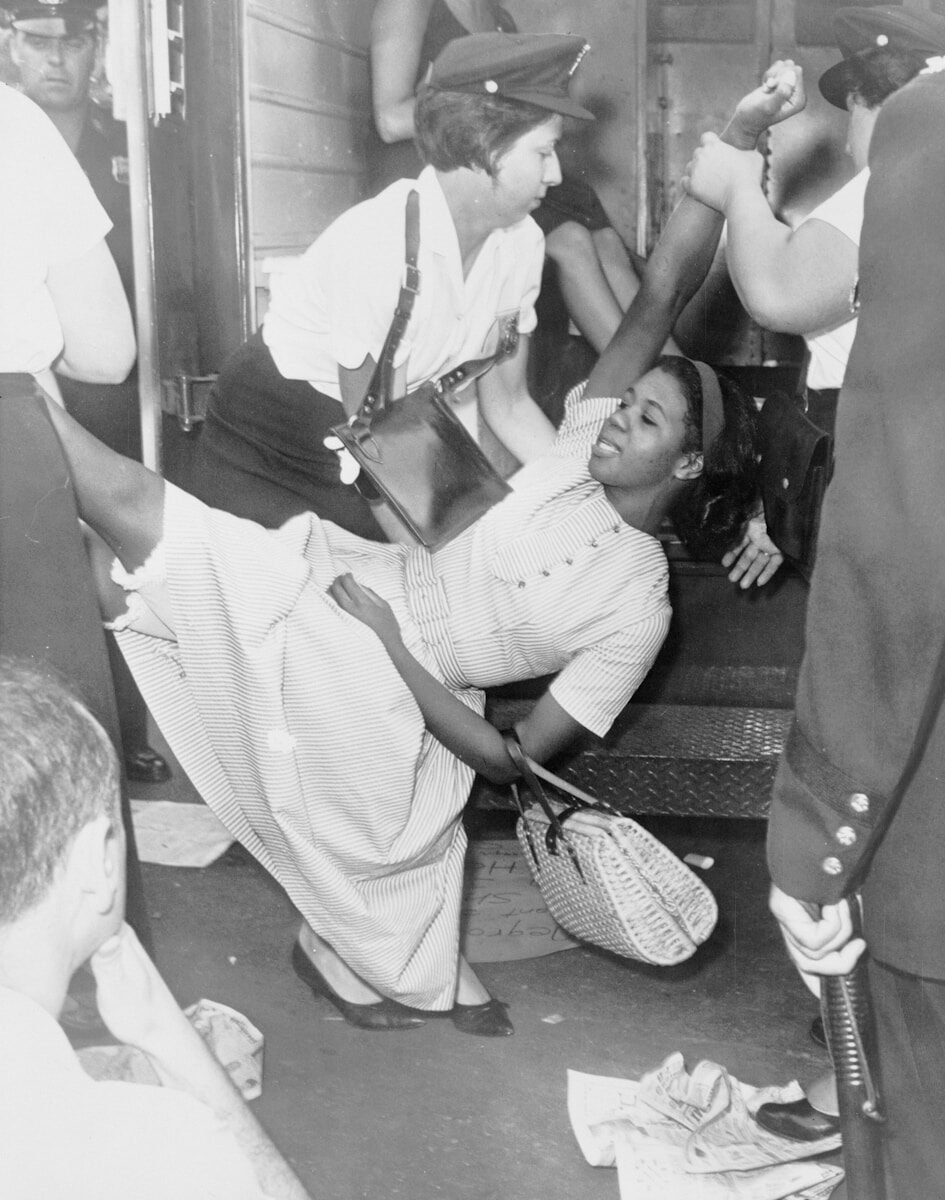
African American woman, Juanita Sealy, being carried to police patrol wagon during demonstration in Brooklyn, New York Photo by Library of Congress.
If truth is absent, the comparison collapses.
Because one of the defining features of the Black American Movement across generations was this:
• Naming reality when it was dangerous to do so
• Documenting harm when denial was the norm
• Challenging comforting myths
• Refusing silence in exchange for acceptance
Truth was not an accessory.
Truth was the engine.
Consider what that requires:
• People risking livelihoods, safety, reputation
• Evidence gathered against hostile systems
• Lies publicly dismantled
• Narratives corrected despite backlash
Not performance.
Not branding.
Not symbolic resemblance.
(Ida B. Wells, Billie Holiday, Martin Luther King Jr. Malcolm X, Mamie Till, Valerie Castille, Wanda Cooper-Jones (mother of Ahmaud Arbery), Rita Marley, (Jamaican/African diaspora), Nikole Hannah-Jones, Rosa Parks, Fannie Lou Hamer, James Baldwin, Shirley Chisholm, Druella Jones, Ella Baker, …….
There is a difference between:
• Borrowing the “language of justice”
and
• Bearing the cost of honesty
A difference between:
• “Looking like resistance”
and
• Confronting reality
Movements grounded in truth tend to show certain patterns:
• They tolerate scrutiny
• They welcome evidence
• They correct errors publicly
• They resist ideological comfort when facts disagree
Movements drifting from truth often show different signals:
• Facts treated as negotiable
• Disagreement framed as betrayal, hate, and/or bigotry
• Image prioritized over accuracy
• Narratives protected at the expense of reality
Takeaway History Lessons:
Truth is what gives a movement moral gravity.
Without it, a movement becomes aesthetic.
You cannot inherit the credibility of a struggle
while abandoning the discipline that built it.
Truth is not what makes a movement popular.
Truth is what makes it endure.