I was confused by my own exhaustion. I had spent years doing what some people think is the hardest part of advocacy. Helping women find shel
I was confused by my own exhaustion.
I had spent years doing what some people think is the hardest part of advocacy.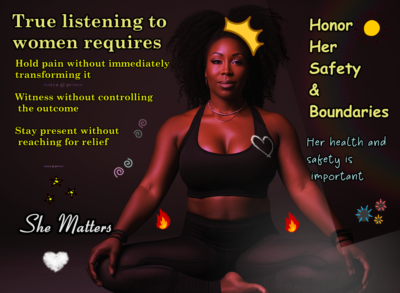
Helping women find shelter
Securing funds for rent and utilities
Tracking down gas money so she could get to work
Finding diapers, food, school supplies, medicine
Sitting in courtrooms
Standing beside women while systems questioned their truth
I knew how to do.
I knew how to move.
I knew how to build safety out of thin air.
So when listening alone began to wear me out, I mean around the edges of my soul, I didn’t understand it at first.
I had even worked hotlines. I was so confused. So stunned. Listening was always a part of my job. I trained others how to do it. I was damn good at it.
And then I turned to my then director, —Jennifer Pollitt-Hill. I just laid it all out. Probably in one breath.
Lovingly and knowingly she shared with me what her mentor had said something simple and unsettling:
Sitting with another person’s pain is exhausting.
It is difficult.
And it is real work.Especially when you are not there to “fix it”.
All I could do was sit there silently now, with her recalling those untold stories. From the Allegheny mountains to Baltimore, to Annapolis, to the Eastern shore……. Wow.
Maryland was a small state compared to the huge one I had come from.
On paper, the work should have felt lighter. Virginia is huge.I was serving in a statewide capacity there too, yes.
And yet, this work felt heavier.
Not because the women’s lives were more complicated.
Not because the need was greater.
But because this time, I was not there to fix anything.I was there to listen.
When you are helping women secure shelter, gather funds, keep the lights on, get to court, protect their children—you are moving with purpose. There is momentum. There are next steps. There is a direction for the pain to travel.
But when you are asked to sit with women’s stories—without redirecting them toward solutions—the weight changes.
Each story lands fully.
Each life presses into your chest, unfiltered by logistics or urgency.
The absence of fixing does not make the pain lighter.
It makes it denser.Story by story, woman by woman, the weight accumulates—not as chaos, but as gravity. You feel the singularity of each life. The particularity. The cost of what SHE has carried alone. All by herself.
I learned then that action can distribute weight across systems and tasks—but listening asks you to receive it whole.
That is why it felt heavier.
Not because the work was too much—
but because the stories were finally allowed to be exactly as heavy as they were.Hit me like a boulder.
When Listening Was the Assignment
On that one assignment, I was hired not to rescue, not to strategize, not to connect resources.
I was hired to listen.
The project was federally funded.
My role was to travel and sit with women across Maryland and hear their stories.
No clipboard solutions.
No next steps.
No referrals.
Just presence.
And something happened that surprised me.
The stories didn’t come in neat summaries.
They came in hours.
Because for many of those women, it was the first time:
Someone sat across from them
Looked them in the eye
Did not rush
Did not correct
Did not judge
Did not interrupt
They spoke until their bodies softened.
They spoke until the words finally caught up with years of silence.
And when the day ended, I was depleted.
Not confused.
Not overwhelmed.
Not afraid.
So often I would enter the building with daylight and come out into complete darkness.
Why Listening Hit Different Than Action
Here’s what I came to understand.
When I was securing shelter, funds, and safety, my nervous system had movement.
There was urgency, but also direction.
There was pain, but also traction.
There was fear, but also momentum.
Listening—true listening—asks something else entirely.
It asks you to:
Hold pain without immediately transforming it
Witness without controlling the outcome
Stay present without reaching for relief
That kind of listening requires emotional containment, spiritual steadiness, and a willingness to be uncomfortable without fleeing.
It is not passive.
It is labor.
What Exhausted Me Was Not Weakness
I had to unlearn a quiet myth many of us carry:
That if listening is tiring, something is wrong with us.
No.
Listening was tiring because:
The pain was real
The stories were layered
The silence before them had been long
The trust being extended was sacred
I wasn’t tired because I lacked strength.
I was tired because I was doing the work properly.
Why Many People Avoid Listening to Women
This is the part we don’t say out loud often enough.
Many people don’t struggle to listen because they don’t care.
They struggle because listening costs them something.
It costs:
Comfort
Certainty
Clean narratives
Easy answers
Emotional distance
Listening forces proximity to truth.
And truth changes you.
What I Know Now
Listening is not lighter than action.
It is not easier than logistics.
It is not softer than courtrooms.
It is simply different labor.
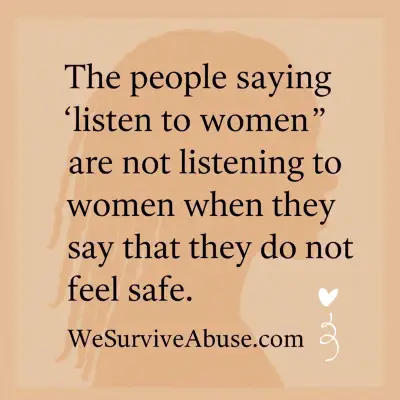
And when women tell us they are tired of not being heard, they are not asking for perfection.
They are asking for presence without punishment.
A Closing Offering
If listening to another woman’s pain makes you tired, pause before you judge yourself.
Ask instead:
Am I staying present instead of escaping?
Am I holding truth instead of minimizing it?
Am I allowing her humanity to touch mine?
That tiredness may not be burnout.
I wasn’t worn down by listening.
I was introduced to the weight of it.
I had spent years moving quickly—finding shelter, securing funds, preparing victims for court and standing alongside them no matter the outcome, securing groceries, education, and transportation.
Facilitating groups, speaking before audiences, playing with children, and strategizing safety plan with urgency and clarity.
I knew how to act. Move things forward.
But when my role became simply to listen—to sit with women across Maryland and hold their stories without rushing toward resolution—I discovered something new.
Listening requires a different kind of strength.
It asks for steadiness instead of speed.
For presence instead of productivity.
For reverence instead of response.
I was surprised by how much energy it took—not because I was doing something wrong, but because I was finally allowing the fullness of another woman’s truth to exist.
That’s not depletion.
That’s depth.