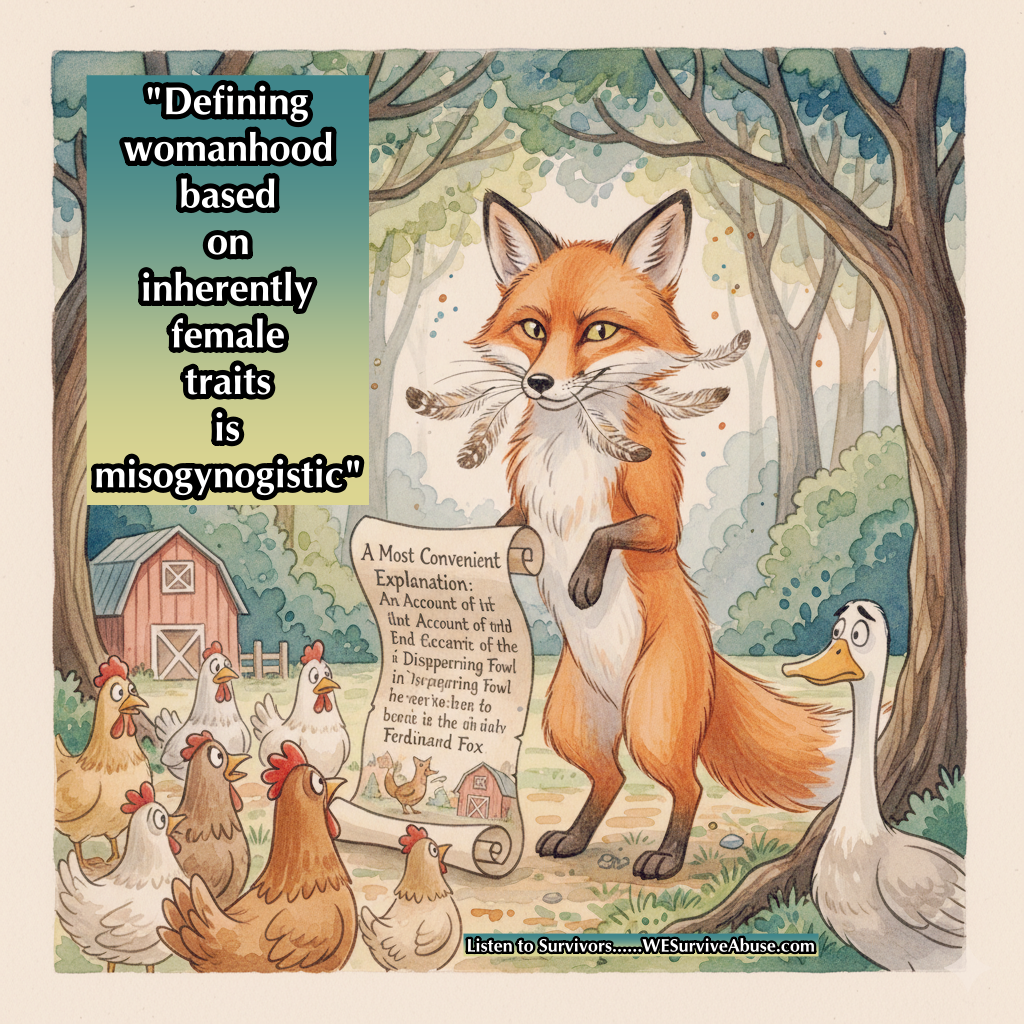
It is harder to ignore now. Some people noticed it earlier but now it is getting harder to ignore isn't it? Across cultures, languages, and generati
It is harder to ignore now.
Some people noticed it earlier but now it is getting harder to ignore isn’t it?
Across cultures, languages, and generations, many Survivors are naming the same unease. Womanhood is increasingly framed as a look, a vibe, or an undefinable identity rather than a concrete human reality.
Lipstick. A dress. Heels. A pout. A hairstyle. A head tilt. A feeling.
Some people warned years ago that this shift is not neutral. It has consequences.
Below are patterns Survivors are seeing globally.
1. Harm Becomes Harder to Name
When women are described primarily through aesthetics, the language needed to describe violations starts to dissolve.
Physical boundaries become “preferences”
Sexual violations become “misunderstandings”
Fear becomes “discomfort” or “paranoia”
Survivors rely on clear language to tell the truth. The blur is intentional because it weakens that power for women’s groups and individuals.
2. Boundaries Are Treated as Optional
Aesthetic framing trains people to see women as flexible, adaptable, and endlessly accommodating.
This makes it easier for others to argue that:
Privacy is negotiable
Consent can be debated
- She “should” do what I want
Safety can be sacrificed for social harmony
Boundaries rooted in facts and material reality are harder to override than boundaries framed as feelings.
3. Women’s Bodies Are Detached From Risk
Aesthetic narratives focus on appearance while ignoring lived vulnerability.
What disappears from the conversation:
The statistical realities of male violence
The physical risks women face when leaving unsafe situations
The long-term impact of coercion, control, and fear
Survivors know that bodies carry real consequence.
4. Speaking Plainly Is Penalized
Women who insist on clarity are often labeled as:
“Harsh”
“Outdated/Irrelevant”
- “Hateful”
“Uncompassionate”
“Difficult”
Meanwhile, those who soften language or remain visually pleasing are rewarded…temporarily. At least for as long as they are useful. This teaches silence without ever demanding it outright.
5. Protection Is Reframed as Exclusion
Requests for sex-based protections are increasingly described as “personal discomfort” rather than legitimate safety needs.
This reframing:
Shifts responsibility back onto women rather than on larger society to create safe spaces for everyone, especially women and children.
Encourages guilt, pile ons, and shaming just for asking for protection
Positions the need for boundaries as moral failures instead of proactive and necessary survival tools
Survivors recognize this tactic. Many have lived it before.
6. Accountability Slips Through the Cracks
Aesthetics do not testify, or let doctors know when something is wrong with the female human body.
Aesthetics do not tap into their intuition.
Aesthetics do not stay present in their body.
They do not document patterns.
They do not hold perpetrators accountable.
When definitions disappear, tracking harm becomes harder. Patterns blur. Responsibility disperses. Survivors are left carrying clarity alone.
7. Reality Is Replaced With Performance
Women are encouraged to perform empowerment rather than actually secure it. Actually hold it.
This often looks like:
Celebrating visibility and exterior beauty while ignoring safety
Applauding resilience and “strength” while avoiding prevention
Elevating stories that comfort the audience rather than protect women
Many Survivors know the difference between being seen and being safeguarded.
8. The Most Vulnerable Women Are Hit First
When womanhood becomes undefinable, those with the least social protection lose ground fastest:
Disabled women
Elder women
Poor women
- Black women/Indigenous women/Non-native language speaking women/Immigrant women
Women leaving violence
Women who speak without what society considers….”polish”
- Young women
Ambiguity always harms those already navigating risk.
A Steady Reminder for Survivors
Women are not aesthetics.
We are not moods, metaphors, or marketing categories.
We are human beings with bodies, boundaries, histories, and needs that deserve precision, protection, and respect.
Clarity is not cruelty.
Definition is not oppression.
Naming reality is often the first step toward safety.