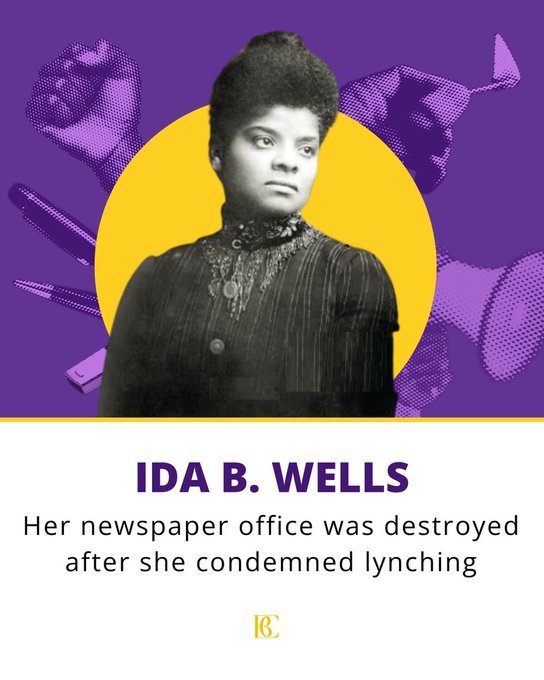
The way to right wrongs is to turn the light of truth upon them.-Ida B. Wells Ida B. Wells spoke repeatedly about truth, evidence
The way to right wrongs is to turn the light of truth upon them.-Ida B. Wells
Ida B. Wells spoke repeatedly about truth, evidence, and the necessity of facing reality — especially when reality was uncomfortable or dangerous.
She risked her life to document them when powerful institutions were actively spreading lies.
She gathered:
• Eyewitness accounts
• Statistical records
• Newspaper investigations
• Court details
…and used evidence to dismantle the false narratives justifying racial terror.
At the core of her work was this principle:
Truth is not a rhetorical device.
Truth is protection. Truth IS resistance. Truth is survival.
She understood something timeless:
When facts are suppressed, distorted, or dismissed, injustice multiplies.
When facts are exposed, denial becomes harder to sustain.
And when denial cracks, change becomes possible.
Ida B. Wells reminds us:
Reality does not become kinder when we refuse to look at it.
But justice becomes possible when we do.
There’s a lot of human beings on this planet.
Different beliefs. Different perspectives.
When you live among billions of people, facts are more than important. They are stabilizing.
When you’re dealing with something as complex, emotional, and high-stakes as a planet full of human beings, facts serve as shared ground beneath very different lives.
Here’s why they matter so deeply and why acknowledging them are an act of kindness and compassion:
• Facts anchor reality
Without them, conversations drift into assumptions, fears, and narratives that feel true but may not be. Facts pull us back to what can be examined, tested, and understood.
• Facts protect against manipulation
Rumors, propaganda, outrage cycles, and charismatic voices can all bend perception. Verifiable information acts like a filter against distortion.
• Facts reduce unnecessary harm
Policies, medical decisions, education systems, justice outcomes — when built on inaccurate beliefs, real people suffer. Facts lower the risk of decisions made in illusion.
• Facts create a common language
People disagree on values, ideology, politics, identity, morality. But facts offer something we can point to together even inside disagreement.
• Facts slow emotional contagion
Human beings are highly suggestible, especially under stress. Facts interrupt panic, hysteria, and mob thinking.
• Facts support accountability
Power without factual scrutiny becomes dangerous. Facts make it harder for institutions, leaders, or systems to rewrite reality.
• Facts empower the vulnerable
Those with less social power often rely on documented reality. When facts are dismissed, the already unheard are pushed further into invisibility.
• Facts sustain trust
Trust collapses when people feel reality itself is negotiable. Stable, credible information is the backbone of social cohesion.
And there’s a deeper truth beneath all of this:
Facts are not cold.
They are a form of care.
Because accurate understanding is what allows:
• Better medicine
• Fairer justice
• Safer systems
• Smarter policies
• Clearer choices
• More honest empathy
A world that treats facts as optional eventually treats human consequences as optional too.
A world that respects facts creates the conditions for dignity, safety, and genuine progress.
Facts do not erase human experience.
They protect it from being overwritten.
Facts are kind to people who need them recognized and acknowledged the most.

Photo by Adam Nemeroff
Truth is mighty and will prevail.-Ida B. Wells