
Benefit is not just about who receives opportunities in a given policy moment but also about who accumulates advantage across time without int
Benefit is not just about who receives opportunities in a given policy moment but also about who accumulates advantage across time without interruption.
Names change on paper before anything changes in the body.
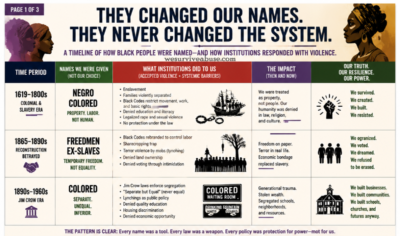
Colored. Negro. Black. African American. Black American. The ink moves. The people stay in motion too, but not because the system is moving toward them with clarity. Because the system keeps revising how it will speak about what it has already decided to contain.
There is a history here that doesn’t sit quietly.
A woman stands in a photograph from another century, her name recorded in a language that does not match her life. Another generation later, the same line of people is written into census forms under a different word. Then another.
Each shift arrives like a correction, because that’s what they told everyone, that’s how they sold it, but the conditions underneath remain familiar: labor demanded, dignity debated, safety uneven, and accusations constant.
No apology settles into the bones of it. No structural repair follows the renaming. Just new vocabulary placed over old arrangements. Shiny new coats of paint over ramshackle structures in dire need of repair and replacement.
And still, the expectation arrives dressed as if nothing happened. Work harder. Prove again. Be grateful for the recognition that does not change the exposure.
There is a particular weariness that forms when language changes faster than life.
“Them names change but they still treat you the exact same. Mean as hell.”
A grandmother might tell it differently. She remembers when “Negro” was official, when “Colored” was official before that, when doors closed the same way regardless of the sign on them. She does not confuse the shift in words with a shift in power. She has seen enough transitions to recognize when a surface is being updated while the structure remains intact.
White ethnic groups in the U.S., like Italian Americans, Polish Americans, and Irish Americans did experience discrimination in earlier waves of immigration. That discrimination was real in housing, employment, and social status. Over time, though, those groups were absorbed into the broader category of “white,” and that absorption is a major part of how whiteness expanded in the United States. The key turning point wasn’t just assimilation—it was that the boundary of “white” itself shifted in a way that granted long-term structural access to resources, mobility, and legal protections.
Affirmative action policies in the U.S. have primarily benefited white women as a group in terms of total gains in education and employment representation. Black Americans and other racial minorities also benefited, but not equally in outcomes due to enormous differences in baseline inequality, enforcement, and institutional resistance. But guess what? No one is bringing law suits against white women because their children did not get into the Ivy League college of their choice. So maybe they don’t have a problem with the “policy”? It is actually some very specific people that some people have a problem with.
How Abusers and Systems Use “You Have It Good” to Normalize Deprivation – WE Survive Abuse
That’s a whole lot different from what happened to Black Americans, where intentional legal and social exclusion persisted far longer, more violently, and was enforced in much more direct and sustained institutional ways.
White ethnic assimilation into “whiteness” functioned as access expansion over generations, not just injury repair. That access became cumulative—passed down, normalized, and embedded in housing, schooling, wealth, and networks.
Black women’s relationship to institutions have been shaped differently: not just through discrimination, but through a longer continuity of exclusion, surveillance, violence, and delayed access to protection and repair mechanisms. Even when policies shift, the starting point is not the same.
Benefit is not just about who receives opportunities in a given policy moment but also about who accumulates advantage across time without interruption.
Somewhere in that lineage, Black women learn something precise about naming. That it can be offer
ed as progress while function stays the same. That recognition without repair is still a kind of management. That being renamed does not automatically mean being re-seen.
So when another category arrives, even one wrapped in the language of affirmation, there is a question that rises before acceptance.
What changes with it?
Not emotionally. Structurally. Materially. Safely.
Because there is memory here too. Memory of being told to “wait” while conditions stayed fixed. (wait) Memory of being reclassified while still carrying the same burdens. (wait) Memory of being described as resilient in the same breath that resources were withheld. (wait) Memory of being called lazy by systems that extracted labor while denying protection. (wait, wait, wait!)
You can never unsee it again. You can see clearly now.
A woman changes her name in marriage, and sometimes the world responds differently. Sometimes access shifts. Sometimes safety increases. Sometimes legal recognition opens doors that were previously closed. There is at least a known logic in it: exchange, reclassification, and the possibility—however uneven—that life changes with the label.
But history teaches something else when it comes to Black women and institutional naming.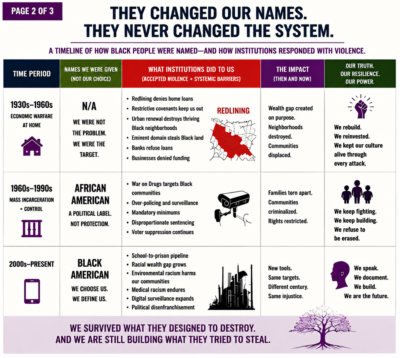
There is no reliable promise that a new category brings protection.
So the question becomes quieter but sharper.
Why accept a name change that does not come with safety attached.
Why treat renaming as progress when it has so often arrived without repair.
Why believe that the next label will behave differently than the last, when the pattern beneath it has not been addressed.
Systems move, sure, but it doesn’t move because systems don’t know what to do with people.
It moves because systems keep deciding what to do with people in ways that preserve the system first, and the person second (or third, fourth, fifth…..or never if possible.)
That is the part history keeps repeating in different clothing. Not confusion. Not an accident. Intentional design that adapts its language faster than it transforms its impact.
And so Black women stand in that long memory with a different kind of attention now. Less impressed by the naming. More interested in what changes in the ground beneath it. Less persuaded by the vocabulary of inclusion. More concerned with whether inclusion ever reaches the level of protection and care for their bodies.
Because a name, on its own, has never been enough to hold a life.
Until I see a CVS length long receipt of good reasons to believe that changing the language will be beneficial, I like the language that directly impacts me right where it is. Otherwise, just leave it be.
How Changing Language Around Sex is Used to Undermine Women in Courtrooms – WE Survive Abuse
23 Common Excuses Used to Downplay Safety Risks for Women – WE Survive Abuse
For Some People, Staying Grounded in Reality Is a Daily Act of Strength – WE Survive Abuse