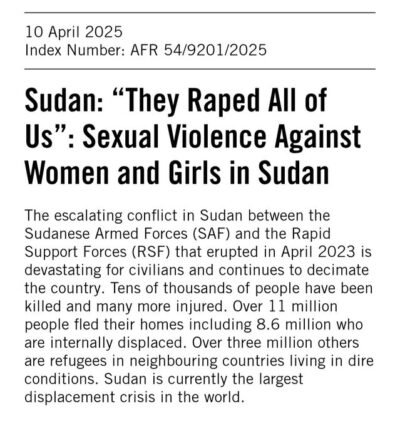
updated from June 13, 2025 Women and girls in Sudan are facing unspeakable violence—sexual violence used as a weapon of war, mass displacement, and e
updated from June 13, 2025
Women and girls in Sudan are facing unspeakable violence—sexual violence used as a weapon of war, mass displacement, and ethnic cleansing. These are not isolated tragedies. These are widespread, systemic, and urgent. The world cannot afford to remain silent.
7 Devastating Truths About What Is Happening to Women and Girls in Sudan
Sudan’s war has become one of the world’s gravest crises of sexual violence. Women and girls are being raped in their homes, while fleeing violence, on roads, in fields and in displacement camps.
And the evidence available in 2026 tells us something important: the numbers we knew before were only part of the story.
1. Sexual Violence Is Being Used as a Weapon of War
The United Nations says conflict-related sexual violence in Sudan has reached an unprecedented scale and is being used to terrorize civilian populations.
Women and girls have endured rape, gang rape, abduction, sexual slavery, forced marriage and other forms of sexual violence.
The Rapid Support Forces (RSF) and affiliated groups have been implicated in the majority of documented conflict-related sexual-violence incidents, although Sudanese Armed Forces personnel and other armed actors have also been implicated.
The violence has sometimes carried an explicitly ethnic dimension, particularly against non-Arab communities in Darfur.
2. Nearly 13 Million People Are Now at Risk of Gender-Based Violence
This number has climbed dramatically.
In 2024, an estimated 6.7 million people were at risk of gender-based violence.
By 2025, that figure had risen to 12.1 million.
By early 2026, UNFPA estimated that approximately 12.7 million people were at risk, with women and girls making up the majority of those facing exploitation, abuse and insecurity.
This is no longer a crisis affecting a few isolated communities. It stretches across a country shattered by war, displacement and collapsing systems of protection.
3. Doctors Without Borders Has Now Treated Thousands of Survivors
The earlier numbers were terrible. The newer ones reveal how much larger the crisis has become.
Between January 2024 and November 2025, at least 3,396 survivors of sexual violence sought treatment at MSF-supported facilities in North and South Darfur.
Ninety-seven percent were women and girls.
MSF warns that even this number represents only a fraction of the true scale because many Survivors cannot safely reach medical care.
Following the RSF capture of El Fasher in October 2025, MSF treated more than 140 Survivors who escaped to Tawila. Ninety-four percent reported being attacked by armed men.
Then, in just one month between December 2025 and January 2026, MSF identified another 732 Survivors in displacement camps around Tawila.
Women were reporting assaults not only during attacks, but while trying to escape and even after reaching displacement camps.
There was no clean line where danger ended.
4. Children Are Being Raped. Some Were Babies.
This correction makes the truth even more horrifying.
UNICEF reported 221 cases of child rape recorded since the beginning of 2024 across nine Sudanese states.
Of those children, 147 were girls and 74 were boys.
Sixteen were under five.
Four were only one year old.
UNICEF has repeatedly warned that these documented cases represent only a small fraction of the actual violence because families may be unable or afraid to report what happened.
These are not merely statistics about “women and children.”
Some of the Survivors are babies.
5. Sexual Violence Has Been Used Alongside Ethnic Violence in Darfur
The assault on El Geneina and surrounding areas of West Darfur included mass killing, forced displacement and sexual violence directed particularly against the Massalit population.
A UN Panel of Experts estimate cited by Human Rights Watch placed the number killed in El Geneina in 2023 at between 10,000 and 15,000 people.
Human Rights Watch documented women and girls being raped during the campaign and found evidence that RSF forces and allied militias targeted the Massalit and other non-Arab communities.
Women have reported racial and ethnic slurs being used during sexual attacks.
Their bodies were not incidental to the violence.
They became one of its battlegrounds.
6. Rape Is Following Women Through Ordinary Life
One of the most disturbing findings from MSF is how thoroughly sexual violence has entered everyday survival.
In South Darfur, Survivors have reported attacks while farming, traveling to fields, collecting firewood, searching for food, getting water, walking along roads and staying inside their own homes.
Among the Survivors treated by MSF in South Darfur, 34% were attacked while farming or traveling to fields.
Women face an impossible calculation.
Go out for food, water or firewood and risk sexual violence.
Stay home and hunger may come through the door instead.
Even home does not guarantee safety.
7. The World Still Does Not Know the True Number of Survivors
Perhaps this is the fact that should sit with us longest.
Every major organization examining Sudan warns that its numbers are undercounts.
War has destroyed health facilities. Families fear retaliation. Survivors may face stigma. Armed groups control territory. Some women cannot reach hospitals. Others flee across borders. Some children are too young to explain what happened to them.
And some Survivors never make it somewhere that records their names.
So when we say 3,396 people received treatment, that does not mean 3,396 people were assaulted.
When we say 221 children were reported raped, that does not mean 221 children were raped.
Those numbers tell us how many people made it through enough doors for somebody to count them.
The real number remains unknown.
And that may be one of the most devastating truths of all.
💔 Why This Matters
This is not collateral damage—it is strategic terror. It is genocide. It is gendered warfare. And it is happening now, largely unseen by the global public.
These stories are not just statistics—they are testimonies of unimaginable strength, survival, and suffering.
✊🏾 How You Can Stand With Women in Sudan
Share this post: Use your voice to amplify theirs. But more importantly, if you have a platform, invite women connected to Sudan to speak about this. Amplify their voices. Keep learning about this history and the present.
Support organizations on the ground: Médecins Sans Frontières, UN Women, and local Sudanese-led efforts.
Demand international accountability: Speak up to your representatives.
- Use your creativity to bring awareness and attention to Sudan (music, drama, videos)
✊ Let Us Remember & Act
Honor their humanity: Each statistic is a lived story—of pain and survival.
Demand justice: Call on international bodies and governments to enforce accountability.
Support survivors: Donate or uplift agencies offering medical and psychological aid (e.g., MSF, UN Women).
Amplify voices: Share stories so Sudanese women aren’t forgotten—even in global silence.
Say their names. See their pain. Honor their survival. Let the world never again say we didn’t know.
#StandWithSudan
#EndSexualViolenceNow
Resources for Learning More and Supporting Women and Girls in Sudan
The suffering of women and children in Sudan should not disappear when the headlines move elsewhere. Sudanese women, local organizations, health workers and humanitarian groups continue to provide care, document abuses and advocate for protection under extraordinarily dangerous conditions.
If you want to keep learning, follow the voices closest to the crisis, or support work serving women and girls, these resources are a place to begin.
Strategic Initiative for Women in the Horn of Africa (SIHA Network)
SIHA has worked in Sudan for more than two decades and works closely with grassroots women’s rights organizations across the Horn of Africa. In Sudan, its work includes documenting sexual violence, advocating for women’s rights and supporting women and communities affected by war. After its Khartoum and North Darfur offices closed following the outbreak of war in 2023, SIHA continued its Sudan work from safer locations, including Kassala and Port Sudan.
Learn more about SIHA Network’s work in Sudan
Sudanese American Medical Association (SAMA)
SAMA supports health services for Sudanese communities affected by war and displacement. Its women’s health work includes maternal and reproductive health care, psychosocial support, HIV prevention and services responding to gender-based violence. Its 2026 women’s health program includes work with displaced women and girls in Sudan and Sudanese refugees in neighboring Chad.
Explore SAMA’s Women’s Health work
UNFPA Sudan
UNFPA is one of the most useful resources for following how the war is affecting women’s health and safety. Its work includes women-and-girls safe spaces, psychosocial support, gender-based violence services, reproductive health care and clinical care for rape Survivors.
The need is enormous. UNFPA estimated in early 2026 that 12.7 million people were at risk of gender-based violence, with women and girls making up the majority of those exposed to heightened exploitation, abuse and insecurity.
UNICEF Sudan
Children are experiencing their own sexual-violence emergency within Sudan’s war. UNICEF documents sexual violence against children while supporting services including medical care, counseling and safe spaces for women and girls.
Its reporting also allows readers to hear from Sudanese women and frontline workers responding to the crisis, rather than encountering children only as numbers in international reports.
United Nations in Sudan: Reports and Documentation
For readers who want to go deeper into the evidence, the UN’s Sudan portal maintains reports and updates from agencies working throughout the crisis. Its resource collection includes dedicated analysis of conflict-related sexual violence as well as broader reporting on human rights and humanitarian conditions.
Explore United Nations Sudan resources
Do Not Forget the Women Already Doing the Work
Sudanese women are not standing somewhere waiting for the outside world to discover their suffering.
Women-led organizations have been providing services to Survivors, organizing community responses, documenting violence and helping displaced families survive. Yet these organizations have historically received only a small fraction of humanitarian funding. UN Women reported that, as of November 2024, less than 2 percent of the Sudan Humanitarian Fund reached local women’s organizations through direct partnerships.
That is worth remembering when deciding where our attention, advocacy and support should go.
Whenever possible, seek out Sudanese voices. Learn about women-led organizations. Support groups providing direct care. Read the documentation. Share credible reporting. And resist the temptation to believe that because a crisis has lasted a long time, it has somehow become less urgent.
Women and children living in high-conflict zones need more than our attention. They need us to respond with the best of our common sense, the fullness of our hearts, and a clear understanding of our shared humanity.
Sudan is still speaking.
We should still be listening.
‘The soldiers broke in and assaulted my daughter as we slept’
Why Blaming Porn Alone Won’t End Violence Against Women – WE Survive Abuse