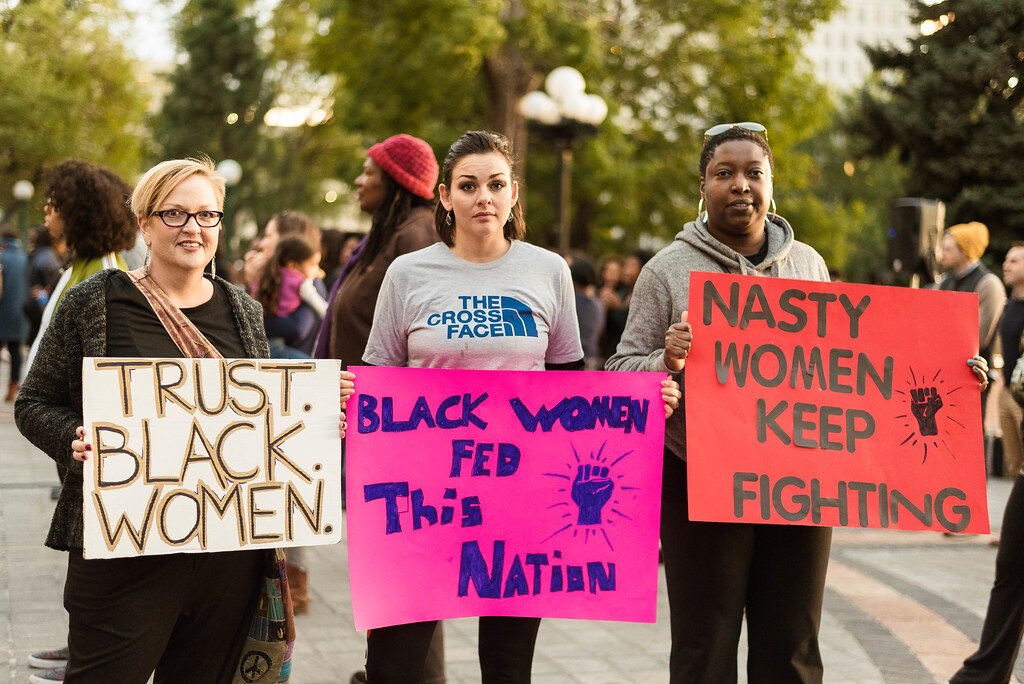
“A river that forgets its source will soon run dry.”— African proverb There is a scene in The Women of Brewster Place where the women get fed up wit
“A river that forgets its source will soon run dry.”
— African proverb
There is a scene in The Women of Brewster Place where the women get fed up with being cut off from all of the wonderful things on the on the other side of a brick wall. The final scene.
That brick wall also traps them in where there is a cycle of abuse, violence, poverty and bigotry. At the end of the television movie produced by Oprah (based on the novel written by Gloria Naylor) the women tear down the wall and vow to tear it down again if the city puts it back up.
There is something troubling happening in many conversations today.

Black Woman March
A new idea appears.
A new generation steps forward.
Energy rises. Passion rises. Critique rises.
All of that is natural.
Every generation questions the one before it. That is part of how societies grow.
But sometimes the critique goes further. It moves past learning, past reflection, past improvement. It turns into something else.
The suggestion becomes clear:
Push aside what came before.
Start fresh.
Act as if the earlier work holds little value and nothing was done for you.
That approach may sound bold. It may sound revolutionary.
But it is not wise.
Because the people who came before us were not simply speaking opinions. They were breaking through cement ……with their bare hands.
And cement is not easily broken.
And people who are criticizing them forget that you are doing it with the aid of wifi and on the latest digital technology. That’s something many around the globe, women and Black people are still unable to do.
— The Cost of Breaking Through Cement
Many of the freedoms, opportunities, and conversations we see today exist because earlier generations fought for them under conditions far harsher than most people living today have experienced.
They organized when the law was openly against them.
They spoke when speaking could cost them their jobs, their homes, or their safety.
They created art and culture even while their work was stolen or copied without recognition.
They built institutions while facing open hostility and constant barriers.
- Some lost employment.
- Some lost protection.
- Some lost their lives.
They built language that named injustice.
They built strategies that shifted laws.
They built cultural movements that shaped the world.
They built spiritual frameworks that helped people survive suffering.
They built institutions that protected communities.
None of that was easy. None of it appeared overnight.
It was work done slowly, courageously, and often with very little recognition.
Even asking questions about why people like YOU don’t have what others have has made them instant pariahs. It put others on notice that they were not there to ‘go along to get along’.
“The young walk faster, but the elder knows the road.”- African Proverb
They Were Not Perfect — And That Matters
Some voices today focus heavily on the imperfections of earlier generations.
Yes, they had flaws.
Yes, some ideas from the past need refinement.
But it is worth remembering something important.
Many of those elders were living through conditions far harsher than the ones we face today.
They lived under open segregation.
They lived under laws that limited where they could live, work, learn, or travel.
They faced violence that was often ignored by institutions.
They navigated systems that openly denied their humanity.
Under those conditions, perfection was never the standard.
Survival, courage, and persistence were.
And despite those harsh realities, they still managed to create pathways that changed the world.
That is not something to dismiss lightly.
“Don’t tear down a fence until you know why it was built.”
What Happens When Cultural Memory Is Ignored
When people forget what earlier generations built, something dangerous begins to happen.
Knowledge disappears.
Strategies that once worked are lost.
Communities begin solving the same problems over and over again, without realizing someone already left clues about how to move forward.
It slows progress.
It drains energy.
It leaves each generation feeling as though they must start from nothing.
That is not growth.
That is repetition.
Others See the Value Even When We Don’t
Across the world, people study the cultural, artistic, and political contributions that Black communities have created.
They study Black music.
They study Black organizing traditions.
They study Black rhetorical power.
They study Black community survival models.
Then they build on those ideas.
Meanwhile, within the very communities that created many of these breakthroughs, some voices are encouraged to treat them as outdated or embarrassing.
That is a painful contradiction.
Because when a people stop valuing their own cultural and intellectual inheritance, someone else will gladly carry it forward.
Critique Is Not the Problem
Critique is necessary.
No generation gets everything right.
No movement is perfect.
Critique helps refine ideas.
Critique helps correct mistakes.
Critique helps strengthen what is already strong.
But critique should lead to understanding and improvement, not erasure.
A healthy cultural rhythm often looks like this:
• Study what came before you.
• Honor the breakthroughs that made today possible.
• Learn the strategies behind those victories.
• Improve the parts that need strengthening.
• Then build something even better.
That is how wisdom grows across generations.
Celebrating Those Who Broke Through
The people who came before us were human beings navigating extremely difficult circumstances. Treacherous. A world that was not built for them to speak, live, or thrive.
They were not perfect.
But they were determined.
They opened doors that had been locked for generations.
They changed conversations that once seemed impossible to change.
They laid foundations that many people now walk across without realizing how hard the ground once was.
Their efforts deserve reflection.
They deserve study.
And yes, they deserve celebration.
Because celebrating those breakthroughs does not weaken new ideas.
It strengthens them.
“Critique can sharpen a legacy. But forgetting the people who broke
through cement only forces the next generation to start digging again.”
The Future Belongs to Builders
I worry that young people tend to overlook the struggles previous fighters have endured, believing that their own situation can’t worsen.
Movements grow stronger when each generation adds something meaningful to what already exists.
The elders broke through the concrete.
The next generation can widen the path.
The generation after that can build bridges.
And one day, the road becomes wide enough for many people to travel safely.
But that kind of progress only happens when people understand the value of the foundation beneath their feet.
History has taught us something simple.
When people forget the hands that broke the concrete, they often spend generations trying to dig through the same ground again.
The wiser path is different.
Remember the builders.
And then build something even stronger for those who will come after us.
“The elders broke through the cement. Our task is not to pretend the road began with us. Our task is to widen it.” -Tonya GJ Prince
By the way,
In many parts of the world:
• Wi-Fi is unreliable
• mobile data is expensive
• electricity can be inconsistent
• video streaming drains phones quickly
Reflection Questions: Remembering the People Beyond High-Speed Internet
• Who around the world depends on low-data spaces just to participate in conversations?
• Are we designing our messages only for people with strong internet access?
• What wisdom might we hear if we created more spaces for voice instead of polished media?
• How can audio conversations reach people who cannot stream video or download large files?
• Are we remembering that some of the most powerful traditions in human history were spoken, not posted?
• What would it look like to build movements that welcome people with simple phones and limited connectivity?
• How can we keep our work accessible to people in rural communities, developing nations, and working-class neighborhoods?
“A river that forgets its source will soon run dry.”
— African proverb
P.S. Some of the resistance to listening to and studying previous generations and texts has people walking in wilderness circles. Nearly everyone has an opinion. What concrete are you breaking through to make it easier for others?
SEE THIS FILM! READ THE BOOK!!!