updated from September 25, 2023 For over thirty years I have been dedicated to working to end violence against women and girls. Along the way, I wor
updated from September 25, 2023
For over thirty years I have been dedicated to working to end violence against women and girls.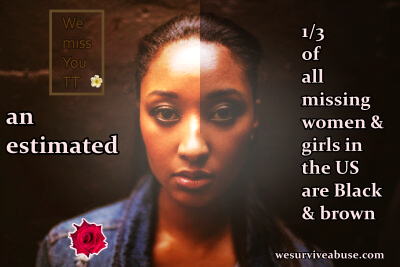
Along the way, I worked closely with law enforcement.
That is something I will always stand by—because that work was never about institutions.
It was about women.
It was about children.
It was about families trying to survive.
It was about communities refusing to let harm go unanswered.
I have watched officers race through red lights to respond to domestic violence calls—calls where someone was being threatened, stalked, beaten, or held at gunpoint.
I have been in those cars myself, gripping the seat in fear yet knowing that seconds mattered.
For police officers, responding to life-or-death danger is part of the job.
So when people say “defund the police,” I need us to slow down and ask real questions—especially where women and girls are concerned.
Because an estimated one-third of all missing women and girls in the United States are Black and Brown.
That is not rhetoric. That is reality.
If police disappear tomorrow:
Who looks for these women and girls?
Who investigates when a mother does not come home?
Who responds when a woman is trapped in her own house with an enraged partner and children are present? Who is going to stop what they are doing to go speeding through red lights to rescue a family being held hostage at gun point?
Who holds perpetrators accountable when harm escalates into homicide?
These are not abstract policy debates.
These are survival questions. I do not assume that there aren’t answers within the community. Haven’t some of the world’s most innovative ideas always come from deep within the roots of Black communities? Still, we must have these conversations in ways that will stretch us. Women will be the leading voices because we bear the brunt of the violence in human trafficking and domestic and sexual violence cases which often intersect with cases involving missing women and girls.
Everyday working class Black women who know the stories and the terrain well. Trained experienced, and dedicated advocates for victims. Holistic and spiritual leaders. Otherwise, if some people ever get what they want…..then what happens to women and children in dangerous situations?
We Can Name Harm Without Erasing Protection
It is also true—undeniably true—that policing in the United States is deeply flawed.
Sexism.
Racism.
Failures to investigate sexual violence.
Dismissal of missing persons—especially Black women and girls.
Police brutality.
Abuse of power.
Black feminist scholars have named these failures clearly and consistently.
Dr. Beth Richie, in her foundational work on gender violence, has shown how Black women experience a double bind—over-policed in some ways, under-protected in others.
Dr. Carolyn West has documented how Black women’s victimization is routinely minimized, doubted, or reframed as mutual conflict rather than violence.
The problem has never been that women want unchecked power.
The problem has been inconsistent protection and selective care.
A Proven Path Forward: Advocacy + Law Enforcement
We already have models that work.
Women’s rights advocates did not wait for perfection.
They built partnerships.
Domestic violence and sexual assault advocacy programs were designed to work alongside law enforcement—not instead of it.
A domestic violence advocate is a trained professional who supports Survivors through crisis and aftermath:
Critical life-saving strategic safety planning
Court accompaniment to help victims navigate the legal process
Medical advocacy to be there when the rape victim is the crime scene (rape kits), therapy, pregnancy tests, STI testing
Emergency housing access
Long range emotional and practical support/coaching
Advocates translate systems.
They protect dignity.
They center survivor choice.
This partnership matters because no single system can carry the full weight of violence alone.
We Can Build More — Not Less
Instead of tearing everything down and leaving women exposed, we could expand what already saves lives.
Imagine:
Missing persons advocates, trained specifically to respond when women and girls disappear
Mental health crisis advocates, working alongside officers—not replacing emergency response, but strengthening it
Disability-informed advocates, ensuring people with disabilities are protected rather than dismissed
Expanded, well-funded survivor advocacy programs in every state
These advocates could be publicly funded, accountable, and community-rooted—working in tandem with trained officers to reduce harm, not deny it.
Because here is the truth:
In 2016 alone, nearly one million women in the United States survived being shot at by an intimate partner (Everytown for Gun Safety).
That means someone pulled a trigger—and missed.
That is not a moment for ideology.
That is a moment for rapid response, accountability, and protection.
The Truth We Must Hold
Police do not have to be our only response to harm.
But pretending women do not need emergency protection is not justice—it is abandonment.
We do not keep women safe by erasing responders.
We keep women safe by building layered systems—systems that listen, intervene, document, investigate, and hold accountable.
Women and children are not policy experiments.
Our lives matter.
Our safety matters.
And we deserve solutions grounded in reality—not slogans.
At We Survive Abuse, we tell the truth plainly:
Protection and accountability are not opposites.
They are partners.
And we will not sacrifice women and girls to prove a point.
Domestic Violence Awareness Month: Keep Talking About This (video) | WE Survive Abuse