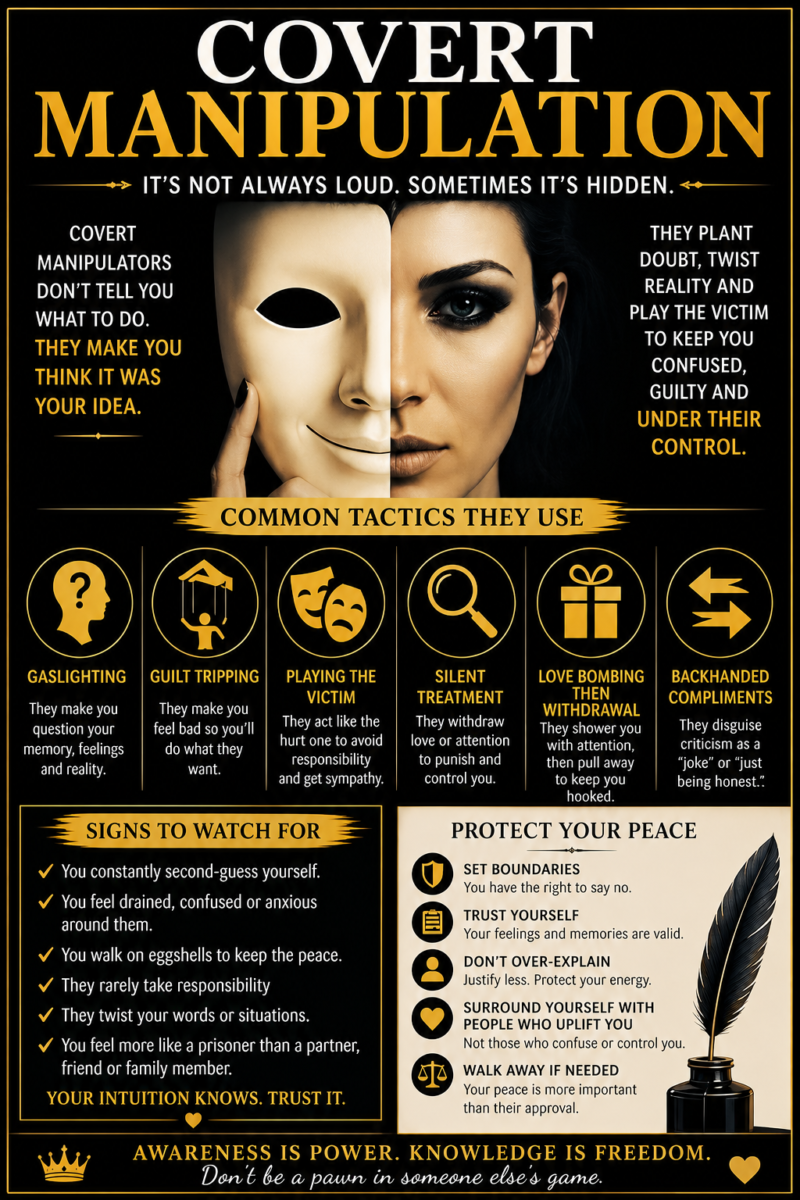
Much of today's manipulation no longer looks openly threatening. It often arrives looking compassionate, progressive, emotionally intelligent,
Much of today’s manipulation no longer looks openly threatening. It often arrives looking compassionate, progressive, emotionally intelligent, romantic, therapeutic, empowering, or inclusive. That doesn’t mean those things are manipulative. It means manipulation increasingly borrows the language and appearance of safety.
That shift is important because many women were taught to watch for anger, insults, yelling, and violence. They were not taught to recognize manipulation wrapped in kindness, urgency, guilt, or social approval.
Here are twelve lessons I believe every woman and girl benefits from understanding.
1. Manipulation often begins by making you question yourself instead of the other person’s behavior.
Years ago manipulation was often obvious control.
Today it often sounds like:
“You’re overthinking.”
“You’re reading too much into it.”
“Everyone else is fine with this.”
“Maybe you’re just anxious.”
Instead of examining whether the situation is safe, your attention gets redirected toward fixing yourself.
Healthy people welcome honest questions.
Manipulative people often make questions feel like defects.
2. Fast intimacy is one of the biggest warning signs.
Real trust develops over time.
Manipulation frequently tries to skip that process.
Someone you’ve known for three days suddenly calls you their best friend.
Someone you’ve dated twice wants exclusive access to your life.
Someone you’ve just met expects emotional loyalty.
Someone online tells you they’ve never met anyone like you.
Urgency benefits the manipulator far more than the person being rushed.
3. Access is often treated as if it were a right.
This is one of the biggest cultural shifts.
Today many women are taught that saying “no” requires an explanation.
It doesn’t.
Access to your:
body
attention
emotions
home
- opportunities
children
phone
finances
time
- spaces
forgiveness
energy
is earned.
Not requested once.
Earned consistently.
4. Many manipulators study kindness because kindness is easier to exploit than fear.
This surprises people.
Manipulative people often look for women who are:
generous
forgiving
patient
community-minded
highly empathetic
conflict avoidant
Those are beautiful qualities.
Without boundaries, however, they become predictable entry points.
Never confuse having a kind heart with abandoning good judgment.
5. Confusion is information.
Many women were taught that confusion means they need more communication.
Sometimes.
But chronic confusion can itself be evidence.
Healthy interactions generally become clearer with time.
Manipulation often becomes more confusing with time.
If every conversation leaves you wondering:
“Wait…what just happened?”
Pay attention.
6. Guilt is one of the most commonly used tools of control.
Instead of respecting your decision, someone makes you feel responsible for their emotions.
Examples include:
“If you loved me…”
“You’ve changed.”
“After everything I’ve done for you…”
“I guess I’ll just be alone.”
“You hurt me by having boundaries.”
Adults are responsible for managing their own disappointment.
They are not entitled to your compliance.
7. Watch patterns, not performances.
Almost anyone can perform well for an afternoon.
Patterns reveal character.
Ask yourself:
How do they handle “no”?
How do they treat people with less power?
Do they apologize without changing?
Do they create the same conflict repeatedly?
Are they reliable when no one is watching?
Character lives in patterns.
8. Public image can hide private behavior.
One of the hardest lessons many Survivors learn is that being admired does not necessarily mean being safe.
Someone may be:
respected
funny
generous
educated
attractive
successful
deeply involved in community life
and still mistreat people behind closed doors.
Reputation and character are related, but they are not identical.
9. Isolation no longer always looks like physical isolation.
Today isolation can happen digitally.
Someone slowly encourages you to:
stop talking to certain friends
distrust everyone except them
spend all your free time messaging
avoid outside opinions
keep the relationship secret
believe only they truly understand you
The result is the same.
Your world gets smaller.
Their influence gets larger.
10. Manipulation increasingly borrows the language of healing.
This is one women especially need to understand.
Psychological terms have become everyday language.
Someone may casually accuse you of being:
toxic
narcissistic
abusive
unsafe
triggering
emotionally unavailable
Those words sometimes accurately describe harmful behavior.
They can also be misused to silence disagreement or pressure someone into compliance.
Don’t let labels replace careful observation of actual behavior.
11. Your nervous system often notices danger before your mind explains it.
You may notice:
tension
dread
difficulty relaxing
constantly rehearsing conversations
walking on eggshells
feeling relieved when someone leaves
feeling guilty for wanting distance
These feelings don’t automatically prove someone is unsafe.
But they deserve curiosity rather than dismissal.
Your body gathers information your conscious mind may still be sorting through.
12. You do not have to convince someone to respect your boundaries.
This may be the hardest lesson.
Many women believe boundaries are negotiations.
Often they are observations.
You say no.
The other person reveals who they are.
That response is information.
If someone repeatedly argues with your boundaries instead of respecting them, you have learned something valuable.
Believe what you’ve learned.
The deeper cultural shift is this: women and girls are increasingly expected to be emotionally available, psychologically accessible, digitally reachable, endlessly understanding, and immediately accommodating. Those expectations can come from romantic relationships, workplaces, families, social groups, online spaces, or institutions.
Protective wisdom does not require becoming suspicious of everyone. It requires becoming a careful observer of behavior over time. Healthy relationships can withstand questions, boundaries, slower trust, independent thinking, and the occasional “no.” Relationships that depend on pressure, confusion, guilt, or speed often cannot.