HomeSurviving DailyWomanism/Feminism

Why I Believe Women When They Say They’re Afraid — And Why You May Want To Too (updated with podcast link)

updated from June 28, 2024  Listen to this blog post here  There are moments when listening is not polite or optional.List
You Are Worthy Now and You Were Then: Featuring Brielle Fowler (audio/podcast)
Survivor Affirmations on Audio
Even Pain Has a Purpose: A Call to Men Who Have Lost Women They Love to Male Violence
Spotting the Red Flags: Early Warning Signs of Manipulative and Abusive People (audio/podcast)
The Deadly Danger of Eroding Girls’ Boundaries: Black Women Murdered Among Friends (audio)

updated from June 28, 2024


There are moments when listening is not polite or optional.

Listening can save a life.

Over the years, I have sat with countless women who were preparing to leave violent relationships. In those moments, I reminded them of something that often gets lost in systems, paperwork, and professional titles:

I might bring information.
I might bring resources.
But they were the experts.

Their fear was not abstract.
It was not imagined.
It was not dramatic.

“He said he would kill me.”
“He said he would kill the family.”
“I’m afraid he will hurt the children.”

Even when a woman gathers a team—police, lawyers, advocates, counselors—no one knows the rhythms, moods, triggers, patterns, or warning signs of an abuser the way the woman living with him does.

When a woman told me, “I think he is going to kill me,” I believed her.

Every time.

From there, we built a strategic safety plan that was specific, individualized, and rooted in her reality—not someone else’s assumptions about risk.

That is my profession.
It is also my calling.

But this level of listening cannot belong only to advocates and professionals. That’s the problem now.

My hope is that everyday people—friends, family members, neighbors, faith leaders, coworkers—learn to listen this way too. Because women and children are often reaching out before the danger becomes visible to everyone else.

Too often, the response they receive is dismissal:
You’re paranoid.”
“You’re overreacting.”
“You’re being dramatic.”

And then the worst happens.
And suddenly, people say they “never saw it coming.”

What we do not hear often enough is this:

“I was wrong.”
“I didn’t listen.”
“I didn’t take her fear seriously.”
“I didn’t do enough to help keep her safe.”

We can change this.

Believing women does not require expertise.
Protecting children does not require perfection.

It requires listening—deeply, humbly, and in time.

Because fear, when spoken aloud, is often a warning.
And warnings deserve our full attention.


Quotes from Gavin de Becker:
 
Here are some of the most well-known quotes and lessons from “The Gift of Fear”:

“I encourage people to remember that “no” is a complete sentence.”

“No” is a word that must never be negotiated, because the person who chooses not to hear it is trying to control you.”

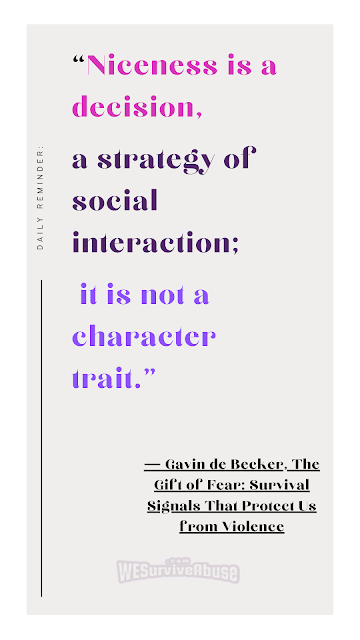
“Niceness is a decision, a strategy of social interaction; it is not a character trait.”

“It is understandable that the perspectives of men and women on safety are so different–men and women live in different worlds…at core, men are afraid women will laugh at them, while at core, women are afraid men will kill them.”

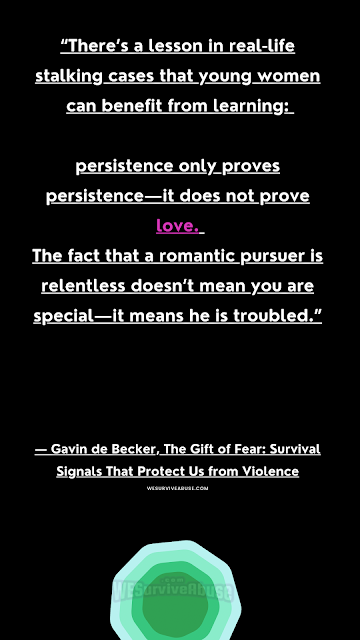
“There’s a lesson in real-life stalking cases that young women can benefit from learning: persistence only proves persistence—it does not prove love. The fact that a romantic pursuer is relentless doesn’t mean you are special—it means he is troubled.”

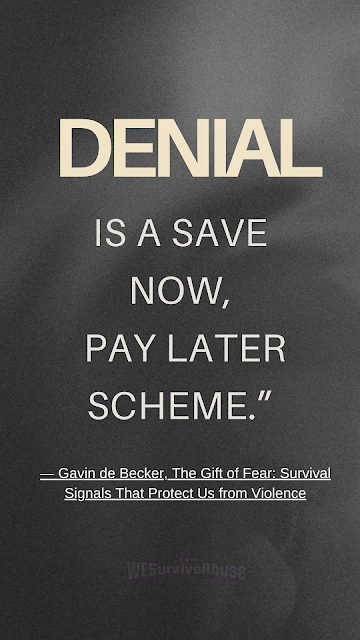
Denial is a save now, pay later scheme.”

“If you tell someone ten times that you don’t want to talk to him, you are talking to them—nine more times than you wanted to.”

“The solution to violence in America is the acceptance of reality”

“Believing that others will react as we would is the single most dangerous myth of intervention.”

“We must learn and then teach our children that niceness does not equal goodness. Niceness is a decision, a strategy of social interaction; it is not a character trait. People seeking to control others almost always present the image of a nice person in the beginning. Like rapport-building, charm and the deceptive smile, unsolicited niceness often has a discoverable motive.”

“Only human beings can look directly at something, have all the information they need to make an accurate prediction, perhaps even momentarily make the accurate prediction, and then say that it isn’t so.”


If you have not read this book yet please make 2024 (well 2026 now) the year that you read The Gift of Fear by Gavin de Becker

Each and every woman and every person who cares about a woman ought to read this book from cover to cover. 


Spread the love