updated from April 21, 2026 Her Fear Is Not Yours to Edit The women and children whom society listens to the least suffer the most intense,
updated from April 21, 2026Her Fear Is Not Yours to Edit
The women and children whom society listens to the least suffer the most intense, torturous, and excruciating harm.
There is a pattern that keeps showing up, and it needs to be named plainly.
A woman reports a concerning interaction with a man. She names discomfort. She describes pressure. She says a boundary was crossed. She describes her fears based on facts.
And almost immediately, someone steps in with his résumé.
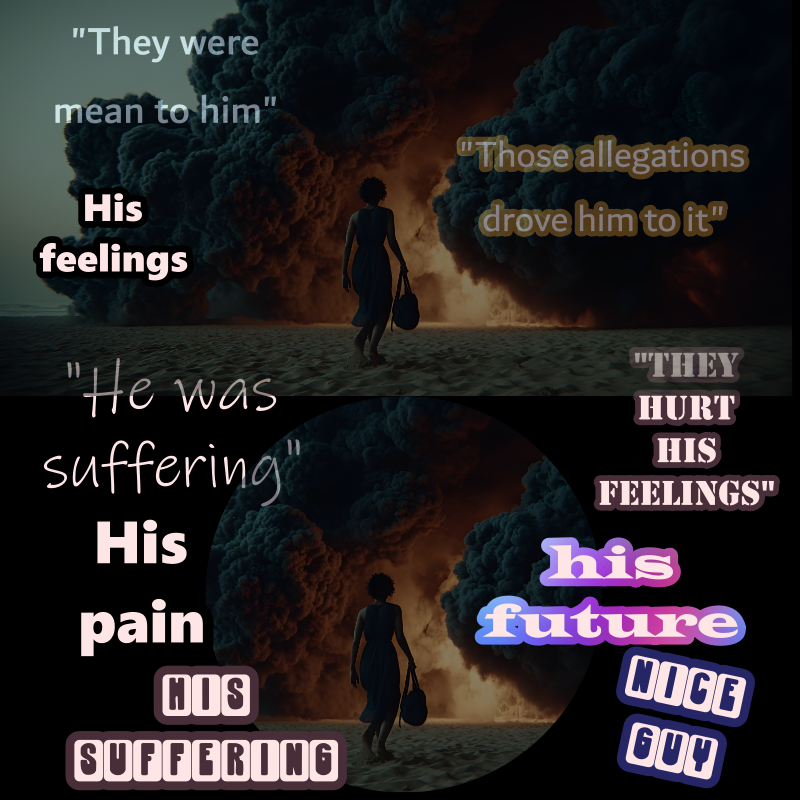
“He’s always been respectful.” “He’s never done that to me.” “He’s a good boy.” “What about his future?” — after he robbed someone else of theirs.
Now the focus has shifted.
Not to what she experienced. Not to what she is navigating. Not to what risk might be present.
The focus becomes defending him.
And in that moment, something dangerous happens: her safety gets debated instead of respected.
Let’s be direct.
No one has the authority to pre-approve which men a woman is allowed to fear.
Not a friend. Not a colleague. Not a family member. Not a community.
Fear is not a group decision. It is a signal. It is information moving through the body faster than language. It is pattern recognition built from experience, observation, and survival.
Dear Enabler: no one is allowed to tell a woman which fears she’s allowed to have. Every human being deserves safety and respect. We find — or we create — new ways to make that happen, without pushing the needs of women and children aside.
It is the mind and body working together to say: pay attention.
And if we are serious about safety — real safety, not performance — we have to be honest about something deeper.
We do not arrive at the headlines first.
We do not start with family annihilations. We do not start with mass shootings. We do not start with the shooting of children.
Those are the outcomes. Before that, there were moments.
Moments where someone felt uneasy. Moments where someone spoke up. Moments where something did not sit right.
And in those moments, the people closest to the risk were often overruled. Dismissed. Smoothed over. Told to reconsider — not reconsider the facts, but soften her feelings about the facts.
If we want safety, we have to start earlier.
We have to listen to those in the crosshairs of vulnerability — women and children navigating the behavior of the men around them. Because male violence against women and children is escalating. Globally.
And still, we hesitate.
Still, we debate tone. Still, we defend reputation. Still, we ask women to soften what they already know.
That hesitation has a cost.
There’s a line most people credit to Einstein: if you always do what you’ve always done, you’ll always get what you’ve always gotten. Sometimes people put their own flavor on it — you’ll hear it carried in the voice and timing of Moms Mabley, sharp, knowing, not interested in pretending. Nowadays everybody takes credit for that saying. Funny how it only gets quoted when the subject is making more money — never when the subject is keeping women and children safe.
The truth of it hasn’t changed.
If we keep overriding early warnings, if we keep prioritizing comfort over clarity, if we keep defending familiarity instead of examining risk — we will keep getting the same outcomes.
So let’s say it plainly, in the language of right now:
If we keep dismissing early warnings, we should not be surprised by late-stage consequences.
A man’s charm is not evidence of safety. It is evidence of range.
A person can be kind in one setting and harmful in another. They can be well-liked publicly and dangerous privately. They can build trust broadly and violate it selectively.
So when a woman speaks, the question is not: “Has he ever been good to me?”
The question is: “What is she telling me right now?“
And if you cannot offer her protection, then at minimum, offer her respect.
Do not override her. Do not negotiate her instincts. Do not position yourself as the filter between her experience and her decision-making.
She is not asking for permission. She is making an assessment. And she has the right to act on it without being managed, softened, or corrected.
You do not get to decide which risks she takes seriously. You do not get to approve which men she avoids. You do not get to rewrite her sense of safety so it better fits your comfort.
A woman who pays attention to her instincts is not overreacting. She is informed.
And in a world where harm so often hides behind familiarity, politeness, and reputation — that awareness is not excessive. It is necessary.
Her safety is not a debate.
And her fear is not yours to edit.
Here are 11 signs you’re offering a character reference instead of listening:
- You reach for his résumé before you’ve asked what happened to her. “He’s a good guy” comes out before “Are you okay?”
- You measure his behavior only by what he’s done to you. “He’s never done that to me” treats your experience as the ceiling of what’s possible, not one data point among many.
- You ask her to soften her language before you engage with what she said. “Maybe don’t say ‘scared,’ say ‘uncomfortable.'” You’re editing her account, not hearing it.
- You bring up his future before you’ve acknowledged what he cost someone else. His potential becomes the priority; her present reality becomes an inconvenience to it.
- You position yourself as the referee between her and her own instincts. “I think you’re overreacting” said with authority, as if her nervous system needs your approval to be valid.
- You require proof before you’ll offer belief. Not curiosity — a formal burden of evidence, applied selectively, and usually only to her.
- You change the subject to his character the moment risk comes up. Risk assessment gets rerouted into a referral letter.
- You treat his charm as evidence of safety rather than range. Public warmth becomes a shield against private accountability, and you’re the one holding it up.
- You go quiet when the group consensus doesn’t match hers. Silence in that moment isn’t neutral — it tells her the room has already sided against her account.
- You frame her caution as damage to his reputation, not information about her safety. The conversation becomes about what she might cost him, not what he might have already done to her.
- You wait for a headline before you take an early warning seriously. You already know the moments before the outcome exist — you just haven’t decided they count yet.
The through-line in all eleven: none of them are about her being wrong. They’re about someone else deciding that her being right is inconvenient.