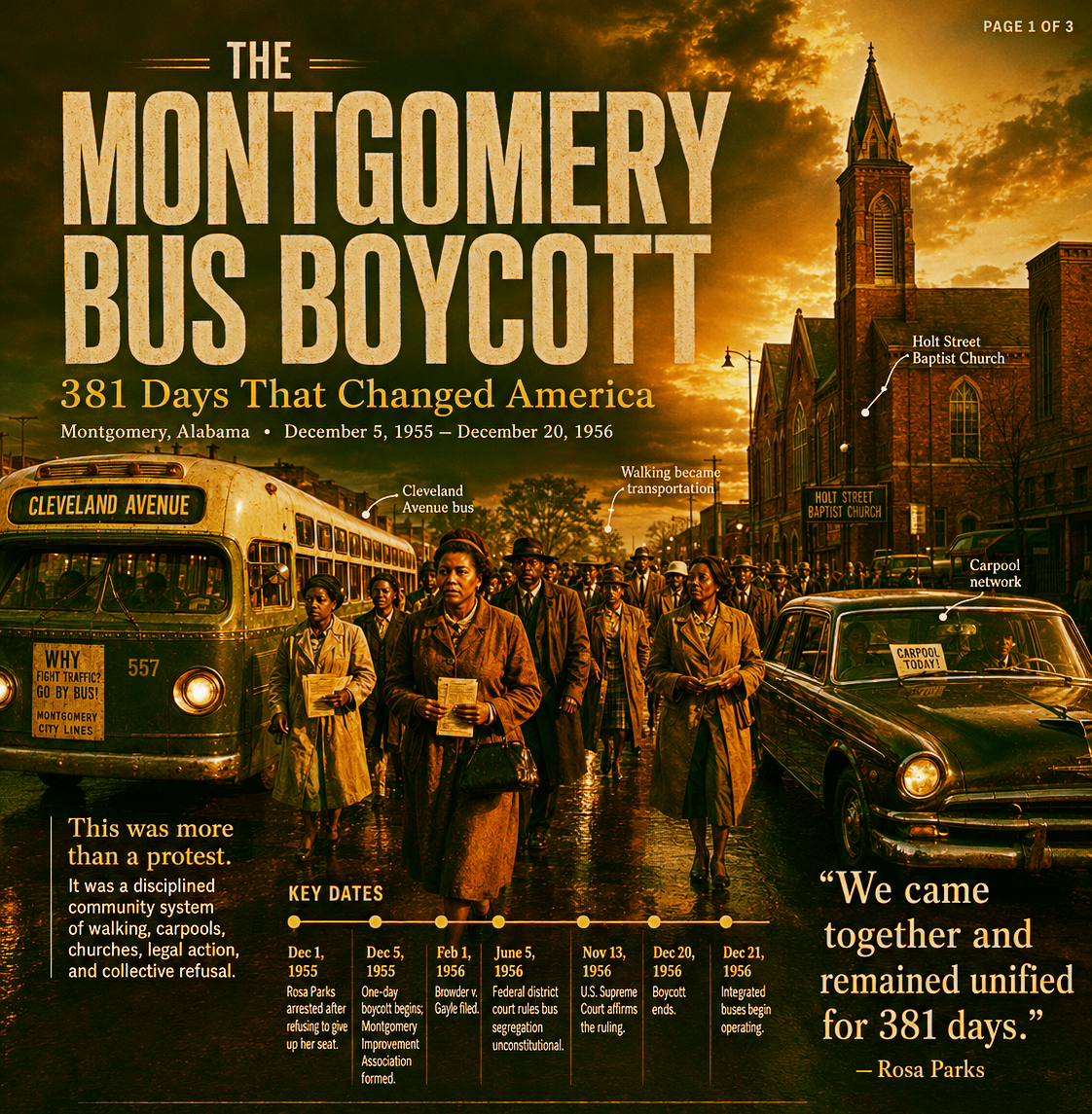
Since those who seek to despoil study, you have to be a student too..... The Montgomery Bus Boycott teaches something deeper than “Rosa
Since those who seek to despoil study, you have to be a student too…..
The Montgomery Bus Boycott teaches something deeper than “Rosa Parks sat down and people got mad.”
That is the child’s version.
The adult lesson is this: Black people in Montgomery built a disciplined system. They made their labor, money, feet, churches, cars, kitchens, courage, legal strategy, and shared memory move in one direction.
That is why it worked.
The boycott lasted from December 5, 1955, to December 20, 1956. It challenged segregated seating on Montgomery city buses and ended after the U.S. Supreme Court affirmed that bus segregation was unconstitutional.
But dates alone do not teach the lesson.
The real lesson is in the discipline.
1. Know your own history before other people turn it into a lesson plan for themselves.
Everybody studies Black history because Black people have repeatedly shown the world how to resist under pressure.
But when other people study our history and we do not, they extract the tactics and leave us with the slogans.
They learn the strategy.
We inherit the poster.
That cannot be enough.
The Montgomery Bus Boycott was not just a proud moment. It was a blueprint. It showed how a people under pressure could organize money, transportation, messaging, legal action, church networks, and community discipline into one force.
That is not nostalgia.
That is instruction.
2. It was not spontaneous. It was organized.
The boycott is often told as one tired woman making one brave choice.
Rosa Parks was brave, yes. But she was not random. She was trained, connected, disciplined, and already part of a larger civil rights network. Claudette Colvin and others had kept their seats before Rosa Parks. But Claudette Colvin was a child carrying a child. It would have been immoral for any movement to put her on the front lines knowing what type of violence a Black woman, pregnant or not, was potentially up against.
Her Name Is Mary Turner. Her Story Still Speaks. – WESurviveAbuse
The Women’s Political Council, led by Jo Ann Robinson, had already been warning city officials about the mistreatment of Black riders. When Rosa Parks was arrested, there were people ready to move.
That matters.
Movements need preparation before the “moment” arrives.
What looks sudden to the public is often the result of years of people meeting, writing, planning, noticing patterns, saving names, building trust, and waiting for the right opening.
The spark mattered. But so did the wood.
3. Black women were the engine.
Rosa Parks, Jo Ann Robinson, the Women’s Political Council, domestic workers, mothers, teachers, church women, and everyday Black women carried much of the weight.
Many were the ones riding those buses.
They were the ones being insulted, forced to stand, told to move, expected to swallow humiliation, and still show up to work.
They were also walking long distances, organizing rides, feeding people, making calls, passing messages, keeping records, encouraging tired neighbors, and holding the line.
When history removes Black women from the machinery of change, it is not history.
It is editing. And that editing weakens us because it hides where so much of the power actually came from.
4. They were singularly focused.
This may be one of the most important lessons for now.
The Montgomery community was not made up of people with only one concern. They had many.
People were dealing with poverty, bad wages, domestic pressures, racist policing, housing issues, health problems, school concerns, church politics, family obligations, and the daily exhaustion of living under Jim Crow.
They were not people with simple lives.
They were people with many burdens.
But for the boycott, they came together around one mission.
End the humiliation and segregation on Montgomery buses. That focus mattered.
They did not allow every other concern, no matter how real, to hijack the mission.
They did not turn the boycott into a long list of purity tests where everyone had to agree on every issue before they could walk together.
They did not let mission drift swallow the work.
They understood something we need to remember: a coalition does not require everyone to be identical. It requires enough shared discipline to move together where the mission is clear.
Hate is often focused. Love has to learn focus too.
Not soft focus.
Not vague goodwill.
Focused love.
Love with a schedule.
Love with a carpool.
Love with a legal strategy.
Love with enough discipline to say, “That issue matters, but this is the mission we are carrying right now.”
That is how movements keep from being scattered to death.
5. Economic pressure matters.
Black riders were a major part of the bus system’s customer base. When they stopped riding, the city and bus company felt it.
That is one of the enduring lessons of the boycott.
Dignity has economic force when people act together.
The boycott was not only moral pressure. It was financial pressure. It said, “You cannot keep taking our money while treating us as though we are beneath you.”
Where your money goes, your power goes.
Where your absence hurts, your presence has value.
Montgomery understood that.
6. They built alternatives, not just complaints.
People did not simply say, “We refuse.”
They created carpools.
They coordinated rides.
People walked.
Churches became organizing hubs.
Kitchens became planning rooms.
Phones became organizing tools.
Feet became transportation.
That is the part many people miss.
A boycott without infrastructure becomes exhaustion.
A boycott with infrastructure becomes power.
It is not enough to reject what harms you. You have to build a way to live without it.
That is where the genius was.
The Montgomery Bus Boycott was not only a protest. It was a replacement system.
7. Unity did not mean ease.
People lost jobs.
Homes were threatened.
Leaders were arrested.
Martin Luther King Jr.’s home was bombed.
People were harassed, watched, pressured, and frightened.
Still, the community kept going.
Unity did not mean everybody woke up inspired every day.
Unity did not mean there was no fear, no fatigue, no disagreement, no private worry.
Unity meant shared discipline when fear arrived.
That is a different kind of strength.
It is easy to admire courage after the danger is over. It is harder to understand what courage costs while people are still living inside the threat.
Montgomery teaches that courage is not always loud.
Sometimes courage is putting on your shoes before sunrise and walking anyway.
8. Leadership was layered.
Martin Luther King Jr. became a national figure through the boycott, but he was not the whole movement.
There were lawyers, ministers, organizers, drivers, printers, cooks, donors, walkers, strategists, elders, young people, and working people whose names never became famous.
That is how real movements work.
No liberation movement survives on one hero.
Hero-only history weakens people because it hides the system behind the victory.
It makes us think change comes from charisma alone.
It does not.
Change comes from people knowing their role and respecting the roles of others.
Somebody speaks.
Somebody drives.
Somebody prints.
Somebody cooks.
Somebody watches the children.
Somebody raises the money.
Somebody files the case.
Somebody walks.
Somebody keeps the records.
Somebody reminds everybody why they started.
That is layered leadership.
That is power with roots.
9. The courts mattered, but the people created the pressure.
The legal case mattered.
The Supreme Court ruling mattered.
But the courts did not move in a vacuum.
The people created moral, political, and economic pressure that made the legal fight impossible to ignore.
Courtroom strategy and community strategy had to work together.
That is another lesson worth keeping.
A legal victory without community pressure can be delayed, weakened, ignored, or reversed in spirit.
A community movement without legal strategy can be punished, trapped, or worn down.
Montgomery used both.
They had feet in the street and arguments in the court.
They had walkers and lawyers.
They had prayer meetings and petitions.
They understood that freedom work needs more than one tool.
10. Their power did not come from trying to look acceptable. It came from discipline.
The Montgomery Bus Boycott is often softened into a story about polite people asking politely to be treated decently.
But that is not what made it powerful.
These were Black people living under a harsh and dangerous racial system. They answered it with planning, courage, restraint, coordination, and deep community commitment.
They were not being passive.
They were being strategic.
They knew when to speak, when to walk, when to withhold their money, when to organize rides, when to go to court, and when to keep going after threats came.
That was not weakness.
That was power under control.
11. Memory is not just remembrance. It is protection.
The biggest lesson may be this: if you do not know what your people built, other people will study it, package it, sell it, quote it, teach it, and use the methods while telling you to calm down.
So yes.
People are studying your history.
You better know your own.
Not to worship the past.
To recognize the blueprint.
The Montgomery Bus Boycott teaches us that power is not only in protest.
Power is in preparation.
Power is in transportation.
Power is in communication.
Power is in money discipline.
Power is in legal strategy.
Power is in spiritual stamina.
Power is in collective refusal.
Power is also in focus.
A coalition can carry many people without carrying every argument into the center of the mission.
That is a hard lesson, but it is necessary.
Because a people can be right about many things and still lose direction.
A people can have many wounds and still need one shared task.
A people can care deeply and still need to say, “This is the work in front of us right now.”
The Montgomery Bus Boycott worked because people knew what they were refusing, what they were building, and why they had to stay together long enough to win.
A people who can walk together for 381 days can teach the world something about power.
A people who forget how they did it may find themselves begging for lessons from those who studied them.
So study the shoes.
Study the carpools.
Study the women.
Study the churches.
Study the money.
Study the legal strategy.
Study the focus.
Study the discipline.
Because Black history is not only what happened.
It is what was built.
And what was built once can teach us how to build again.
Civil Rights Treasures from the March on Washington: Gloria Richardson – WESurviveAbuse
The Women Behind the Victorious Montgomery Bus Boycott – WESurviveAbuse
Claudette Colvin: The Young Revolutionary Who Moved a Nation – WESurviveAbuse
Her Name Is Mary Turner. Her Story Still Speaks. – WESurviveAbuse
Juneteenth: Proof That Even Our Freedom Is Seen as “Too Much” – WESurviveAbuse
📢 Hidden Herstory: The Leesburg Stockade Girls – WESurviveAbuse
@flforallvote THAT’S IT @dulcesloan 👏🏽👏🏾👏🏿 #FreedomForAll #FundOurFutures #FloridaForAll ♬ original sound – FLForAllVote
@thatjazleegirl Once they have the ability to do that… who knows what these people will try to change
@thatjazleegirl All they need is ONE to show that an amendment can be ratified.