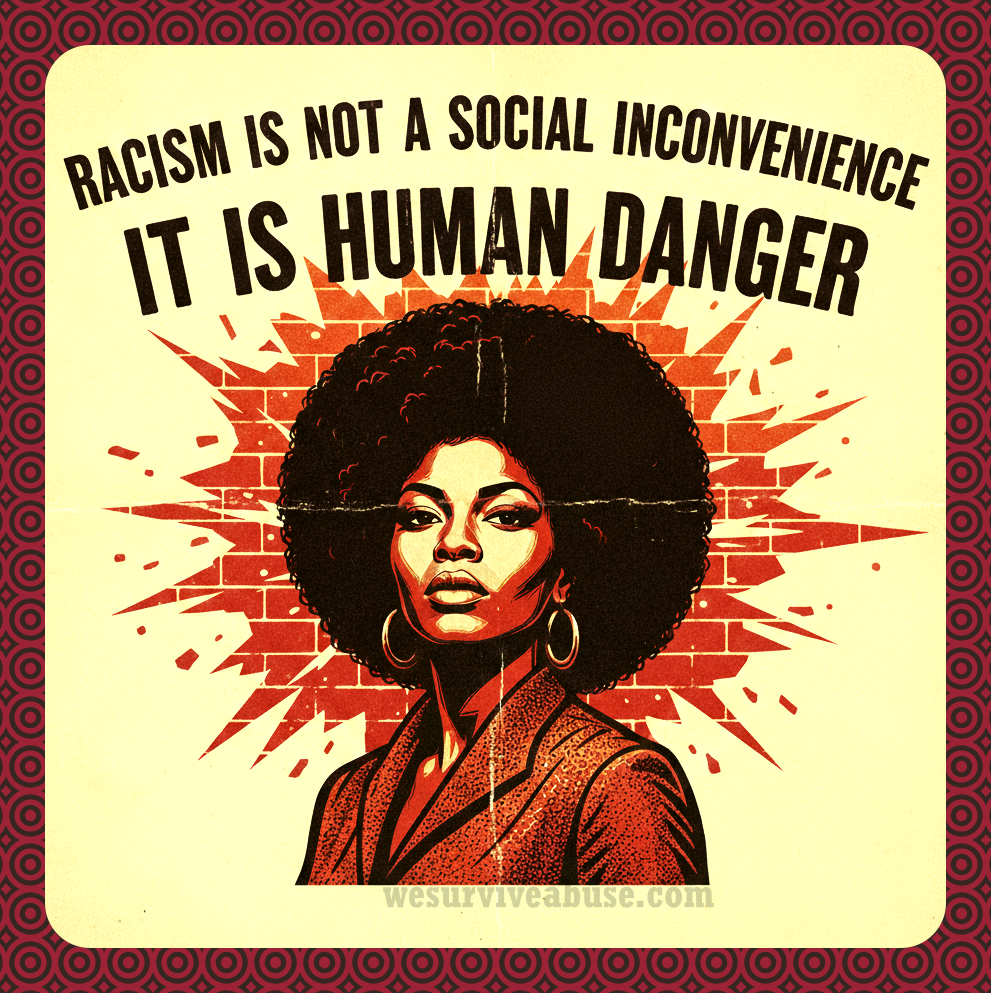
Many Black people have endured generations of: “It’s not that bad.”“You’re overreacting.”“They didn’t mean it.” That pattern is its own harm. “Raci
Many Black people have endured generations of:
“It’s not that bad.”
“You’re overreacting.”
“They didn’t mean it.”
That pattern is its own harm.
“Racism is like a Cadillac.
They bring out a new model every year.”
Swallowing the fire
Smile stitched across breaking bones
Silence screams inside
Racism is not merely offensive.
It can be:
• identity-eroding
• stress-inducing
• reality-distorting
• socially isolating
• health-damaging
There is nothing small about something you must metabolize every day.
Because racism is often harmful not only when it is:
• overt
• explosive
• unmistakably hostile
But when it is:
• constant
• subtle
• ambiguous
• normalized
• dismissed
• rationalized
That ambiguity itself destabilizes people.
“Did that just happen?”
“Am I imagining this?”
“Should I respond?”
“Will I be punished if I do?”
That mental taxation is real.
Even “lower-intensity” exposures are not harmless when they are chronic.
A single drop vs a flood.
The nervous system lives in the flood.
“Racism is not about how you feel.
It’s about what you’re allowed to do.”
– Dick Gregory
Major bodies of research in:
• public health
• psychology
• psychiatry
• stress physiology
have documented that racism can function as a chronic stressor with measurable effects, including: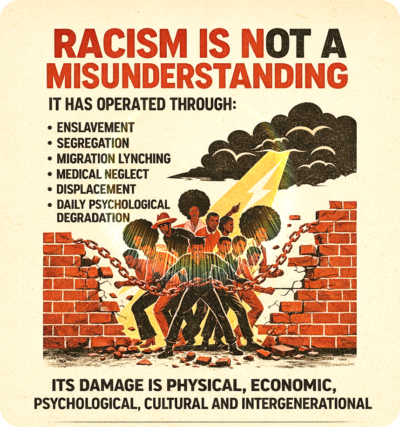
✔ Elevated stress hormones
✔ Increased allostatic load
✔ Higher risk of hypertension
✔ Anxiety and depressive symptoms
✔ Sleep disruption
✔ Trauma-like responses
✔ Increased risk of suicidal ideation
Which are associated with:
• cardiovascular strain
• immune dysregulation
• anxiety and depression
• sleep disruption
• increased suicide risk
This is established knowledge, not opinion.
The repetition, the accumulation, the atmosphere — these are part of what makes racism lethal.
Racism is deadly in its shocks
and in its slow grind.
In the spectacular moments
and the daily abrasion.
In violence
and in erosion.
“Not everything that is faced can be changed,
but nothing can be changed until it is faced.”
Racism is not light.
Not socially.
Not psychologically.
Not physiologically.
It is widely recognized across research and lived experience as a threat to:
• mental health
• physical health
• sense of safety
• identity stability
• nervous system regulation
• overall well-being
And yes — for many people — a threat to sanity when the exposure is chronic, invalidated, or inescapable.
Racism is not merely dislike.
It is a system of dehumanization with material consequences.
Politeness revoked
Dignity is not silence
I stand. Unmuted.
“They demand patience from those who suffer
and tolerance from those they wound.”
Upon Reflection
Who is allowed anger?
Who is allowed boundaries?
Who is told to endure?
It is reasonable to need acknowledgment when harm is experienced.
Racial harm should never be treated as inconsequential.
| Health Domain | Common Impacts |
| Physical Health | Higher blood pressure, heart disease, diabetes, and increased maternal/infant mortality. |
| Mental Health | Chronic stress, racial trauma, hypervigilance, depression, and anxiety. |
| Structural/Systemic | Environmental racism (e.g., air pollution in redlined areas), medical bias, and lack of insurance. |
Race, Inequality, and Health
Kaiser Family Foundation (KFF): Race, Inequality, and Health A comprehensive 2025 report detailing how racism leads to higher rates of chronic illness, maternal mortality, and lower life expectancy for people of color. View the KFF Report
Mental Health Foundation: Racism and Mental Health An overview of how racial trauma leads to higher rates of depression, anxiety, and PTSD, as well as the impact of being “on guard” against discrimination. Read the Mental Health Summary
National Institutes of Health (NIH): The Effect of Racial Discrimination This study examines the “weathering” effect—how the chronic stress of racism leads to physiological wear and tear, including higher cortisol levels and increased risk for cardiovascular disease. Read the NIH Study
World Health Organization (WHO): Tackling Structural Racism The WHO discusses how ethnicity-based discrimination increases vulnerability to health risks and reduces access to quality services globally. Explore WHO Activities
American Medical Association (AMA): Racism as a Public Health Threat The AMA recognizes racism as a serious threat to public health and a barrier to effective medical care, outlining policies to dismantle systemic racism in medicine. Read the AMA Statement
CDC: Racism and Health The Centers for Disease Control and Prevention (CDC) officially declared racism a “serious public health threat,” highlighting how it creates inequities in social determinants of health. Visit CDC Website