Table of Contents
Women are not responsible for fixing every wound the world refuses to face.
When people talk about ending rape, sexual violence, and rape culture, one group often gets handed the microphone, the clipboard, and the responsibility: feminists.
But here’s an important question:
Why is ending rape treated like a “feminist issue” instead of a human issue?
Let’s talk about it in simple, honest FAQ form.
FAQ: Why Isn’t It Just Feminists’ Job to End Rape?
Q: Haven’t feminists been leading the fight against rape for decades?
Yes.
Feminists have done a tremendous amount of work to bring sexual violence out of silence.
Many people today understand concepts like consent, victim blaming, coercion, marital rape, workplace harassment, and rape culture because feminists pushed these conversations into public view—often while being mocked, ignored, or attacked.
Feminists helped build:
- Rape crisis centers
- Domestic violence shelters
- Survivor advocacy movements
- Campus accountability conversations
- Public education about consent, coercion, and grooming
- Legal reforms around domestic and sexual violence
- Workplace sexual harassment training, prevention, and response
That work matters.
And it still matters.
But here is the key point:
Just because feminists started carrying the weight does not mean they should carry all of it forever.
Ending rape culture is everyone’s work, not women’s lifelong assignment.
Q: Why isn’t ending rape just feminists’ responsibility?
Because rape affects everyone.
Survivors exist in every community, family, religion, race, class, profession, and political belief system.
Sexual violence harms:
- Children
- Teens
- Adults
- Elders
- Women
- Men
- Families
- Friend groups
- Entire communities
If the harm touches everyone, then the responsibility belongs to everyone.
Imagine a neighborhood with a fire.
Would it make sense to say:
“Well, only the people who first noticed the fire should put it out.”
Of course not.
Everyone who can help should help.
The same goes for rape culture.
Women do not owe the world endless labor while others enjoy freedom.
We reject the idea that pain caused by systems must be repaired only by those harmed.
Q: What exactly is rape culture?
“Rape culture” describes the beliefs, behaviors, jokes, systems, and excuses that make sexual violence easier to commit—or easier to ignore.
It can look like:
- Laughing off sexual harassment
- Blaming survivors for what they wore or drank
- Pressuring people after they say “no”
- Protecting popular or powerful abusers
- Treating consent like a technicality instead of a requirement
- Staying silent because confronting harmful behavior feels uncomfortable
- Name-calling, threatening, and slurring people who raise genuine concerns around safety, violence, and abuse.
Rape culture is not only about individual criminals.
It is also about the everyday habits that help violence hide.
And because culture belongs to all of us, changing culture belongs to all of us too.
Q: But aren’t feminists already experts on this?
Some are.
Many feminists have spent years studying, organizing, educating, volunteering, and supporting survivors.
That expertise matters.
But expertise is not the same thing as obligation.
Knowing more about a problem does not mean someone should be expected to solve it alone.
Think about doctors.
Doctors understand health problems deeply. But we still expect communities, schools, governments, families, workplaces, and individuals to help improve public health.
The same logic applies here.
Feminists can contribute leadership and insight.
But ending rape cannot depend only on feminists doing emotional labor forever. We can demand change without becoming the world’s unpaid repair team.
The work of safety belongs to every body, every home, every institution, every community.
Q: What is emotional labor, and why does it matter here?
Emotional labor is the exhausting work of constantly:
- Explaining basic problems
- Correcting misinformation
- Teaching empathy
- Responding to defensiveness
- Comforting Survivors
- Challenging harmful behavior
- Repeat, repeat, repeat
Too often, feminists—and Survivors themselves—are expected to educate everyone else while also carrying their own pain.
That is unsustainable.
People sometimes say:
“Why don’t feminists teach men better?”
But a better question may be:
Why are so many people waiting to be taught instead of choosing to learn?
Ending rape culture requires participation, not spectatorship.
Q: So whose job is it?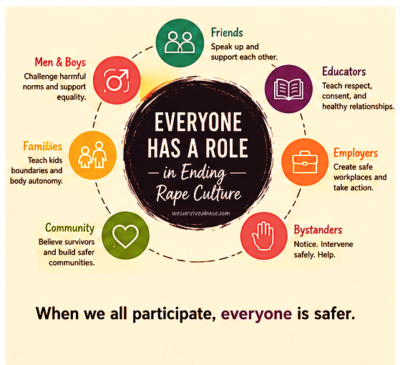
Short answer?
Everyone’s.
Different people have different roles.
Friends
Speak up when someone crosses boundaries, brags about coercion, or treats consent like a joke.
Parents and caregivers
Teach children about body autonomy, respect, and consent early—not just danger.
Schools
Teach healthy relationship skills and consent in age-appropriate ways.
Faith communities
Stop protecting harmful people to avoid embarrassment.
Employers
Take harassment seriously.
Media creators
Stop romanticizing coercion or ignoring accountability.
Men
Challenge harmful behavior among other men instead of staying silent.
Bystanders
Intervene safely when something feels wrong.
Community members
Support Survivors instead of interrogating them.
This is not about blame.
It is about participation.
Q: Why do people often expect feminists to handle it?
Sometimes because feminists are the people already speaking up.
Sometimes because society has a habit of pushing difficult emotional work onto women and marginalized people.
And sometimes because people feel uncomfortable.
It can feel easier to say:
“The activists are handling that.”
But sexual violence is too widespread and too serious to outsource.
No movement can fix a culture if the culture refuses to participate.
Q: Does saying “everyone’s responsible” mean no one is accountable?
No.
People who commit harm are responsible for their actions.
Full stop.
But preventing violence takes more than punishing individuals after the damage is done.
It also means creating environments where harmful behavior is challenged earlier, consent is respected, and survivors are believed.
Prevention works best when many people are involved.
Q: What if I’m not a feminist? Can I still help end rape culture?
Absolutely.
You do not have to identify as feminist to:
- Respect consent
- Believe survivors
- Challenge harmful behavior and policies
- Teach young people respect
- Refuse rape jokes
- Support safer communities
You just have to care enough to participate.
This is bigger than labels.
Ending sexual violence should not depend on whether someone joins a movement.
It should depend on whether they care about human dignity.
Q: What’s one thing people can stop doing immediately?
Stop treating sexual violence prevention like somebody else’s assignment.
Not feminists’.
Not Survivors’.
Not advocates’.
Not “women’s groups.”
Everyone’s.
Because here’s the truth:
When only a small group is expected to fix a massive cultural problem, burnout happens.
When more people join the work, change becomes possible.
Final Thought
Feminists have carried an enormous amount of this work for generations.
That deserves recognition.
But recognition is not the same thing as recruitment.
If we truly want to end rape culture, the answer is not to pile more responsibility onto feminists.
The answer is to recruit more people.
More listeners.
More interrupters.
More educators.
More accountable friends.
More people willing to say:
“This matters to me too.”
Because ending rape was never supposed to be a one-group job.
It has always been everyone’s work.
The deal is simple: no more outsourcing humanity’s healing to women.
Why Is Every Problem Affecting Women Treated Like Feminism’s Job to Solve? – WESurviveAbuse
When “Nothing Will Happen” Isn’t a Safety Plan: Asking About Real Safeguards – WESurviveAbuse
We Called It Rape Culture for a Reason. And That Reason Still Exists – WESurviveAbuse
Dehumanization Has Habits. So Does Liberation – WESurviveAbuse
The Old Code of Chains: A Timeline of Control Over Women’s Privacy and Safety – WESurviveAbuse
💔 Understanding Marital Rape: Consent Still Matters – WESurviveAbuse
A Brief Timeline: Marital Rape Laws in the West – WESurviveAbuse
No, Feminists Didn’t “Give Up a Happy Home.” We Fought to Escape a Cage – WESurviveAbuse
Boundaries Are Freedom in Disguise: Reclaiming What History Tried to Take – WESurviveAbuse
If the Harm Is Precise, Our Words Must Be Precise – WESurviveAbuse
Black Women Do Not Ever Have to Sacrifice Safety to Prove Solidarity – WESurviveAbuse
The Bench at Maple and Ninth: When Men Decide Whether Women Get Boundaries (audio) – WESurviveAbuse