I get when some groups defend some aspects of abusers. I've slipped (more than once) and done it too. I'm a human. I still have a duty to push bac
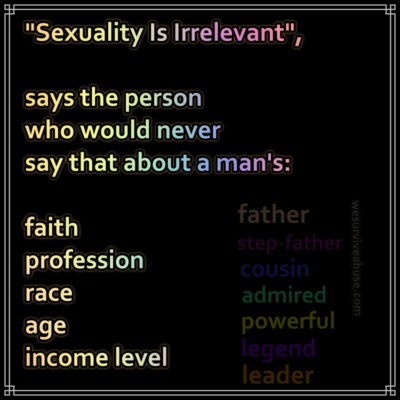 I get when some groups defend some aspects of abusers. I’ve slipped (more than once) and done it too. I’m a human.
I still have a duty to push back because some victims are surviving and that’s their absolute best. Others, aren’t here anymore to have their say. The pain others have no time, balm, or depth for……
It is a survival imperative to push back when identity is weaponized to protect abusers.
When communities defend abusers because they share a race, religion, political affiliation, social identity, gender identity, or sexual orientation, they are not protecting the identity—they are shielding harm. They are saying:
“Your pain is less important than the image of the group.”
I get it. Flinching is a human instinct.
And, that is a profoundly violent message. It tells the victim that loyalty matters more than safety, that silence is the price of belonging, and that abuse can be forgiven if the abuser sits inside the “right” category.
Victims are under no obligation to hold onto identities that betrayed them. In fact:
🔥 Identity is a SACRED bond—not a trap
Identity is supposed to offer:
safety
belonging
language
shared meaning
continuity of self
When an identity structure—whether cultural, political, or communal—chooses image over truth, the relationship is broken. The victim didn’t destroy it; the silence did.
🛑 Identity does not outrank humanity
A victim who pushes back is not being “divisive.”
They are asserting the oldest human truth:
What harms me cannot claim to represent me.
If a community, movement, or ideology demands that:
you stay quiet because the abuser is a “pillar,”
you protect men or leaders because they do good work,
you sacrifice yourself for the reputation of the group, or
your suffering is an inconvenience,
then the victim is not leaving their identity—
the identity left them.
🧠 This is a core principle in healing work
Survivors often need to renegotiate or reclaim identity after betrayal. Trauma doesn’t just injure the nervous system—it breaks meaning. If identity was used as a muzzle, the Survivor’s pushback is a form of psychological self-rescue.
🕯️ A victim’s truth does not threaten identity
It refines it. It purifies it.
It says:
“The group is not entitled to my silence.”
Healthy identities survive truth.
Fragile identities demand secrecy.
A movement, faith, culture, or community worth belonging to must be strong enough to face the harm done by its own members. If it cannot, then it is not an identity—it is a costume. And that’s a HARD truth but a necessary one. It’s all the way up from here. Or, it can be.
Victims reclaim identity when they say:
“This name, this belief, this culture does not include abuse.”
“My body is not collateral damage for your narrative.”
“If truth threatens your identity, the problem is the identity.”
That’s not betrayal.
That’s renaissance.