People closest to power. Belief, in our world, is not evenly distributed. It flows along familiar lines—toward those whose voices already sound “righ
People closest to power.
Belief, in our world, is not evenly distributed. It flows along familiar lines—toward those whose voices already sound “right,” whose language fits established norms, and whose presence feels comfortable to institutions.
Those who are believed without footnotes tend to speak in ways that match:
Institutional language
Academic tone
Cultural comfort
 Dominant narratives
 Dominant narratives
Their words are assumed to be thoughtful.
Their intentions are assumed to be reasonable.
Their experiences are assumed to be representative.
They are trusted first.
Black women rarely receive that kind of trust.
Instead, Black women’s knowledge is often treated as:
Anecdotal
Emotional
Biased
Even when it is deeply informed.
Even when it has been lived daily.
Even when it has been proven repeatedly—often at great personal cost.
This is not accidental.
It is structural.
How This Shows Up in Real Life
Black women speak about what happens to us in healthcare, and we are asked for studies. We name patterns in workplaces, and we are told to “be objective.” We describe harm in feminist spaces, and we are accused of being divisive. We share what we see in our families, communities, and systems—and are told we are too close to it to be trusted.
Meanwhile, the same observations are taken seriously once someone closer to power repeats them.
Suddenly they become “insights.”
Suddenly they are “research-backed.”
Suddenly they are safe to discuss.
The information did not change.
Only the messenger did.
The Burden of Proof Is Uneven
Black women are expected to arrive with receipts already in hand.
We are expected to:
Cite sources
Reference theory
Explain context

Anticipate pushback
Remain calm while doing it
All while speaking about our own lives.
This constant demand for proof sends a quiet but powerful message:
Your word is not enough.
And over time, that message takes a toll.
It teaches Black women to second-guess ourselves.
It trains us to over-prepare.
It encourages us to speak less—or not at all.
Not because we lack knowledge, but because we are tired of defending reality.
Knowledge vs. Legibility
The issue is not that Black women lack understanding.
The issue is that our understanding is often not considered legible to systems built without us in mind.
Legibility favors:
Detachment over lived experience
Polished language over plain truth
Distance over intimacy
Abstraction over embodiment
Black women often speak from proximity—from inside the experience. That closeness is misread as bias, rather than recognized as expertise.
But lived knowledge is not inferior knowledge.
It is knowledge with consequences.
The Cost of Constant Translation
When Black women are forced to translate our lives into acceptable formats, something is lost.
Nuance disappears.
Urgency gets dulled.
Emotion is pathologized.
And the truth arrives too late—or not at all.
This is why so many systems claim they were “caught off guard” by outcomes Black women warned about for years. The warnings were there. They just were not believed.
A Necessary Shift
A more honest question than “Where’s your proof?” would be:
Who am I accustomed to believing?
Whose voice feels familiar to me?
Whose discomfort do I prioritize?
Because belief is not just about evidence.
It is about trust.
And trust is shaped by power.
Closing Reflection
Black women do not lack insight.
We lack the benefit of the doubt.
Our knowledge is not new.
It has simply been dismissed too often.
Belief should not require translation into someone else’s comfort language.
And truth should not need permission to exist.
Listening to Black women does not weaken understanding.
It deepens it.
And any movement, system, or community serious about justice must reckon with this:
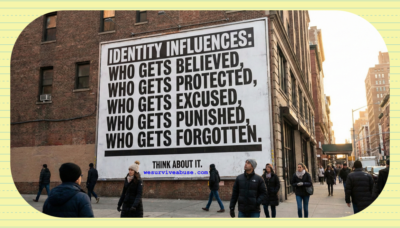
Who gets believed—and why—will always shape whose lives are protected.