
“America has the laws and the material resources it takes to insure justice for all its people. What it lacks is the heart, the humanity.” ~ Shirl
“America has the laws and the material resources it takes to insure justice for all its people.
What it lacks is the heart, the humanity.”
~ Shirley Chisholm
There is a difference between causing harm and participating in the conditions that allow harm to continue.
Naming that difference is not cruelty.
It is how progress begins.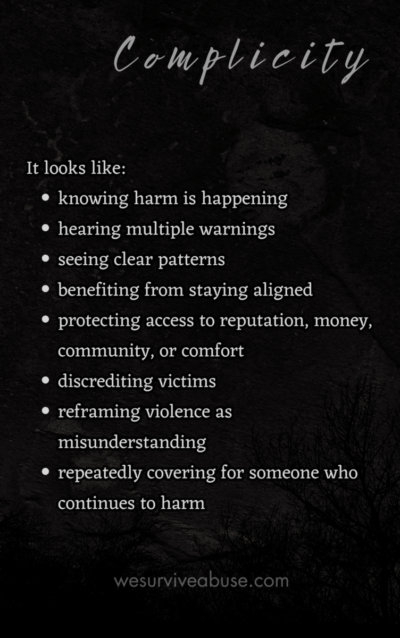
Complicity
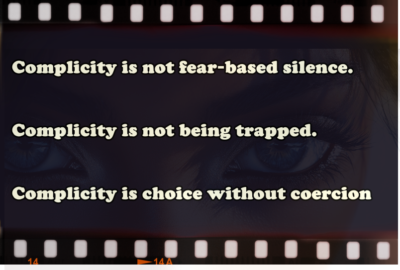
Complicity is not fear‑based silence.
Complicity is not being trapped.
Complicity is choice without coercion. A lot of us have engaged in this at one time or another in our lives. Unless we take the time to name it, claim it, confront it, and deal it…progress stalls. Even worse, it can stop.
It looks like:
- knowing harm is happening
- hearing multiple warnings
- seeing clear patterns
- benefiting from staying aligned
- protecting access to reputation, money, community, or comfort
- discrediting victims
- reframing violence as misunderstanding
- repeatedly covering for someone who continues to harm
And sometimes, when that man finally harms someone publicly, another move appears:
Using the language of women’s protection to avoid accountability.
Hiding behind phrases like:
“Do not blame women.” (the smaller font is intentional because that is small character stuff. Some folks are wearing that song out. A few things are actually our fault. One or two things.)
Not to protect women who actually are coerced.
But a shield to protect themselves from being named for what they chose.
That is not feminism.
That is reputation management.
This is not the same as committing the abuse.
But it is participation in the conditions that allow abuse to repeat.
Not loudly. Not dramatically. But effectively.
As I said, many of us have been guilty of this at one time or another. We may have thought it was the only way, the best way, or what felt right. Many of us can choose differently.
Why naming complicity is not “blame”
Blame says:
You caused his violence.
Accountability says:
You chose your response to it.
Those are not the same statement.
A person can be innocent of the crime and still responsible for their choices around it.
Silence is a choice.
Public loyalty is a choice.
Discrediting women is a choice.
And using women’s pain as a shield to avoid being named is also a choice.
These choices shape whether harm spreads or stops.
Naming that reality is not an attack on women.
It is a refusal to let the language of women’s safety be used to protect people who knowingly stood beside harm.
Violence does not survive through male perpetrators alone. Women have been holding up individual harm doers and entire harmful systems since harm began. The truth will set us free but we have to tell it all.
Violence does not survive through male perpetrators without aid and assistance from female individuals and networks.
Women are human beings. That means we are not only capable of being flawed-we ARE flawed. Sometimes what you did is your fault. You were WRONG. It turns out that pain, suffering and harm has the same impact when women participate or dish it directly too.
The good news though, is that change is a choice. Women are known for changing our minds. That’s our brand.
Telling the truth about participation in harm is not the same as blaming people for violence.
This is not new.
We require people who have a history with betrayal, people who go before parole boards, people requesting forgiveness, people requesting a new beginning, and others to do this all the time. Change requires truths from us all.
Where trust is requested people must see proof that an individual has taken accountability for their part in harm.
Real accountability has weight.
It sounds like:
- naming what we protected
- naming who was harmed
- naming what we ignored
- naming what they benefited from
- naming what we would do differently now
Not excuses.
Not spiritual language.
Not public performances of regret.
But clear ownership of our own choices.
Without that, requests for trust ask others to carry risk they did not create.
That is not reconciliation.
That is displacement.
Recognizing one’s own complicity is not humiliation.
It is character development.
It is the moment someone moves from self-protection to moral adulthood.
It is how people become safer to be near.
A womanist truth
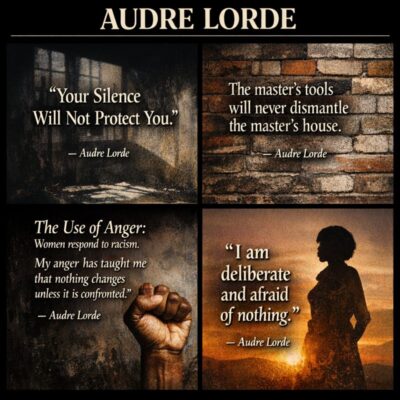
Black women, women across the Black diaspora, women from many Asian cultures, and other women whose cultures taught them to carry pain quietly, where emotional restraint is often mistaken for strength and silence is mistaken for maturity — we were trained early to hold other people’s secrets.
To protect family names.
To protect movements.
To protect men who are called “important.”
To protect institutions that never protected us.
Some of us were coerced into that role.
Some of us survived it.
And some were taught to confuse loyalty with goodness.
We can hold compassion for survival without romanticizing silence that protects harm.
Both truths can live together.
What progress actually requires
Progress does not require turning women into villains.
It does not require erasing fear.
It does not require cruelty.
Clear language.
And moral boundaries that are strong enough to protect the vulnerable.
That means we can say:
- You did not cause his violence.
- You may have been trapped.
- You may have been surviving.
- And some people, without coercion, choose to protect harm.
Those statements do not cancel each other out.
They create clarity.
For Survivors reading this
If you stayed quiet to stay alive — this is not about you.
If you protected your children by moving carefully — this is not about you.
If you were calculating safety minute by minute — this is not about you.
Your nervous system deserves respect.
Your intelligence deserves honor.
But if you were harmed and then watched others protect the person who hurt you…
Your reality also deserves language.
You are not cruel for noticing.
You are not divisive for naming it.
You are not wrong for telling the truth.
Closing
Telling the truth about participation in harm is not the same as blaming people for violence.
It is the difference between a world that manages abuse and a world that finally learns how to interrupt it.
Survivors do not need softer lies.
They need precise truth.
And communities strong enough to hold it.
—
WeSurviveAbuse exists to protect dignity, language, and reality for Survivors everywhere.