Myth 1: “Talking about unfairness is divisive.” Fact: Silence does not create unity. It only hides the wound. When people name unfair treatment, the
 Myth 1: “Talking about unfairness is divisive.”
 Myth 1: “Talking about unfairness is divisive.”
Fact: Silence does not create unity. It only hides the wound.
When people name unfair treatment, they are not breaking the peace. They are revealing where peace was already missing. A fair society does not punish people for naming what harmed them.
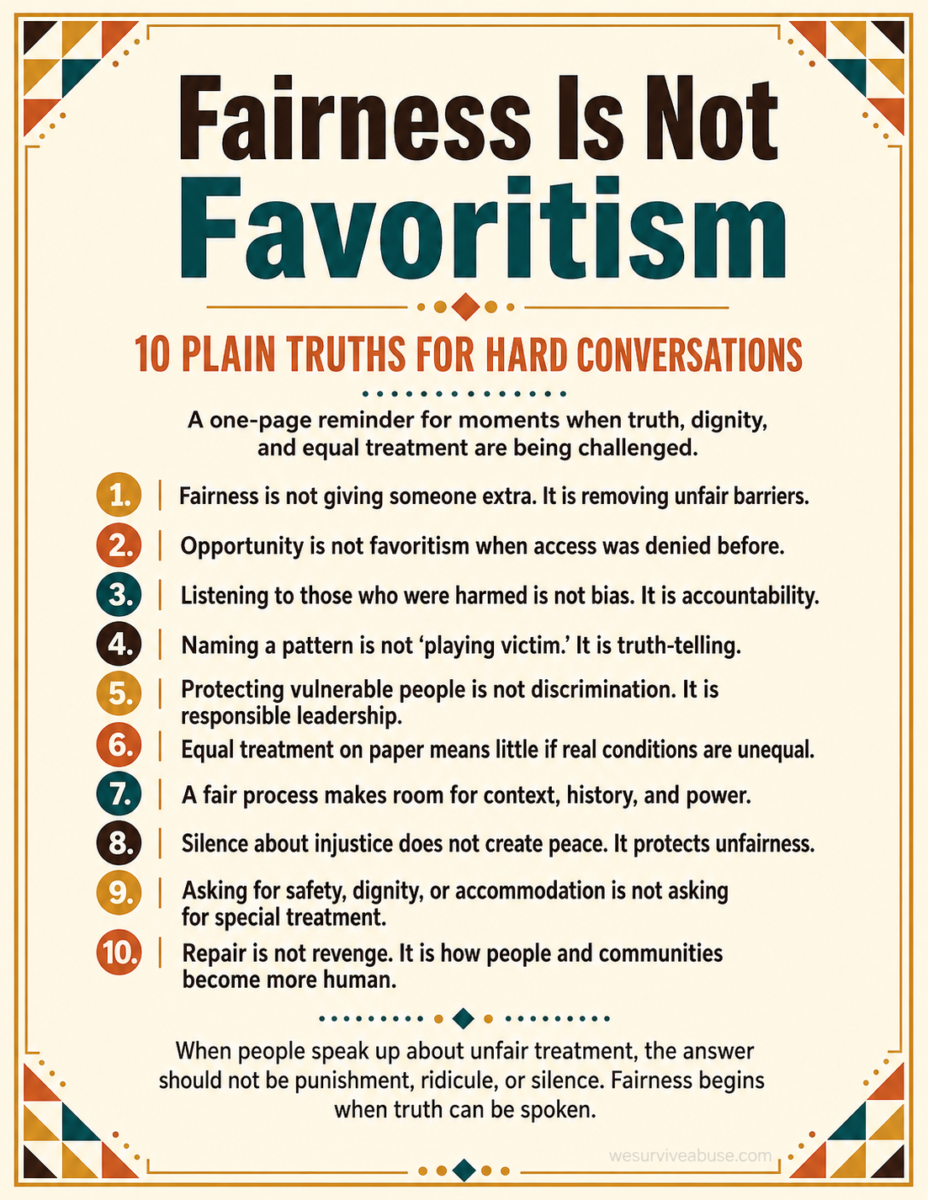
Plain truth: Naming harm is not division. It is the beginning of repair.
Myth 2: “Fairness means giving certain people special treatment.”
Fact: Fairness means noticing when people were blocked, dismissed, underpaid, unsafe, excluded, or punished before they ever had an honest chance.
Special treatment is not the same as removing unfair barriers. A ramp is not favoritism. A translator is not favoritism. A harassment policy is not favoritism. A fair hiring process is not favoritism.
Plain truth: Access to opportunity is not a gift. But access to people is never an entitlement. Fairness opens doors to opportunity. It does not erase anyone’s boundaries.
Myth 3: “If people are truly qualified, they will succeed without support.”
Fact: Many qualified people have been denied opportunity because they lacked access, sponsorship, safety, transportation, childcare, disability accommodations, fair evaluations, or protection from bias.
Talent needs a doorway. Skill needs a chance to be seen.
Plain truth: A locked door can hide excellent people, their gifts, talents, and insights.
Myth 4: “We should just treat everyone the same.”
Fact: Treating everyone the same can still be unfair when people are not standing in the same conditions.
If one person is standing on steady ground and another is standing in a ditch, “same treatment” may preserve the gap. Fairness asks what people need in order to participate with dignity.
Plain truth: Equal words do not always create equal conditions.
Myth 5: “Listening to victims or Survivors creates bias.”
Fact: Listening is not bias. Listening is information gathering.
People who were harmed often understand patterns that outsiders missed, excused, minimized, or benefited from ignoring. A fair process does not automatically believe every detail without review, but it also does not punish people for speaking.
Plain truth: Listening to the harmed is part of accountability.
Myth 6: “People are just playing victim.”
Fact: That phrase is often used to shame people out of telling the truth.
Yes, facts matter. Yes, discernment matters. But dismissing people with “playing victim” protects unfairness by making truth-telling socially dangerous.
Plain truth: Some people -many, many people- are not “playing victim.” They are naming what happened.
Myth 7: “Fairness lowers standards.”
Fact: Unfairness lowers standards by allowing exclusion, favoritism, harassment, retaliation, and closed networks to decide who advances.
Fairness can strengthen standards by making expectations clearer, opening opportunity wider, and requiring decision-makers to explain themselves.
Plain truth: Fairness does not weaken excellence. It exposes counterfeit excellence.
Myth 8: “The past is over, so we should stop bringing it up.”
Fact: The past is not over when its systems, habits, language, wealth gaps, punishments, exclusions, and silences are still shaping the present.
People are not “stuck in the past” because they remember. Often, they are trying to stop the past from being repeated under a new name.
Plain truth: Memory is not the enemy. Denial is.
Myth 9: “If we talk about race, sex, disability, class, or other barriers, we are creating the problem.”
Fact: Naming a pattern does not create the pattern.
The pattern existed before it was named. The naming simply makes it harder to ignore.
Plain truth: The smoke alarm did not start the fire.
Myth 10: “Good people do not need policies.”
Fact: Good intentions are not enough.
Policies matter because harm often happens through habits, loopholes, private decisions, vague standards, and unspoken preferences. Clear rules help protect people when kindness fails, courage disappears, or power gets comfortable.
Plain truth: Fairness needs structure, not just sympathy.
Myth 11: “Asking for safety, dignity, or accommodation is asking for too much.”
Fact: People are allowed to ask for conditions that protect their humanity.
A woman asking for safety is not being difficult. A disabled person asking for access is not being demanding. A worker asking for fair treatment is not being ungrateful. A Survivor asking not to be punished for speaking is not causing trouble.
Plain truth: Dignity is not excess.
Myth 12: “If someone speaks up, they must be trying to destroy someone.”
Fact: Sometimes speaking up is an effort to stop harm, prevent repetition, protect others, or force a system to finally pay attention.
Accountability is not automatically destruction. In many cases, it is the only path left after quieter efforts were ignored.
Plain truth: Truth-telling is not the same as attack.
Myth 13: “Fairness is political.”
Fact: Fairness is human.
People may argue about policies, language, and programs, but the deeper question is simple: should people be blocked, silenced, harmed, mocked, or denied opportunity because others are comfortable with unfairness?
Plain truth: Human dignity should not need a permission slip.
Myth 14: “If unfairness cannot be proven immediately, it should not be discussed.”
Fact: Many harmful patterns are noticed before they are documented.
That does not mean people should be reckless with accusations. It means early noticing matters. Patterns, repeated stories, unequal outcomes, quiet warnings, and lived experience can all point toward something that needs serious review.
Plain truth: Noticing is not a conviction. It is a call to look closer.
Myth 15: “Silence keeps things calm.”
Fact: Silence often keeps things convenient for people with power.
Silence may look calm from the outside while people underneath are swallowing humiliation, fear, exclusion, retaliation, or despair. A quiet room is not always a safe room.
Plain truth: Calm is not the same as justice.