DARVO is a pattern some harmful people use when they are confronted.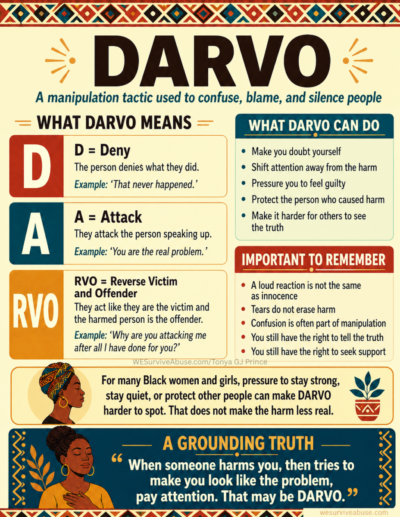
It stands for:
Deny
They deny what happened.
Attack
They attack the person who spoke up.
Reverse Victim and Offender
They act like they are the real victim, and the person they harmed becomes “the problem.”
It may sound like:
“You’re lying.”
“You’re just angry.”
“You’re trying to ruin him.”
“You’re too sensitive.”
“You’re making this about race.”
“She’s bitter.”
“She wanted attention.”
“She knew what she was doing.”
“She’s always been fast.”
“She acts like a man anyway.”
“She’s too strong to be a victim.”
This is why DARVO is so dangerous.
It does not only deny harm.
It gives people a story to repeat.
Instead of asking, “What happened to her?” people begin asking, “Why is she speaking up like that?”
Instead of looking closely at the person who caused harm, people start studying the Black woman or Black girl who told the truth.
Her tone.
Her attitude.
Her past.
Her clothing.
Her face.
Her body.
Her anger.
Her reputation.
Her way of speaking.
Her survival choices.
Her refusal to shrink.
For Black women and Black girls, DARVO can hit differently because it often feeds on stereotypes that are already waiting in the room.
Not always.
But too often.
A Black woman may be painted as:
“angry”
“aggressive”
“lazy”
“bitter”
“jealous”
“masculine/look like a man”
“too strong”
“hard to victimize”
“always starting something”
“trying to destroy a good man”
A Black girl may be painted as:
“fast”
“grown”
“disrespectful”
“sneaky”
“too mature”
“knowing what she was doing”
“not innocent enough”
“old enough to understand”
These stereotypes do harm before the truth even gets a fair hearing.
Sometimes the person using DARVO does not truly know the Black woman or Black girl at all.
They do not know her heart.
They do not know her history.
They do not know what she survived.
They do not know what happened behind closed doors.
So they fill in the gaps with stereotypes.
Then they sell that false story to others.
And because racist and sexist stereotypes are already familiar to many people, the lie can sound “believable” even when it is not true.
That is the trap.
DARVO works by using what people already suspect, fear, or resent.
It can pull in other attackers.
People who were not there.
People who do not know the facts.
People who already carry bias about Black women and Black girls.
People who are eager to defend a man they like, admire, worship with, work with, date, follow, or see as valuable.
Because the perception of truth often leans too heavily on likeability.
If he is liked, DARVO may work faster.
If he is charming, people may protect him.
If he has status, people may excuse him.
If he is calm, people may believe him.
If she is hurt, angry, afraid, or exhausted, people may doubt her.
That is not justice.
That is image management.
And it can make the Black woman or Black girl question herself.
“Did I say it wrong?”
“Did I sound too angry?”
“Will anyone believe me?”
“Am I making too much of this?”
“Maybe I should have stayed quiet.”
That is another layer of harm.
DARVO does not only confuse the community.
It can confuse the Survivor. Survivors of violence, abuse, harm, and trauma are especially at risk of turning blame on ourselves.
It can make her feel like she is on trial for being harmed.
It can make her feel like her pain has to be perfectly packaged before it will be respected.
But a Black woman does not have to be universally liked to be telling the truth.
A Black girl does not have to be quiet, soft-spoken, or “perfect” to deserve protection.
A Survivor can be angry and still be honest.
A person can have flaws and still be harmed.
A person can be strong and still be violated.
A person can talk back and still be unsafe.
A person can survive loudly and still deserve care.
The original question should not be buried:
Who caused harm?
Not who is more popular.
Not who sounds calmer.
Not who has a better public image.
Not who has more friends.
Not who knows how to perform innocence.
Not who can weaponize stereotypes most effectively.
The real questions are:
What happened?
Who was harmed?
Who is being protected?
Who is being blamed?
Who benefits when she is not believed?
When we understand DARVO, we become harder to manipulate.
We stop mistaking charm for truth.
We stop treating Black women’s pain as attitude.
We stop treating Black girls’ survival instincts as guilt.
We stop letting people use racist and sexist stereotypes as evidence.
We stop joining the crowd just because the crowd feels certain.
A simple reminder:
When someone is confronted with harm and quickly turns the room against the person who spoke up, slow down.
Do not join the pile-on.
Do not rush to defend the most liked person.
Do not confuse calmness with innocence.
Do not confuse pain with dishonesty.
Do not let stereotypes fill in the facts.
Ask better questions.
Listen for patterns.
Notice who is trying to shift attention away from the harm.
Protect the person who may be standing alone.
Because sometimes the person being called “the problem” is the person brave enough to finally name it.
DARVO becomes even more dangerous when it borrows from racism, sexism, and old lies about Black women and Black girls. We do not honor truth by protecting the most liked person. We honor truth by refusing to let stereotypes testify in place of facts.