They were in the kitchen. It was a small, minor disagreement, but he was frustrated and didn't like her tone. He hit her. She was shocked; ther
They were in the kitchen. It was a small, minor disagreement, but he was frustrated and didn’t like her tone. He hit her. She was shocked; there was blood. That’s when he “checked on her” and decided that she was fine. “Finish cooking,” he said.
One of the most troubling things about how we respond to harm is that we often become very good at teaching women and children how to live around it.
We teach them to “anticipate it,” avoid provoking it, “recover from it,” and make adjustments so it doesn’t happen again. (But the concern isn’t for the victim; it is to keep someone else from consequences. “So he doesn’t have to go to jail.”)
Some of that advice is necessary for immediate safety. But too often, we spend more energy teaching people how to survive harmful behavior than we spend confronting the people responsible for it.
And sometimes we call that “prevention.”
Here are 18 ways this happens, often so routinely that we barely recognize it anymore.
18 ways we teach women and children to manage harm instead of confronting it
1. 🧭 Teaching avoidance instead of stopping the behavior
We tell girls which streets to avoid, which clothes might attract attention, and which places are dangerous. Meanwhile, the people creating the danger continue their behavior.
The shift: Safety education is valuable. But avoidance cannot be our entire prevention strategy.
2. 🤫 Teaching silence to keep the peace
A woman is told not to bring up something hurtful because it will cause an argument. A child is told not to embarrass the family by discussing an adult’s behavior.
The person who caused the harm gets peace. The person who experienced it gets silence.
3. 🪑 Making the uncomfortable person move
A girl is bothered by a classmate, so the teacher moves her seat. A woman is repeatedly harassed at work, so management changes her schedule.
The immediate discomfort may end, but the person responsible hasn’t necessarily been required to change anything.
4. 🧠 Teaching emotional regulation without requiring behavioral accountability
We teach children breathing exercises, calming techniques, and ways to manage their feelings. Those are useful skills.
But when a child is being bullied, emotional regulation alone cannot solve the problem. The bullying must be addressed.
A child should not have to become exceptionally skilled at tolerating mistreatment.
5. ❤️🩹 Encouraging forgiveness before accountability
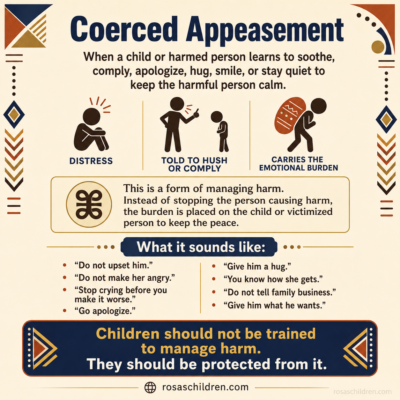
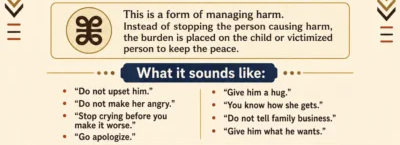
A woman is pressured to forgive an abusive relative. A child is encouraged to hug someone who has frightened or hurt them.
The conversation moves toward reconciliation before anyone has established safety, acknowledged wrongdoing, or demonstrated change.
Forgiveness becomes something demanded of the harmed person rather than a choice.
6. 🚪 Removing opportunities from those at risk
Instead of confronting harassment, girls are discouraged from participating in certain activities. Women are advised to avoid professions, public spaces, or events where mistreatment occurs.
The person behaving badly keeps access. The person seeking safety loses opportunity.
7. 🗣️ Criticizing the reaction more than the original behavior
A woman finally raises her voice after repeated boundary violations. Suddenly, her tone becomes the main issue.
A child who has endured bullying lashes out, and the school treats the reaction as seriously as, or more seriously than, the repeated harassment.
The response becomes the offense, while the original harm fades into the background.
8. 🧩 Calling repeated boundary violations misunderstandings
Someone keeps touching, questioning, following, or pressuring a woman after she has expressed discomfort.
Instead of investigating the pattern, people explain that the person responsible may be socially awkward, lonely, confused, or well-intentioned.
Intent becomes the center of attention. The repeated conduct becomes secondary.
9. 👗 Making appearance the prevention plan
Girls are told to dress differently to avoid distracting boys. Women are told to dress differently to reduce unwanted attention.
Clothing rules may have legitimate purposes in some settings, but clothing is not a substitute for teaching people to respect boundaries and refrain from harassment.
10. 🏠 Treating escape as the only solution
A woman experiencing domestic abuse is repeatedly asked why she doesn’t leave.
Leaving may be essential, but it can also be dangerous, expensive, and complicated by children, housing, threats, and financial dependence.
Meanwhile, far less attention may be paid to stopping the perpetrator’s stalking, threats, financial abuse, or violence.
11. 🕊️ Demanding that the harmed person demonstrate compassion
A girl reports inappropriate behavior, and adults ask her to consider the boy’s difficult home life.
A woman raises a safety concern, and the discussion turns toward how the person making her uncomfortable might feel.
Understanding someone’s circumstances can inform an appropriate response. It should not become a reason to overlook harmful conduct.
12. 📋 Creating reporting systems without meaningful responses
Schools, workplaces, shelters, and other institutions encourage people to report misconduct.
But reporting may lead to repeated interviews, delays, dismissive treatment, retaliation, or no meaningful action.
The institution can point to its reporting policy while the person who reported remains exposed.
A reporting process is not the same thing as protection.
13. 🔄 Requiring repeated proof of harm
A woman reports a pattern of harassment, but each incident is treated as isolated.
A child reports bullying, but adults wait for another incident before intervening.
Instead of recognizing escalation, institutions sometimes require the harmed person to experience more of it before they will act.
14. 🧸 Teaching children to accommodate behavior that frightens them
A child doesn’t want to hug an adult, sit beside someone, or participate in an interaction that makes them uncomfortable.
Rather than exploring the concern, adults tell the child not to be rude, selfish, or unkind.
Children learn that maintaining someone else’s comfort can be more important than their own boundaries.
15. ⚖️ Treating both parties as equally responsible
A woman reports intimidation and is told that both people need to communicate better.
A child reports persistent bullying and is instructed to work things out with the bully.
Mutual conflict and targeted mistreatment are not the same thing. A mediation approach can be inappropriate, particularly when coercion or a power imbalance is involved.
16. 🏥 Offering recovery services while neglecting prevention
We fund counseling, crisis intervention, and healing programs. These services are essential and often lifesaving.
But recovery services cannot replace effective investigation, enforcement, prevention, and accountability.
Helping people recover from harm should never become an excuse to accept its continuation.
17. 🛡️ Calling constant vigilance empowerment
Women are praised for being strong, alert, resourceful, and resilient.
Girls are encouraged to trust their instincts, watch their surroundings, and develop confidence.
These skills can protect them. But there is a difference between equipping someone for danger and expecting them to carry permanent responsibility for managing it.
Resilience is not evidence that the conditions producing harm are acceptable.
18. 🏛️ Protecting institutional reputation instead of the people affected
A school worries about its image. A workplace worries about liability. A family worries about scandal. A religious institution worries about public trust.
The harmed person is encouraged to handle the situation quietly, privately, or internally.
The institution’s reputation receives urgent protection while the person’s safety becomes something to negotiate.
The difference between managing harm and preventing harm
Managing harm | Addressing the source of harm |
|---|---|
Teach girls to avoid the bully | Investigate and stop the bullying |
Tell women to change their routines | Confront harassment and enforce protections |
Encourage silence for family peace | Address abuse and protect those reporting it |
Teach children to tolerate discomfort | Respect boundaries and investigate concerns |
Provide counseling after repeated incidents | Intervene early while also providing counseling |
Move the person being targeted | Restrict the harmful conduct and prevent retaliation |
The distinction is not that personal safety advice is wrong. Women and children need practical tools for navigating the world as it exists.
The problem begins when their adaptation becomes the institution’s entire solution.
A woman can learn every safety strategy available and still encounter someone determined to harm her. A child can develop excellent coping skills and still need an adult to intervene.
There is a question I would put to every school, employer, family, and organization claiming to prioritize safety:
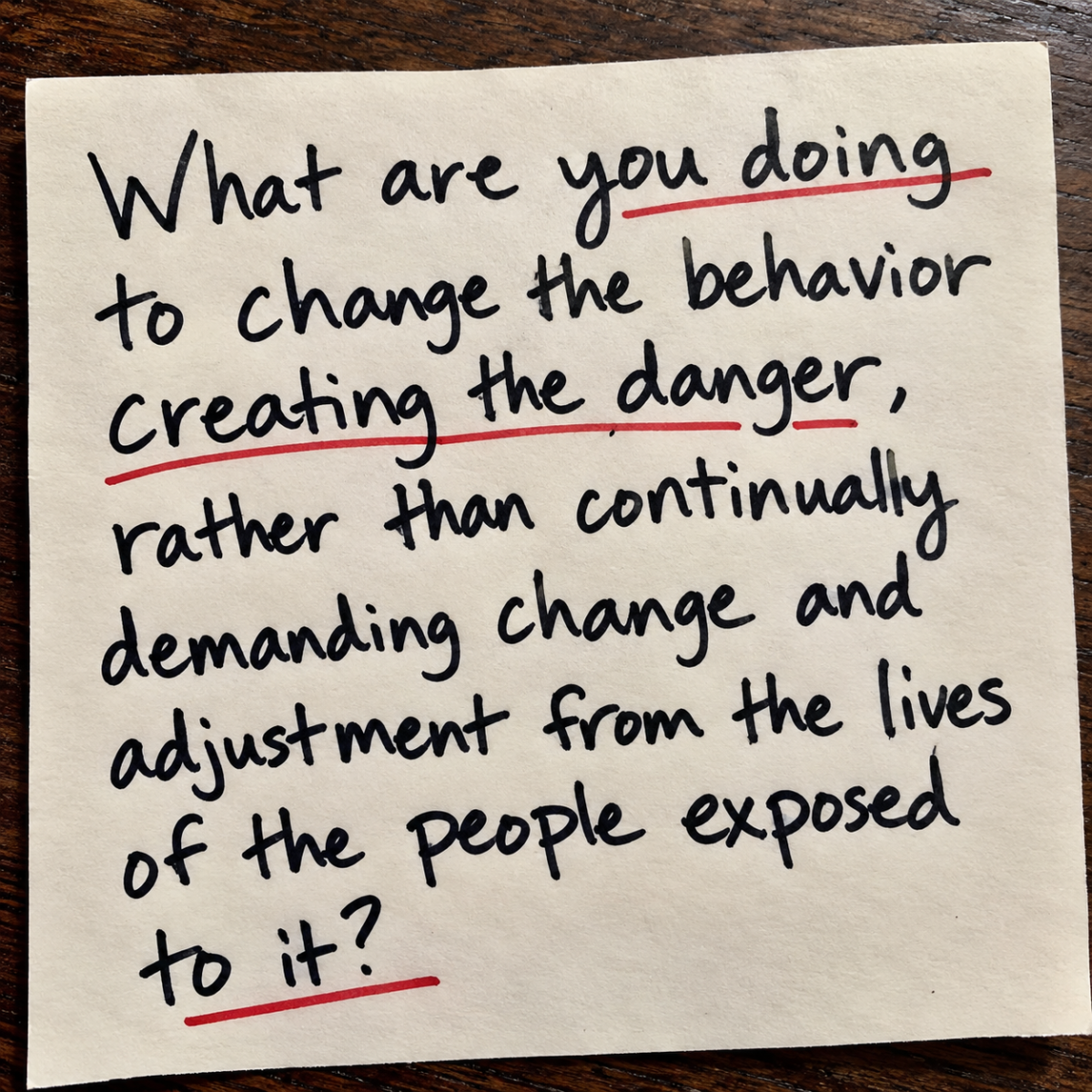
What are you doing to change the behavior creating the danger, rather than continually demanding change and adjustment from the lives of the people exposed to it?
Because a society that only teaches women and children to manage harm has not solved the problem. It has simply made them responsible for living with it.
And that is a distinction worth building an entire prevention education series around.
“Say the Right Words and Walk Right In” Was Always Stupid AF – WE Survive Abuse