“What is dismissed in a momentcan echo for a lifetime.” There was a time I didn’t fully understand this. I knew violence was wrong.I knew it caused
“What is dismissed in a moment
can echo for a lifetime.”
There was a time I didn’t fully understand this.
I knew violence was wrong.
I knew it caused harm.
But I did not yet understand how often that harm was minimized, explained away, or treated like something a woman should simply “get past.”
Then I sat with women.
I listened.
I watched what happened after the moment everyone else moved on.
And I learned something that does not leave you once you see it:
Women are living with injuries people keep calling “minor.”
Women are carrying damage that was never taken seriously enough to treat properly.
Women are trying to function through pain that was dismissed at the very moment it mattered most.
Some are not the same again.
Some are navigating memory loss, chronic pain, vision changes, difficulty speaking or eating—while being told nothing serious happened.
Some were sent home without answers.
Some were told they were overreacting.
Some never received care that matched what their bodies had endured.
And some did not survive.
That is the part people avoid.
We have built entire systems that can innovate, fund, and rapidly respond when certain male bodies are affected.
But when it comes to violence against women—especially injuries that do not present neatly or dramatically—there is still hesitation, dismissal, and delay.
Not a lack of intelligence.
Not a lack of capability.
A lack of urgency.
This post is not written from theory.
It is written from witness.
Because what is minimized in a moment
does not disappear.
It lives on in women’s bodies.
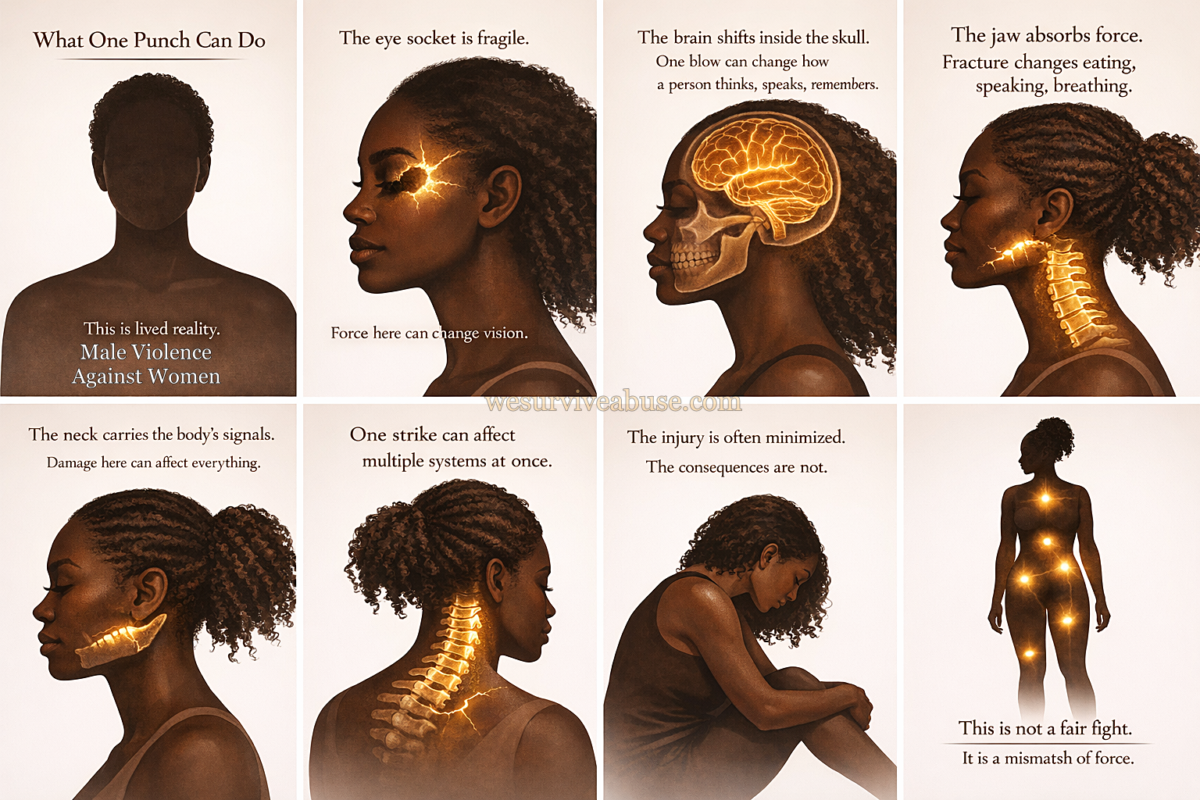
 1. Head injuries are often dismissed as “minor” — but they are not.
A single blow can cause traumatic brain injury (TBI), even without loss of consciousness. Many women are sent home without proper evaluation.
2. Repeated blows increase the risk of long-term brain damage.
Memory loss. Difficulty concentrating. Personality changes.
These are not “mood issues.” They are neurological injuries.
3. Vision damage can happen instantly and permanently.
The eye socket is fragile.
Women have lost vision from one strike and were later told it was “unlikely.”
4. Jaw fractures change daily life in ways people don’t see.
Eating becomes painful. Speaking becomes difficult.
Healing can take months — and sometimes never fully resolves.
5. Neck injuries can affect the entire body.
The neck carries signals between brain and body.
Damage here can lead to chronic pain, dizziness, and loss of coordination.
6. Internal injuries are frequently missed in early exams.
Swelling, bleeding, and organ damage may not show immediately.
Women are often told they are “fine” before symptoms fully appear.
7. Chronic pain is a common long-term outcome.
Years later, many women still live with migraines, nerve pain, and physical limitations.
This is not temporary harm. It reshapes daily life.
8. Medical professionals sometimes minimize women’s reports of pain.
Women are statistically less likely to have their pain taken seriously.
Black women, in particular, face higher levels of dismissal and disbelief.
9. Psychological effects are directly tied to physical injury.
Brain trauma can affect emotional regulation.
What gets labeled “anxiety” or “overreacting” may be injury-related.
10. Family and community responses can deepen the harm.
When women are not believed or are told to “move on,”
they are left to manage both injury and isolation.
11. Delayed care leads to worse outcomes.
The longer injuries go untreated or undertreated,
the more likely they become permanent.
12. One act of violence can create a lifetime of consequences.
This is not about a single moment.
It is about years of impact — on the body, the mind, and the course of a woman’s life.
Professional Responsibility
Take all reports of injury seriously
Document thoroughly and accurately
Avoid assumptions based on presentation or demeanor
Recognize patterns of cumulative harm
Understand that absence of visible injury does not equal absence of harm
Minimization is not neutrality.
It is a decision with consequences.
WeSurviveAbuse.com | Professional education grounded in lived reality
Supporting informed, responsible, and responsive care