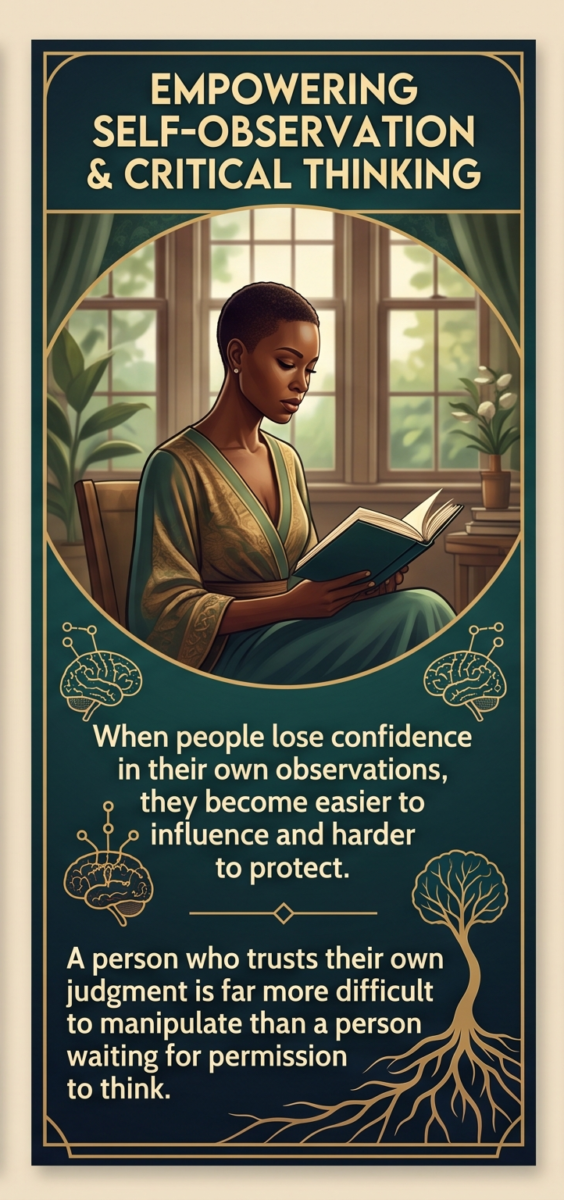
The first step in controlling a person is often convincing them they cannot trust what they know. Violence prevention begins long before viole
The first step in controlling a person is often convincing them they cannot trust what they know. Violence prevention begins long before violence. It begins with protecting people’s right to trust what they see, hear, feel, and know.
🌻 Sometimes the deepest battles are not fought over land, money, jobs, or power.
Sometimes the battle is over reality itself.
Who gets to say what happened?
Who gets to define the meaning of an experience?
Who gets believed?
And who is expected to remain silent while someone else explains their life to them?
That struggle has a name: epistemic control.
Now, don’t let that big phrase scare you away. 😊
Epistemic control simply means controlling whose knowledge counts and whose interpretation of events is considered legitimate.
In plain language, it is the attempt to become the author of someone else’s reality.
I have spent decades working alongside Survivors. I have sat with women whose instincts warned them that something was wrong long before anyone else believed them. I have listened to children trying to explain danger while adults dismissed their concerns. I have watched systems ask people to prove what they knew in their bones.
Over time, I noticed something.
Many harmful situations begin long before physical violence.
They begin when someone starts challenging a person’s right to know what they know.
🌿 “That didn’t happen.”
🌿 “You’re remembering it wrong.”
🌿 “You’re too emotional.”
🌿 “You’re being dramatic.”
🌿 “Everybody else agrees with me.”
🌿 “You misunderstood.”
The goal is not simply disagreement.
The goal is to replace your interpretation with theirs.
That is epistemic control.
You should not have to surrender your understanding of reality in exchange for belonging.
Black Women Know This Story Well
One of the deepest forms of dignity is being recognized as a reliable witness to your own life.
As I began reading the work of scholar Patricia Hill Collins and her groundbreaking exploration of Black feminist thought, I found language for something many Black women have recognized for generations. Collins writes about knowledge validation and the ways Black women have developed traditions for creating and validating knowledge outside dominant institutions.
That idea matters.
Because throughout American history, Black women were often expected to provide endless proof of experiences that others were allowed to describe without question.
Our grandmothers knew things.
Church mothers knew things.
Women sitting around kitchen tables knew things.
Women braiding hair knew things.
Women rocking babies on front porches knew things.
Many of those women possessed wisdom long before institutions were willing to acknowledge it.
💛 They compared notes.
💛 They observed patterns.
💛 They shared warnings.
💛 They preserved truth.
Sometimes that truth was the only thing standing between a family and danger.
Patricia Hill Collins describes Black feminist thought as a knowledge tradition built from lived experience and collective wisdom.
In many ways, Black communities have survived because people learned to trust what they could see, hear, and observe for themselves.
Every act of prevention begins with someone trusting what they notice. Before people can stop danger, they must first be allowed to recognize it.
What Epistemic Control Looks Like
Here is a simple comparison.
| Healthy Communication | Epistemic Control |
|---|---|
| “Help me understand your perspective.” | “Your perspective is wrong.” |
| “We remember this differently.” | “Your memory cannot be trusted.” |
| “Let’s examine the facts.” | “Only my interpretation matters.” |
| “Your experience matters.” | “Your experience doesn’t count.” |
| “Tell me what happened.” | “I’ll tell you what happened.” |
Notice the difference.
One approach creates understanding.
The other creates dependence.
One invites conversation.
The other demands submission.
The freedom to say, ‘Something isn’t right here,’ has saved more lives than we will ever know.
The Diagram Nobody Talks About
Observation
     ↓
Personal Experience
     ↓
Personal Meaning
     ↓
Personal Judgment
     ↓
Action

Epistemic Control Interrupts Here:

Observation
     ↓
Personal Experience
     ↓
Someone Else Replaces The Meaning
     ↓
Someone Else Replaces The Judgment
     ↓
Compliance
That interruption is powerful.
If someone can control how you interpret what you experience, they often gain influence over what you do next.
The women who protected communities were often the same women accused of seeing problems where none supposedly existed.
American Violet and the Fight for Reality
One reason the film American Violet resonates so deeply is because it is not merely a story about the legal system.
It is a story about authority attempting to define reality.
The central question becomes:
Who gets to decide what is true?
The main character knows she is innocent.
Yet powerful institutions pressure her to accept their version of events.
The pressure is relentless.
Not because she lacks knowledge.
Because her knowledge is considered less important than theirs.
Many Survivors recognize that feeling immediately.
Not because their experiences are identical.
But because they understand what it feels like when power demands agreement.
Many systems do not need to erase the truth. They only need to exhaust the people speaking it.
The Hidden Cost
😔 Epistemic control creates confusion.
😔 It creates self-doubt.
😔 It creates hesitation.
😔 It teaches people to second-guess themselves.
Eventually some people stop asking:
“What do I think?”
And start asking:
“What am I supposed to think?”
That shift is dangerous.
Because confidence does not disappear all at once.
It erodes.
Like water slowly wearing down stone.
One conversation.
One dismissal.
One correction.
One humiliation.
One accusation.
Until a person begins looking outside themselves for permission to trust their own judgment.
Audre Lorde Understood This
Audre Lorde challenged people to transform silence into language and action. Her work reminds us that naming reality is an act of courage.
I often think about that when I hear people say:
“Why are they speaking up now?”
Because speaking up is often the final stage of a long internal struggle.
Before a person speaks publicly, they usually have to reclaim their own trust.
They have to decide:
“I know what happened.”
“I know what I saw.”
“I know what I experienced.”
That is not stubbornness.
That is self-possession.
Black women have long carried knowledge that institutions were not yet prepared to acknowledge.
The Wisdom Our Ancestors Left Us
Black communities have always carried traditions of reality-testing.
People checked in with trusted friends.
People sought counsel from elders.
People compared experiences.
People paid attention to patterns.
People listened.
There is wisdom in that.
Not because communities are perfect.
But because truth often survives through collective memory.
The ability to compare notes has protected countless people from manipulation.
When someone says:
“Maybe it’s just me.”
A trusted friend can say:
“No. I noticed it too.”
That simple exchange has saved lives.
The women who protected communities were often the same women accused of seeing problems where none supposedly existed.
Protecting Your Right to Know
🌻 Trust patterns, not promises.
🌻 Pay attention when someone becomes angry about your interpretation.
🌻 Notice who demands agreement rather than understanding.
🌻 Keep records when necessary.
🌻 Compare notes with trustworthy people.
🌻 Respect your own observations.
🌻 Remember that disagreement is not proof that you are wrong.
Most importantly, remember this:
You are the primary witness to your own life.
Others may offer insight.
Others may offer expertise.
Others may offer perspective.
But no one should be handed ownership of your reality.
A person who trusts their own judgment is far more difficult to manipulate than a person waiting for permission to think.
Conclusion
The struggle against epistemic control is ultimately a struggle for human dignity.
It is the right to observe.
The right to interpret.
The right to remember.
The right to speak.
The right to make meaning from your own experiences.
For Black women, this struggle is not new.
It stretches through generations of women who preserved truth in kitchens, churches, beauty shops, classrooms, community centers, front porches, and family gatherings.
Their lesson remains powerful today.
✨ Do not surrender your ability to know.
✨ Do not surrender your ability to think.
✨ Do not surrender your ability to witness.
Because the moment someone else becomes the unquestioned author of your reality, freedom becomes much harder to hold.
And freedom, my friend, begins with the courage to trust what you know.