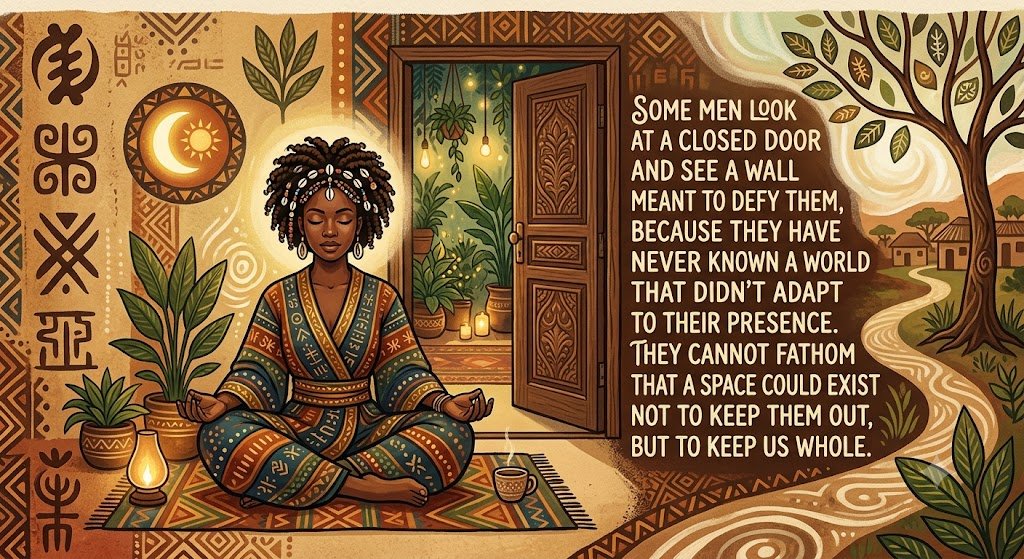
The erasure of women’s spaces begins the moment we treat a man’s discomfort at being excluded as weightier than a woman’s need to be safe
The erasure of women’s spaces begins the moment we treat a man’s discomfort at being excluded as weightier than a woman’s need to be safe

When people dismiss the conversation around women’s spaces as trivial or “not worthy of the time,” they are often thinking about this critical issue in ways that do not impact them. They have no idea they are actually talking about an entire global infrastructure of survival, faith, and progress.
By narrowing the scope to just one or two battlegrounds, they completely miss the massive, interconnected ecosystem of physical, digital, professional, and cultural spaces that women have deliberately built, secured, or fought to enter over generations.
Dismissing women’s spaces as a frivolous topic is a form of erasure. It treats the specific, material needs of half the human population—needs concerning safety, biology, privacy, and economic or social survival—as a sideshow, an annoyance, or a distraction from “real” issues.
Historically, every major advancement women have made came from having the autonomy to gather, organize, heal, and excel away from institutional and cultural pressures. Shrinking that reality down to a joke, a single talking point, or a political annoyance isn’t just dismissive; it is a way to invalidate the entire infrastructure that allows women and girls to navigate the world with dignity.
If we don’t name these spaces, defend them, and acknowledge why they exist, it becomes all too easy to let them slip away.
Here are 50 specific spaces they are referring to—whether they realize it or not—where the distinct safety, privacy, community, or equity of women is actively at stake:
Bodily Care, Health, & Healing
Maternity Wards & Labor/Delivery Rooms – Places where women experience profound vulnerability, medical risk, and intimacy.
Abortion Clinics & Reproductive Health Centers – Medical spaces specific to female biology, requiring heightened physical security.
Breastfeeding & Lactation Rooms – Private spaces mandated to allow mothers to pump or nurse comfortably in public/work settings.
Gynecology & Obstetric Exam Rooms – Spaces where intimate physical examinations require absolute privacy and trust.
Women’s Substance Abuse Rehab Centers – Recovery environments designed to address trauma often tied to domestic or sexual abuse.
Eating Disorder Clinics – Therapeutic spaces dealing with conditions that disproportionately affect women and girls.
Menopause Support Groups & Wellness Clinics – Specialized care spaces for a distinct female life stage.
Infertility Clinic Waiting Rooms – Spaces where women navigate deeply emotional and physically demanding reproductive treatments.
There is a particular kind of rage reserved for the man who discovers that a woman’s privacy is not a personal insult to him, but a sovereign right to herself
Safety, Crisis, & Vulnerability
Domestic Violence Shelters – Confidential, secure residential locations protecting women and children from abusers.
Rape Crisis Centers – Spaces designed for immediate trauma response, forensic collection, and counseling post-assault.
Homeless Shelters (Women-Only Wards/Facilities) – Places keeping unhoused women safe from the high rates of street-level sexual violence.
Women’s Prisons & Correctional Facilities – Detainment spaces where sex-segregation is vital for protection against exploitation.
Juvenile Detention Centers (Girls’ Wings) – Protecting vulnerable young girls within the justice system.
Supervised Visitation Centers – Court-mandated spaces where mothers and children can meet safely away from abusive ex-partners.
When a society teaches men that their validation requires access to women’s bodies, minds, and spaces, it transforms basic boundary-setting into an act of political defiance.
Privacy, Hygiene, & Dignity
Public Restrooms – The foundational space for basic civic participation, privacy, and sanitation.
Gym & Fitness Center Locker Rooms – Places where women undress, shower, and change clothes.
Retail Clothing Fitting Rooms – Private stalls in commercial spaces for trying on apparel.
Spa & Sauna Changing Areas – Wellness spaces designed for relaxation, requiring communal or individual nudity.
School & University Locker Rooms – Where young girls and young women change for athletic or physical education.
Airport Security Screening Private Rooms – Where sensitive physical pat-downs are conducted by female agents.
To believe you are entitled to enter every room, join every conversation, and witness every ritual is to mistake your privilege for a passport to the world.
Athletics, Competition, & Leisure
Olympic & Elite Sports Divisions – Categories created so female athletes can compete fairly, win titles, and secure careers.
NCAA & Collegiate Sports Teams – Title IX-protected spaces securing scholarships and athletic development for young women.
High School & Youth Sports Leagues – The pipeline where girls build confidence, teamwork, and physical fitness safely.
Women’s Professional Sports Leagues (WNBA, NWSL, etc.) – Commercial entertainment and professional spaces owned and driven by women.
Women-Only Gyms & Fitness Studios – Training spaces free from the gaze, intimidation, or harassment sometimes found in co-ed gyms.
Women’s Social & Country Clubs – Historical and modern networking spaces centered on female fellowship.
Women’s Travel Groups & Retreats – Curated excursions focusing on safety, solo travel empowerment, and bonding.
Education, Intellect, & Professional Development
Historically Women’s Colleges (HWCAs) – Institutions like Smith or Spelman built to cultivate female leadership and scholarship.
Women-in-STEM Academic Programs – Target spaces designed to break down barriers in historically male-dominated fields.
Women’s Professional Networks & Guilds – Industry-specific associations (e.g., Women in Film, Women in Tech) for career advancement.
Corporate Employee Resource Groups (ERGs) for Women – Workplace spaces to address systemic pay equity, parental leave, and retention.
Girls’ Coding Bootcamps & Robotics Clubs – Safe, encouraging educational spaces to foster early technical skills.
Women’s Business Incubators & Venture Funds – Financial and mentorship spaces addressing the massive gap in venture capital for female founders.
We have always been expected to be the hosts of the world—to open our doors, pour the tea, and offer up our stories, our bodies, and our labor for consumption. When we finally turn the key in the lock to sit with ourselves, the world calls it a hostility. But it isn’t hatred. It is the simple, holy act of keeping some of the harvest for our own hunger.
Community, Culture, & Faith
Traditional Sacred Spaces (Mosque/Synagogue/Temple Women’s Sections) – Cultural and religious spaces designated for women’s prayer, modesty, and community.
Convent & Monastic Spaces – Spiritual, cloistered residential spaces for women pursuing religious vows.
Women’s Book Clubs & Literary Circles – Intellectual spaces historically used by women to discuss politics, life, and art autonomously.
Mothers’ Support Networks & Playgroups – Community spaces for navigating the specific isolated labor of early parenting.
Feminist Bookstores & Archives – Cultural hubs dedicated to preserving women’s history, literature, and radical thought.
Crafting & Fiber Arts Circles (Quilting, Knitting Guilds) – Historically female spaces that served as vital networks for community care and political organizing.
Digital & Virtual Spaces
Online Support Forums for Survivors – Digital spaces requiring strict moderation to protect women sharing trauma narratives.
Women-Only Professional Slack/Discord Channels – Digital workspaces for candid conversations about industry challenges, salary transparency, and bias.
Fertility & Period Tracking App Communities – Digital spaces centered around personal, biological data and shared experiences.
Female Creator & Influencer Networks – Online collectives navigating the specific digital safety challenges (trolling, doxxing, harassment) faced by public women.
Global & Geopolitical Spaces
Micro-Finance Collectives – Community banking spaces in developing nations that loan directly to women to build local economies.
Refugee Camp Safe Zones – Designated secure areas within displaced person camps to protect women and girls from trafficking and violence.
Women’s Peace Tables & UN Delegations – Diplomatic spaces ensuring women have a voice in post-conflict treaty negotiations.
Water Collection Points – In many developing regions, the physical routes and stations that are overwhelmingly managed by women and require safety infrastructure.
Girls’ Schools in Conservative Regimes – Physical classrooms that represent the dangerous, radical act of educating girls against systemic prohibition.
Maternal Health Literacy Classes – Rural educational spaces teaching preventative health, nutrition, and infant care.
When we talk about “women’s spaces,” we are talking about the entire infrastructure of female autonomy, safety, and progress. To call it unworthy of time is to ignore the hundreds of ways women have shaped society just to survive and thrive in it.