With all my heart and soul I hate when men do this, Too often, when women say “no”—especially in conversations about safety, space, and

Photo by Edz Norton
With all my heart and soul I hate when men do this,
Too often, when women say “no”—especially in conversations about safety, space, and autonomy—we are met with a manipulative refrain: “If you just got to know us…” As if our boundaries are born of ignorance instead of lived experience. As if our resistance is an invitation to persuade. This tactic isn’t new—it’s a well-worn script designed to erode women’s sovereignty, shift the focus to male comfort, and demand emotional labor from the very people asking to be left in peace.
Let this be clear: women do not need to get to know anyone to justify their right to say no. No is a complete sentence. And upholding it is not cruelty—it’s courage. It’s legacy. It’s survival.
🚫 1. It Undermines Clear Boundaries
When women say “no,” they are establishing a boundary. To respond with “if you just get to know us” is to dismiss that boundary and insist that women must engage, must explain, must accommodate. It implies that women do not have the right to say no without being persuaded, softened, or guilted.
🧠 2. It’s a Manipulative Reframing of Consent
This tactic attempts to turn the boundary-setting into a personality flaw or ignorance.
It sounds like:
“You only say no because you’re misinformed.”
“If you truly understood us, you wouldn’t say no.”
This is textbook coercion: reinterpreting someone’s refusal as a failure of understanding, rather than a valid and sovereign decision.
💡 3. It Centers Male Feelings Over Women’s Safety
This response reveals that men’s comfort, feelings, and desires are being centered over women’s autonomy, safety, and trauma-informed spaces. It’s a refusal to sit with male discomfort and instead places the burden of soothing that discomfort back onto women — the very group asking for space to breathe, heal, and exist on their own terms.
🛑 4. It Demands Emotional Labor from the Oppressed
Women are not responsible for “getting to know” every person who wants access to women’s spaces. This phrase pressures women to:
Do the work of understanding someone else’s experience
Justify their own need for protection and peace
This is exploitation of emotional labor and often used as a tool to reframe oppression as misunderstanding.
📚 5. It Has Been Used Throughout History to Guilt Women Into Submission
This is not new. Variations of this tactic have been used historically:
“You just don’t know how good he really is.”
“If you just opened your heart, you’d see the real me.”
“Don’t be scared, I’m not like other men.”
These are emotional manipulation scripts, not good-faith arguments. They are designed to make women question their instincts, minimize danger, and prioritize others’ needs over their own discernment.
🔁 6. It’s a Form of Boundary Grooming
When someone says “get to know me” in response to a boundary, it’s a form of boundary grooming — slowly pressuring someone to let their guard down so the person can gain access they were originally denied. This tactic relies on:
Persistent persuasion
Social shaming (e.g., “you’re being exclusionary”)
Making refusal look like bigotry or cruelty
✊🏽 Final Word
When women say “no,” the conversation ends there.
It’s not a cue to negotiate.
It’s not a misunderstanding to correct.
It’s not a wound to heal with kindness.
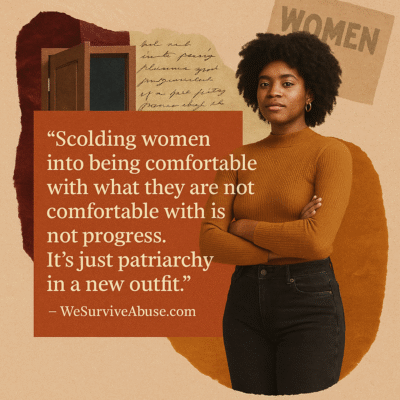 It is a self-protective act, especially in a world where violating women’s “no” has been normalized, encouraged, and even legally excused.
To insist on access to women’s spaces after being told no is not allyship — it is entitlement disguised as outreach.
NOTE: Some women will politely nod along when a man says, “If you just got to know me…”—even though deep down, they know the truth. If the roles were reversed, and a woman stood on his porch saying the exact same thing after being told no, he wouldn’t see it as endearing. He’d call the police and have her removed for trespassing. What’s seen as persistence in a man is often treated as danger in a woman. The double standard is loud—and it’s exhausting.