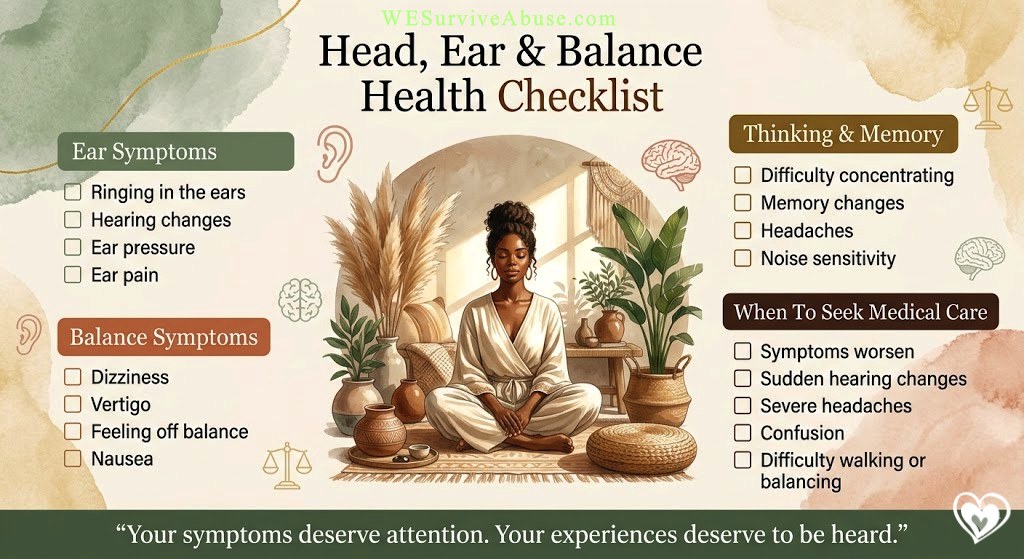
Some injuries announce themselves with bruises. Others move in quietly, sit behind the ear, ring through the night,
Some injuries announce themselves with bruises. Others move in quietly, sit behind the ear, ring through the night, and make a woman wonder if she is “just stressed.”
That is one of the cruel things about domestic violence. Harm can happen in a flash, then the Survivor is left trying to explain symptoms nobody else can see. A ringing ear. A room that suddenly tilts. A headache that keeps returning like an unwanted visitor. Trouble focusing. Noise that feels too sharp. A strange pressure in one ear. A memory that used to be reliable, now acting like a porch light with a bad wire. 💡
So let’s give this some language.
A forceful slap to the ear can cause real injury. It can damage the eardrum, affect hearing, trigger ringing in the ears, cause dizziness, bring on nausea, and disturb balance. A blow near the ear is also a blow to the side of the head, and that force can contribute to concussion or traumatic brain injury symptoms. Strangulation can add another layer of danger because it can affect blood flow and oxygen to the brain.
This is education, not medical advice. But it is also validation. Because too many Survivors have been told, “You’re fine,” when their bodies were telling the truth the whole time. 🖤

The ear is small, but it is doing mighty work
The ear is not just the part that holds earrings and catches music. It is a delicate system connected to hearing, balance, pressure, and the brain. Stanford Medicine’s patient guide to the normal ear and hearing explains that the ear includes the outer ear canal, eardrum, tiny middle-ear bones, cochlea, and balance canals. That means a hard slap over the ear can disturb more than one thing at once.
The eardrum, also called the tympanic membrane, is a thin piece of tissue that helps carry sound. A sudden force or pressure change can tear it. According to Mayo Clinic’s guide to a ruptured eardrum, symptoms may include ear pain, fluid or blood coming from the ear, hearing loss, ringing in the ear, spinning sensations, nausea, or vomiting. Mayo Clinic also advises people who suspect a ruptured eardrum to keep the ear dry and avoid putting drops in the ear unless a healthcare professional prescribes them.
Plain language? If someone hits you over the ear and now that ear rings, hurts, drains fluid, feels full, or hears differently, that is not “nothing.” That is worth medical attention.
What a slap to the ear can cause
A forceful slap to the ear can cause several problems. Some are ear-related. Some may involve the brain. Some may involve both. This is where people get confused, because the symptoms overlap like voices in a crowded room.
| What happened | What it may affect | What the Survivor may notice | Why it gets dismissed |
|---|---|---|---|
| Forceful slap over the ear | Eardrum, middle ear, hearing system | Ear pain, hearing loss, ringing, pressure, drainage, dizziness, nausea | People minimize it as “just a slap” |
| Blow to the side of the head | Brain, nerves, balance, concentration | Headache, brain fog, memory problems, sensitivity to noise, dizziness | Symptoms may be blamed only on stress |
| Repeated head injuries | Brain health over time | Ongoing headaches, mood changes, trouble focusing, feeling slowed down | Survivors may never have been screened for brain injury |
| Strangulation or choking | Blood flow, oxygen, neck structures, brain | Dizziness, confusion, memory gaps, voice changes, trouble swallowing, neurological symptoms | There may be few visible marks |
That table is important because domestic violence injuries often come in clusters. A woman may have been slapped, shoved, shaken, strangled, and hit in the head across months or years. Then when she starts forgetting appointments, struggling with noise, or feeling dizzy, people may call her anxious, dramatic, careless, or unstable. That is how harm gets hidden in plain sight.

Ear symptoms and concussion symptoms can look alike
A concussion is a type of mild traumatic brain injury. It can happen when the head is hit, shaken, or forced to move quickly. The CDC’s current page on mild traumatic brain injury and concussion symptoms lists dizziness, balance problems, headaches, nausea, sensitivity to light or noise, trouble concentrating, memory problems, feeling slowed down, and feeling foggy or groggy.
Mayo Clinic’s concussion information also names ringing in the ears, nausea, vomiting, fatigue, dizziness, headache, blurry vision, and confusion as possible concussion symptoms.
That overlap is why Survivors need clear words. A ringing ear may be an ear injury. Dizziness may come from the inner ear. Headaches and fogginess may be concussion symptoms. Noise sensitivity may show up after a brain injury. A person can also have trauma, fear, poor sleep, and brain injury symptoms at the same time. The body is not a neat little office file. It is more like a choir. When one section gets hurt, the whole song can change. 🎶
A concrete example: “I thought I was losing myself”
Imagine a woman named Denise. During an argument, her partner slaps her hard on the left side of her head. Her ear rings immediately. The next morning, the ear feels full, like she is underwater. By the third day, the TV sounds muffled. At work, the copier feels painfully loud. She gets dizzy standing up too fast. She misses two appointments and starts calling herself “scatterbrained.”
Someone says, “You’re probably just stressed.”
Stress may be part of it. Trauma may be part of it. Fear may be part of it. But Denise may also have an eardrum injury, concussion, or both.
That is the insight we need to hold onto: emotional trauma and physical injury can exist together. We do Survivors no favors when we shrink everything down to “stress.” Sometimes the body is not whispering. Sometimes it is testifying.
Strangulation is a serious warning sign and a medical concern
Strangulation deserves its own careful attention. It can affect oxygen and blood flow to the brain. It can cause symptoms even when there are no obvious marks on the neck. That is why advocates often say, “No visible injury does not mean no injury.”
The Brain Injury Association of America explains that strangulation, domestic violence, and brain injury are connected in complex ways, especially when intimate partner violence includes physical attacks, shaking, blows to the head, or near suffocation. Research published in the medical literature has also examined strangulation as an acquired brain injury in intimate partner violence, including changes in consciousness and cognitive or psychological outcomes.
The Ohio Domestic Violence Network’s survivor brain injury resources put it plainly: violence directed at the head, neck, and face, including choking and strangulation, can have serious and long-lasting consequences. :contentReference[oaicite:4]{index=4}
So when a Survivor says, “He choked me and afterward I felt dizzy,” that is not small. When she says, “My ears were ringing after he grabbed my neck,” that deserves attention. When she says, “I blacked out for a second,” that second counts. ⏳
Why this is especially important for Black women
Black women have always had to fight the dangerous expectation that we can absorb pain and keep moving. That old lie shows up everywhere: in medicine, in families, in churches, in workplaces, in courtrooms, and sometimes even in advocacy spaces. It tells Black women to carry harm quietly, pray harder, be stronger, forgive faster, and stop making people uncomfortable.
But the body keeps receipts.
This is why Black-centered advocacy and scholarship belong in the conversation. Ujima: The National Center on Violence Against Women in the Black Community works toward ending violence against Black women and girls and building safer communities where Black women and girls are valued and protected. :contentReference[oaicite:5]{index=5}
Howard University’s Interpersonal Violence Prevention Program provides survivor advocacy, crisis management, training, education, and interpersonal violence prevention support for dating violence, domestic violence, sexual assault, harassment, and stalking.
And when we talk about why Black women may be reluctant to seek help, we should remember the work of legal scholar Kimberlé Crenshaw. In Mapping the Margins, Crenshaw explains how women of color can face barriers shaped by racism, gender violence, community pressure, and distrust of systems.
Dr. Beth E. Richie’s book Arrested Justice: Black Women, Violence, and America’s Prison Nation also gives powerful language for how violence against Black women is often pushed aside by public policy, criminalization, class, race, and gender politics.
This matters because if a Black woman reports ringing ears, dizziness, headaches, or memory problems after abuse, she deserves more than a rushed “you’re stressed.” She deserves careful listening, respectful medical care, documentation, and support.

Words Survivors can use when asking for help
Sometimes the hardest part is finding the sentence. Abuse steals enough. It should not also steal language.
Here are words a Survivor can take to a doctor, nurse, advocate, therapist, hotline worker, or trusted support person:
- “I was slapped hard over my ear, and now I have ringing or hearing changes.”
- “I am worried about a ruptured eardrum.”
- “I was hit near the side of my head, and now I have dizziness and headaches.”
- “I have balance problems after being hit.”
- “Noise bothers me more since the assault.”
- “I was strangled or choked, and afterward I felt dizzy, confused, or had memory gaps.”
- “I have had repeated head injuries from domestic violence.”
- “Can I be evaluated for concussion, traumatic brain injury, ear injury, and strangulation-related injury?”
Those words are not dramatic. They are clear. Clarity is not cruelty. Clarity is care with shoes on. 👟
When to seek urgent help
After a blow to the head, slap over the ear, or strangulation, medical care is important, especially if symptoms appear or worsen. Seek urgent help for symptoms such as loss of consciousness, repeated vomiting, worsening headache, confusion, weakness, seizures, blood or fluid from the ear, serious neck pain, trouble breathing, trouble swallowing, voice changes, or feeling faint after strangulation.

Photo by ZSarpong
The National Institute of Neurological Disorders and Stroke explains that traumatic brain injury can affect thinking, sensation, language, emotions, and physical function. That is one reason ongoing symptoms deserve attention. :contentReference[oaicite:9]{index=9}
And from a safety standpoint, strangulation in domestic violence is a major red flag. If you are in danger right now, contact emergency services where you live. In the United States, The National Domestic Violence Hotline offers 24/7 support at 1-800-799-7233, and you can text START to 88788.
For advocates, friends, and family: stop shrinking the story
If someone tells you they were slapped near the ear, hit in the head, shaken, or strangled, slow down. Ask about symptoms. Help them write things down. Encourage medical care. Offer to sit nearby while they call a hotline, clinic, or trusted provider.
Helpful questions sound like this:
- “Did your hearing change after it happened?”
- “Do you have ringing in one ear or both?”
- “Have you felt dizzy or off balance?”
- “Did you black out, feel confused, or lose time?”
- “Were you choked or strangled?”
- “Do loud sounds or bright lights bother you now?”
And then, believe the answer. Do not make a Survivor prove pain like she is on trial. Too many already had to survive the harm. They should not have to audition for compassion afterward. 🖤
After Harm, Listen to Your Body
A slap to the ear is not just a slap. A blow to the side of the head is not just a bad memory. Strangulation is not just a frightening moment. These can be medical events. They can be safety events. They can change how a Survivor hears, thinks, sleeps, balances, remembers, and moves through the world.
To the Survivor reading this: you are not silly for noticing the ringing. You are not weak because you feel dizzy. You are not “too sensitive” because sound hurts now. You are not careless because memory has become harder. Your body may be carrying an injury that nobody named for you.
May these words become a lantern. May they help you say what happened. May they help an advocate ask better questions. May they help a doctor listen longer. May they help one woman stop blaming herself for symptoms that began after violence.
Your body is telling a story. It deserves to be heard. 👂🏾🧠✨
Resource note: For Black-centered advocacy, visit Ujima. For Black women’s health equity work, visit the Black Women’s Health Imperative. For immediate domestic violence support in the U.S., contact The National Domestic Violence Hotline.