Shame is one of the oldest tools of control.It does not simply tell you that you made a mistake. It whispers that you are the mistake.Healthy
Shame is one of the oldest tools of control.
It does not simply tell you that you made a mistake. It whispers that you are the mistake.
Healthy relationships leave room for accountability without destroying your dignity. Manipulative relationships often do the opposite. Shame becomes the leash. The goal is not understanding. The goal is compliance.
If you have spent years apologizing for existing, shrinking yourself to keep the peace, or questioning your worth after every interaction with someone, shame may have become part of the control.
Here are ten signs to watch for.
1. They make you feel “less than” instead of addressing a behavior.
Healthy correction focuses on behavior.
Control attacks identity.
Instead of saying, “That hurt me,” they say:
- You’re selfish.
- You’re crazy.
- You’re a terrible mother.
- You’re not a real woman.
- No one else would want you.
The conversation moves away from solving a problem and toward convincing you that something is fundamentally wrong with who you are.
2. They weaponize your past.
Your history becomes ammunition.
Past mistakes, childhood trauma, previous relationships, addiction, mental health struggles, or abuse you’ve survived are repeatedly dragged into the present to keep you feeling small.
Healing requires honesty.
Control requires reminders that you “owe” someone because of your past.
3. They embarrass you in front of other people.
Public humiliation is rarely accidental.
Mocking you in front of friends.
Making jokes about private experiences.
Rolling their eyes.
Calling you sensitive.
Sharing personal information without permission.
The audience becomes another tool of control.
4. They convince you that your needs are evidence of your flaws.
You ask for respect.
They call you difficult.
You ask for privacy.
They call you secretive.
You ask for safety.
They accuse you of overreacting.
Eventually, normal human needs begin to feel shameful.
5. They expect endless apologies but rarely apologize themselves.
Control often creates a one-way street.
You become responsible for every conflict.
Even when they caused the harm, somehow you leave believing you should apologize first.
Healthy relationships share responsibility.
Controlling relationships assign it.
6. They make love feel conditional.
Affection appears when you comply.
Distance appears when you disagree.
Approval becomes something you earn rather than something freely given.
Over time, your nervous system begins chasing acceptance instead of expecting respect.
7. They isolate you by making you ashamed of seeking help.
You hear things like:
- Don’t tell anyone.
- They’ll think you’re crazy.
- Nobody will believe you.
- You’ll embarrass the family.
- What happens here stays here.
Isolation grows where shame grows.
This is one reason advocates often say that secrecy protects abuse more than people.
8. They redefine your boundaries as selfishness.
“No.”
“I need time.”
“I don’t feel comfortable.”
“I disagree.”
Instead of respecting your boundary, they shame you for having one.
Healthy people negotiate boundaries.
Controlling people attack them.
9. They make you responsible for their emotions.
If they yell…
You made them angry.
If they cheat…
You neglected them.
If they explode…
You pushed them too far.
Shame teaches people to carry burdens that were never theirs.
10. You begin policing yourself before they even speak.
This is often the deepest sign.
You rehearse conversations.
You hide parts of yourself.
You become afraid to disappoint them.
You apologize before saying anything.
Eventually, they no longer need to shame you.
You have learned to do it for them.
That is how control becomes internalized.
A Different Way Forward
One of the hardest truths Survivors discover is this:
Shame loses power when dignity has witnesses.
Healing rarely begins with becoming perfect.
It often begins with discovering that you were never meant to carry someone else’s contempt as evidence about your worth.
You are allowed to exist without earning your humanity.
You are allowed to need protection.
You are allowed to tell the truth without apologizing for it.
Survivor Affirmations
- I refuse to confuse shame with wisdom.
- My dignity does not require another person’s permission.
- I can accept responsibility without accepting humiliation.
- Healthy love never requires me to disappear.
- I release burdens that never belonged to me.
- My voice deserves room in every conversation about my life.
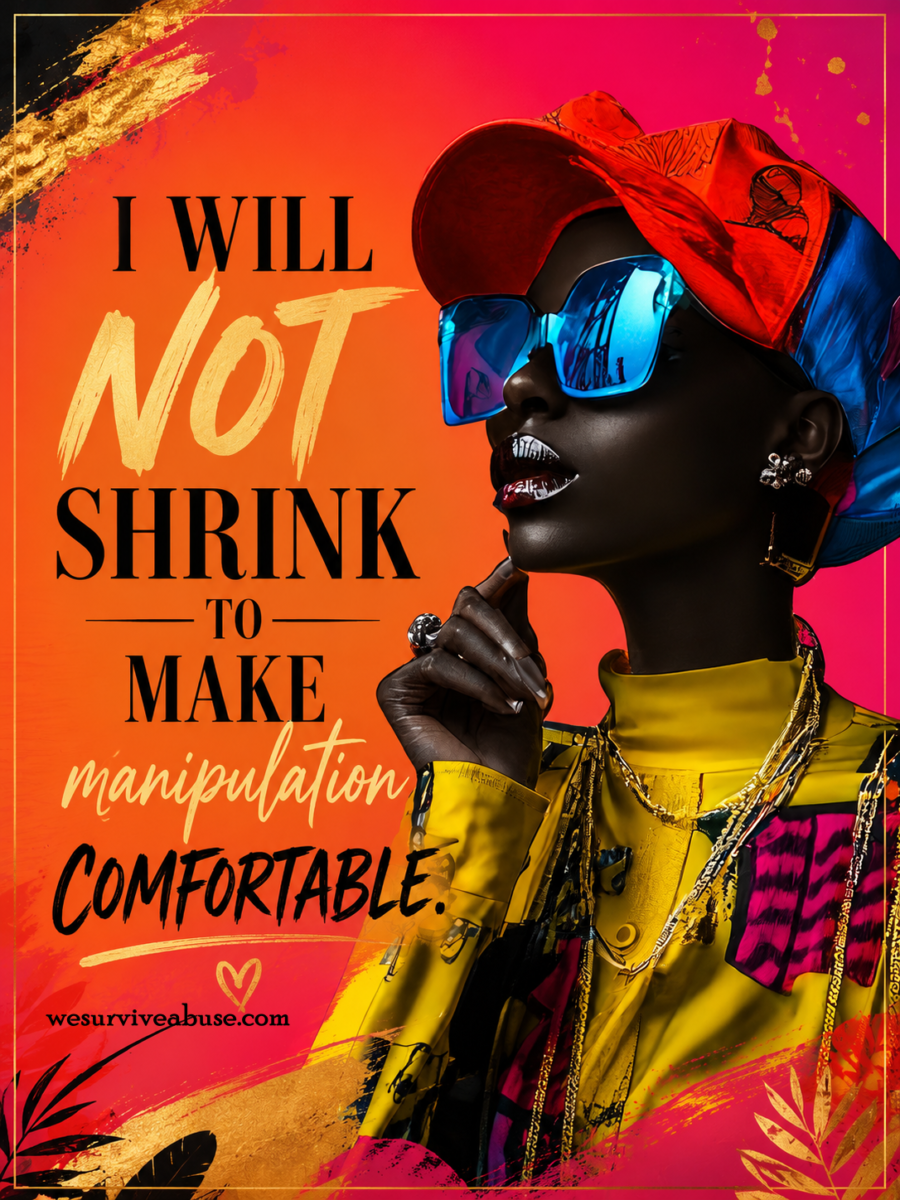
- I will not shrink to make manipulation comfortable.
- My boundaries protect my peace.
- I am rebuilding trust in myself one truthful decision at a time.
Books Worth Reading
- All About Love — explores love, domination, respect, and emotional maturity.
- The Will to Change — examines how patriarchal ideas about masculinity, shame, and domination harm relationships.
- Sisters of the Yam — healing, self-worth, and emotional restoration for Black women.
- You Are Your Best Thing — essays centering vulnerability, shame, and the Black experience.
Abuse and coercive control
- Coercive Control — foundational work explaining how psychological domination limits women’s liberty beyond physical violence.
Films & Documentaries
- The Color Purple
- Precious
- For Colored Girls
- What’s Love Got to Do with It
- The Invisible War
These stories show different ways shame is used to silence, isolate, intimidate, or maintain power over another person.
Scholars to Explore
- bell hooks — love, domination, patriarchy, dignity, and healing.
- Beverly Daniel Tatum — identity, internalized messages, and social development.
- Jennifer L. Eberhardt — shame, bias, stereotypes, and how institutions shape identity.
- Monnica T. Williams — trauma, race, and culturally responsive healing.
Research
Research on intimate partner violence consistently shows that shame is not merely a feeling but can become a mechanism of coercive control. Perpetrators often use humiliation, degradation, and attacks on dignity to reduce autonomy and discourage help-seeking, while institutions may unintentionally reinforce survivors’ shame during reporting or protection-order processes.
Within Black communities, scholars have also examined how racialized shame—including beauty standards, stereotypes, and identity policing—can intersect with interpersonal abuse, creating additional barriers to seeking support and preserving one’s sense of self.
Reflection
Anyone can make you feel guilty.
Manipulators work much harder.
They try to make you believe that your very existence is the problem.
The truth is simpler:
You are not difficult because you require dignity.
You are not shameful because you require respect.