
I was astonished that in a season where we had a string of Black femicides and people were asserting "bidirectional violence" on dead women that they
I was astonished that in a season where we had a string of Black femicides and people were asserting “bidirectional violence” on dead women that they didn’t know. Only she was dead. Only children were gone forever and would never see another birthday or Christmas. But somehow they were sure they knew that she caused it.

The study most people are usually pulling from is probably this one:
“Differences in Frequency of Violence and Reported Injury Between Relationships With Reciprocal and Nonreciprocal Intimate Partner Violence”
Authors: Daniel J. Whitaker, Tadios Haileyesus, Monica Swahn, and Linda S. Saltzman
Published in American Journal of Public Health in 2007.
That study used the term “reciprocal intimate partner violence,” meaning relationships where both partners reported perpetrating physical violence. It found that reciprocal IPV was associated with greater reported injury than nonreciprocal IPV and that men were more likely than women to inflict injury.
But here is the important part:
That is not the same thing as proving “mutual abuse.”
This “phenomenon” is common when there are discussions around rape, violence, and abuse dynamics. Such discussions run up against the typical obstacles of racism, misogyny, sexism, and people who see women as servants to men and not human beings in their own right.
The people who want to save the harmful male from valid critiques often hook their argument to a real study, drag it somewhere else, and pretend the destination is scientific.
Whitaker and colleagues studied reciprocal physical violence. Straus created the Conflict Tactics Scale that helped shape a lot of this “both partners used violence” research. But online commentators and others often misuse that research by turning “both people reported acts of violence” into “both people were equally abusive.” That is not a safe conclusion.
This is how we end up with women who defend themselves from violence, rape, and abuse spending decades in prison, like Marissa Alexander, Chrystal Khizer, and so many others. It is how Joan Little almost ended up in prison for murdering the jail guard who attempted to rape her. These women deserve to be healing from trauma and abuse, not fighting for their lives in the system all over again.
Because everyone is very clear about “standing your ground” until a woman is defending her life.
People misusing what studies were supposed to measure and confirming their own biased and unknowledgeable conclusions. Rather than listen to the voices of women in abusive relationships, they hook on to a substitute.
The broader “bidirectional violence” literature is also tied to the Conflict Tactics Scale, created by Murray A. Straus in 1979. The CTS counts reported acts such as hitting, pushing, slapping, etc., but it has been heavily criticized because it does not adequately capture context, coercive control, motive, fear, self-defense, injury severity, or who is controlling whom.
The study may measure reciprocal physical acts, but it was not designed to measure the full social danger Black women face when their self-defense, fear, anger, or resistance is misread through racist stereotypes.
The “bidirectional abuse” argument often rests on a counting problem. It counts acts, but not terror. It counts contact, but not control. It counts the moment a Black woman fought back, but not the months or years she spent trying to survive.
A slap on a survey is not the same as a pattern of domination. A survival response is not the same as abuse. And when Black women are being murdered, any framework that erases power, fear, and lethal risk deserves to be challenged hard.
And even the authors’ own framework is not the same as the internet’s lazy “mutual abuse” claim. They studied reciprocal intimate partner violence, not the moral or clinical claim that two people were equally abusive.
The study is mainly a population-data study using Add Health survey data on young adults ages 18 to 28. It looked at whether violence in relationships was “reciprocal” or “nonreciprocal,” and whether reported injury differed.
That kind of study can help answer:
“How often did both partners report using physical violence?”
“Was injury reported more often in reciprocal relationships?”
“Were men or women more likely to inflict injury in the dataset?”
But it is much weaker for answering:
“Who was afraid?”
“Who was controlling whom?”
“Who was surviving coercive control?”
“Was the woman responding to being trapped, threatened, stalked, or sexually coerced?”
“How do racist stereotypes shape whether Black women are seen as victims?”
“What happens when police, courts, family, churches, or communities already read Black women as aggressive?”
A data set can count a shove. It cannot automatically tell us whether that shove came from domination or from survival. And when the woman being judged is Black, that missing context is not a small footnote. It can be the whole case.
A survey can record: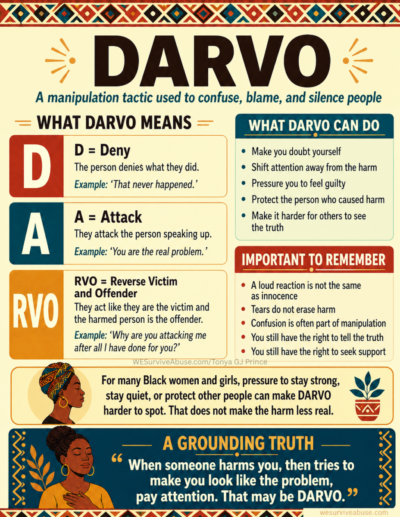
“She hit him.”
But it may not tell you:
He had been choking her.
He blocked the door.
He threatened the children.
He had the gun.
She was trying to get away.
She was fighting back after years of control.
She was terrified.
He was not.
That difference is everything. Where everything is life and death.
The National Domestic Violence Hotline and numerous other service providers-people with experience and expertise in saving lives in domestic abuse situations—directly reject the “mutual abuse” framing, explaining that abuse is rooted in power and control, and that the “mutual abuse” excuse can allow an abusive partner to shift blame onto the victim.
As someone online said, “If all things are “equal,” why is there a global femicide crisis where men are killing women and not the other way around?