Too many women have called a hotline or support number that I was working for where this behavior was a part of her story. Only now they were in seri
Too many women have called a hotline or support number that I was working for where this behavior was a part of her story. Only now they were in serious danger. Threats. (He said that they were promises.) Their family members threatened too. Many of those women wishing that they could go back to these days and know then what they know now. Those behaviors were red flags to start planning her exit.
@aa.cat.meme When she’s mad at you but you’re not a woman beater🤣❤️ #foryou #prank #fyp #fail #funnyprankvideos ♬ เสียงต้นฉบับ – John (Songs Station) – สุขภาพดีกับเบิร์ด
When Anger Becomes a Warning Sign
Some people online are laughing at videos where a boyfriend gets angry because his girlfriend is “giving him the silent treatment” or has an “attitude.”
So he throws things.
He knocks items over.
He destroys the chores she is doing.
She folds clothes, and he angrily unfolds them.
She cleans, and he messes it up.
She tries to disengage, and he escalates.
Some people call it “toxic love.”
Some people call it “passion.”
Some people call it “communication problems.”
But we need to slow down and name what is happening.
These are abusive behaviors.
They are red flags.
And in some relationships, they can be precursors to more serious abuse.
Not every angry person becomes physically violent. But when someone uses anger to intimidate, punish, control, disrupt, or frighten another person, that is not a harmless personality flaw.
That is a warning that could save your life.
1. Throwing Things Is Intimidation
Throwing things during an argument is not just “being upset.”
It sends a message:
“I may not have hit you, but I want you to know I could.”
That matters.
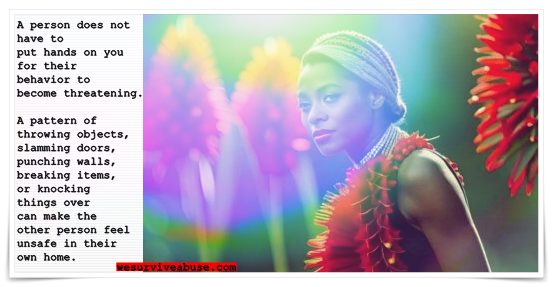
A person does not have to put hands on you for their behavior to become threatening. A pattern of throwing objects, slamming doors, punching walls, breaking items, or knocking things over can make the other person feel unsafe in their own home.
The body understands danger before the mind finishes explaining it.
If you flinch, freeze, go quiet, try to calm them down, or start choosing your words carefully because you fear what they might do next, your nervous system is already responding to threat.
2. Destroying Her Chores Is Punishment
If a woman is folding clothes and he angrily unfolds them, that is not random.
That is punishment.
He is attacking her effort.
He is saying:
“You will not have peace unless I approve.”
“You will not finish what you started unless I allow it.”
“You will feel the cost of displeasing me.”
Destroying someone’s labor is a form of disrespect. It turns ordinary tasks into battlefields. It can make the home feel unstable, hostile, and unsafe.
This is especially cruel when the person being targeted already carries a heavy load of cleaning, organizing, caregiving, or household responsibility.
It says, “Your work can be undone when I am mad.”
That is not love.
That is contempt.
3. Calling It “Silent Treatment” Can Hide the Bigger Issue
Sometimes “silent treatment” is used to describe emotional punishment.
But sometimes silence is not punishment.
Sometimes silence is fear.
Sometimes silence is overwhelm.
Sometimes silence is a person trying not to escalate.
Sometimes silence is a woman’s last remaining boundary when every word she says gets twisted, mocked, dismissed, or used against her.
So before we accept the phrase “she gave him the silent treatment,” we need to ask:
Was she punishing him?
Or was she protecting herself?
Was she refusing to communicate?
Or was she trying to avoid another explosion?
Was she being cruel?
Or had she learned that speaking up makes things worse?
A person’s silence does not give someone else permission to terrorize the room.
4. “Attitude” Is Often Used to Police Women’s Reactions
The word “attitude” gets used against women and girls all the time.
Especially Black women and girls.
A woman can be tired, hurt, disappointed, guarded, cautious, grieving, or simply not performing cheerfulness, and someone will call it an “attitude.”
That label can become dangerous.
Because once he calls it “attitude,” he may feel justified in punishing her.
He may say:
“She made me mad.”
“She knows how to push my buttons.”
“She was acting funny.”
“She started it.”
“She should have just talked to me.”
But his anger is still his responsibility.
Her facial expression is not permission.
Her silence is not permission.
Her disappointment is not permission.
Her emotional distance is not permission.
Her boundary is not permission.
5. Messing Up What She Is Doing Is Control
When someone destroys a task you are working on, they are interrupting your agency.
They are not simply reacting.
They are controlling the environment.
They are making sure your attention returns to them.
They are forcing you to stop what you are doing and deal with their emotional state.
That is a dangerous pattern.
It teaches the other person:
“You are not allowed to focus on yourself.”
“You are not allowed to finish anything while I am upset.”
“My anger becomes the center of the home.”
In abusive dynamics, the angry person often trains everyone around them to monitor their moods.
The house becomes a weather system.
Everyone learns to check the sky.
6. “I Didn’t Hit You” Is Not the Same as “I Didn’t Harm You”
Some people think abuse only counts when there is physical injury.
That is false.
Harm can happen through intimidation.
Harm can happen through fear.
Harm can happen through property destruction.
Harm can happen through threats.
Harm can happen through humiliation.
Harm can happen through punishing someone’s independence, rest, work, friendships, silence, boundaries, or emotional expression.
A person can do serious damage without leaving a bruise.
And many abusive relationships do not begin with hitting.
They begin with testing.
Raised voices.
Slammed doors.
Broken objects.
Mocking.
Withholding affection.
Controlling the mood.
Punishing boundaries.
Destroying small things.
Then larger things.
Then maybe the person.
7. These Behaviors Can Be Precursors to Abuse
A precursor is an early warning sign.
It does not mean the future is guaranteed.
It means the pattern deserves attention.
These behaviors may signal escalating danger when they happen alongside:
jealousy
possessiveness
monitoring
blaming
threats
name-calling
isolation from friends or family
breaking belongings
blocking exits
driving dangerously while angry
forcing conversations when someone needs space
punishing someone for saying “no”
making the other person responsible for their anger
saying, “Look what you made me do”
That last phrase is a danger bell.
Because safe adults take responsibility for their own behavior.
Unsafe people outsource responsibility to the person they are harming.
8. Filming It Does Not Make It Less Serious
Some people perform these behaviors online because they know audiences will laugh, relate, or call it “relationship drama.”
But a camera does not make intimidation cute.
A trend does not make control harmless.
A joke does not erase the message underneath the behavior.
Sometimes the internet turns early abuse patterns into entertainment. That is dangerous because it teaches young people to confuse fear with romance and chaos with passion.
A woman should not have to laugh at being intimidated to prove she is lovable.
A girl should not have to accept destruction as “he just cares.”
Love does not need to scare you to prove it is real.
9. A Healthy Partner Can Be Upset Without Becoming Destructive
People get angry.
People feel rejected.
People feel hurt when communication breaks down.
That is human.
But healthy people still have boundaries around their own behavior.
A healthier response sounds like:
“I’m upset, and I need a minute.”
“I want to talk when we can both speak respectfully.”
“I feel shut out, but I’m not going to scare you.”
“I’m going to step away before I say or do something harmful.”
“I want to understand what’s going on, but I will not punish you.”
That is emotional responsibility.
That is maturity.
That is self-control.
No one is perfect. But there is a major difference between conflict and intimidation.
10. The Real Question Is Not “Why Is She Silent?”
The real question is:
Why does her silence make him feel entitled to punish her?
Why does her mood make him feel entitled to destroy things?
Why does her unfinished chore become the target of his anger?
Why does he need her attention so badly that he is willing to create fear to get it?
Why does he believe his emotional discomfort is more important than her safety?
Those questions take us closer to the truth.
Because abuse is not only about anger.
Often, abuse is about entitlement.
The belief that another person’s body, time, emotions, attention, labor, voice, silence, and peace should remain available for your control.
That belief is dangerous.
11. What Young Women and Girls Need to Hear
If someone throws things when you are quiet, that is a warning sign.
If someone destroys your work because they are angry, that is a warning sign.
If someone punishes you for needing space, that is a warning sign.
If someone says you “made” them scare you, that is a warning sign.
If someone treats your silence like a crime and their rage like justice, that is a warning sign.
You are allowed to notice.
You are allowed to be concerned.
You are allowed to tell someone safe.
You are allowed to step back.
You are allowed to protect your peace before the pattern gets worse.
12. What Safe Adults Must Teach
We must stop teaching young people that destruction is passion.
We must stop romanticizing jealousy, intimidation, and emotional punishment.
We must stop telling girls, “He just likes you.”
We must stop telling women, “At least he didn’t hit you.”
We must stop treating a man’s anger as more important than a woman’s safety. Not everyone is mature enough for a relationship with another human being.
Safe adults can teach:
Love does not punish you for needing space.
Anger does not excuse intimidation.
A person can be hurt without becoming harmful.
Throwing things is not communication.
Destroying someone’s labor is not romance.
Fear is not chemistry.
Control is not commitment.
Apologies mean little without changed behavior.
Safety matters before relationship status.
Peace in the home is not optional.
Paying Attention to Red Flags
A person who destroys the room because they cannot control your reaction is showing you something important.
Pay attention.
Not with panic.
With wisdom.
Because some red flags do not wave loudly at first.
Sometimes they look like a shirt being snatched from a folded pile.
A cup thrown across the room.
A door slammed too hard.
A joke that does not feel funny.
A video everyone laughs at while one person’s body quietly learns to fear love.
And we need to tell the truth:
If someone has to scare you to get a response from you, they are not seeking connection. They are practicing control.
@aa.cat.meme When she’s mad at you but you’re not a woman beater🤣❤️ #foryou #prank #fyp #fail #funnyprankvideos ♬ เสียงต้นฉบับ – John (Songs Station) – สุขภาพดีกับเบิร์ด
What is Going on with Social Media Influencers and Domestic Violence?! Part 2 – WESurviveAbuse
What is Going on With Social Media Influencers and Domestic Violence? Part 1 – WESurviveAbuse