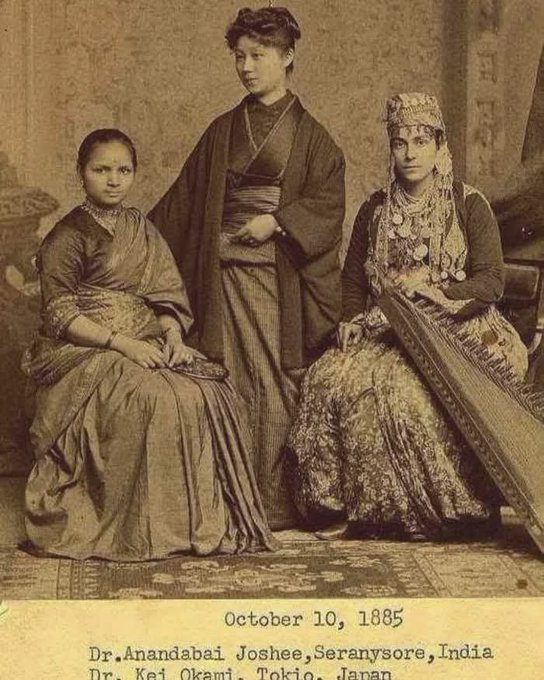
The photograph is quiet. The courage behind it is not.Sometimes people use:"It never happened to me...""He never did that to me....
The photograph is quiet. The courage behind it is not.
Sometimes people use:
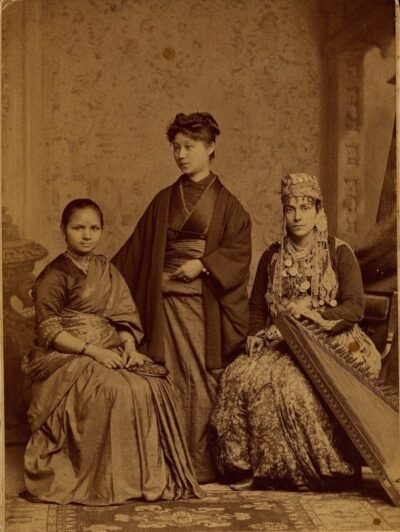
Anandibai Joshee, Kei Okami, and Sabat Islambouli, Woman’s Medical College of Pennsylvania, Philadelphia, October 10, 1885. Public domain.
“It never happened to me…”
“He never did that to me….
“I never heard of this happening to a woman or girl…”
Well, add this to things you’ve never heard or known because there is more that we don’t know than what we do. Especially around women and girls. We carry so much gracefully and quietly.
The three women in this photograph were international medical students who had traveled from three very different parts of Asia to study medicine at one of the rare institutions in the world then willing to train women as physicians. From left to right, they are Anandibai Gopalrao Joshee of India, Kei Okami of Japan, and Sabat Islambouli of Ottoman Syria.
They deliberately posed in clothing associated with their respective homelands. This photograph was taken on October 10, 1885, at the Woman’s Medical College of Pennsylvania in Philadelphia.
Anandibai Joshee — India
A closed door can shape a century. So can the woman who keeps walking until she finds one that opens
Anandibai was only about 20 years old when this photograph was taken.
Her path to that chair was painful. She had been married as a child and became a mother in her teens. Her baby died in infancy. That loss helped propel her toward medicine, particularly because women in India faced serious barriers to obtaining medical treatment from male physicians.
She crossed an ocean to study in Philadelphia and earned her MD in 1886. Tragically, she contracted tuberculosis and died in 1887, at only 21, scarcely getting the opportunity to practice the medicine she had fought so hard to learn.
There’s something almost haunting about looking at her in this photograph once you know that. She doesn’t know she has less than two years left.
But the road she was helping open would outlive her.
Kei Okami — Japan
A woman crossing an ocean for knowledge is already telling you something about how deeply she believes her mind belongs to her.
Standing in the center is Kei Okami, who graduated in 1889.
She returned to Japan and practiced medicine there. She became one of the pioneering Japanese women trained in Western medicine.
Think about the geography alone.
Japan to Philadelphia.
In the 1880s.
A woman traveling halfway around the world because somewhere across that ocean existed a school that would teach her what institutions closer to home often would not.
Sabat Islambouli — Ottoman Syria
They entered medicine carrying more than books. They carried grief, expectation, homeland, family, faith, ambition and the hopes of women they would never meet.
And then there is Sabat Islambouli, seated on the right in that magnificent dress and jewelry.
She came from Ottoman Syria and graduated with her medical degree in 1890. Records indicate that she returned to Damascus and later lived in Cairo. After that, the historical record becomes frustratingly thin. The medical college eventually lost contact with her. She died in 1941.
So there is still a woman’s life hiding from history here.
But there is another story in this photograph.
When women are finally allowed into the room, people call their success extraordinary. Sometimes the extraordinary thing was how long the room stayed closed.
The school itself deserves attention.
The Woman’s Medical College of Pennsylvania existed because ordinary medical education was largely closed to women. It was founded in 1850 as the Female Medical College of Pennsylvania and became one of the world’s important gateways into professional medicine for women.
And not only American women came knocking.
Women came from abroad.
India.
Japan.
Syria.
They crossed borders, oceans, languages and social expectations to sit in classrooms together in Philadelphia.
That changes how I see this photograph.
It isn’t simply:
Look at these remarkable women who became doctors.
It’s also:
Look what women did when somebody FINALLY opened a door that never should have been closed to them.
These were pioneering women who were among the first from their respective countries to earn degrees in Western medicine. Certainly they were not the only ones qualified, but they were among the first. We should be careful when history calls a woman exceptional. Sometimes she was surrounded by equally capable women who were never given the same chance.
That careful wording doesn’t diminish this photograph one bit.
And notice something else beautiful about the photograph: they didn’t have to erase where they came from to represent intellectual achievement. They did not leave their cultures behind to become educated. They carried home with them into the classroom.
They arrived visibly themselves.