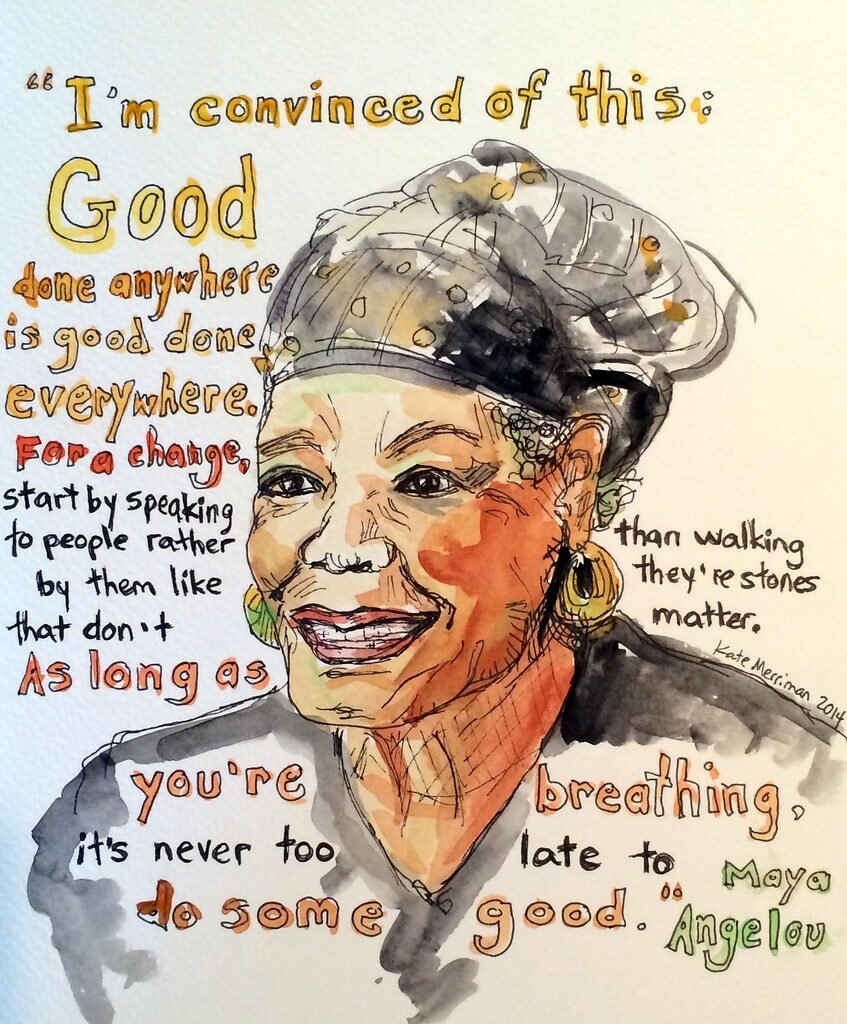
There is something else we should remember when reading the childhood stories of Maya Angelou, or anyone else who survived something overwhelming Adul
There is something else we should remember when reading the childhood stories of Maya Angelou, or anyone else who survived something overwhelming Adults cannot travel backward in time and diagnose the child they once were simply because they now have adult language, education, wisdom, or expertise. They can tell us what they remember.
They can tell us what frightened them. What they believed. What they saw. What they heard. What they did to survive. They can tell us, I stopped talking. I thought my words had killed someone. I was afraid to use my voice.
That testimony is enormously valuable. We can avoid using it to interrogate them. We need this information to help other children and adults too.
Before Maya Angelou became known around the world for the power of her voice, there was a period when she almost completely stopped using it.
She was a beautiful and innocent little girl. And someone harmed her.
When Maya was a child, she was sexually abused and raped by her mother’s boyfriend, a man named Freeman. She eventually told her brother, Bailey, and the abuse was disclosed to the family. They were outraged.
Freeman was prosecuted and found guilty. But despite the conviction, he spent an extraordinarily short time in custody.
Angelou later recalled in her ground breaking memoir, I Know Why the Caged Bird Sings, that he was jailed for only one day and night and then released. A few days later, police came to the family home and announced, within Maya’s hearing, that Freeman had been found dead. According to Angelou, it appeared that he had been kicked to death.
Nobody needed to explain cause and effect to a frightened little girl. Her child’s mind created its own explanation.
She had spoken. She had told. The man died.
Therefore, she came to believe that her voice had killed him.
So Maya stopped speaking to almost everyone except her brother. She would remain largely silent for years. In interviews she described that she didn’t speak for years.
Imagine Carrying That at Seven Years Old
This part of Maya Angelou’s story deserves more attention than it sometimes receives. She had already survived sexual violence. Then came the trial. Then the man’s release. Then his death. And somewhere inside all of that, a child decided that perhaps the safest thing she could do for the people around her was stop talking. Angelou would later explain her childhood reasoning: if speaking someone’s name could result in death, she believed it was better not to speak. There is something here that adults who care for children need to understand:
Children can make meaning from traumatic events in ways adults never anticipate.
A child may blame herself for something no reasonable adult would blame her for.
A child may decide:
I caused this.
I shouldn’t have told.
Talking makes bad things happen.
Everybody was happier before I said anything.
If I stay quiet, maybe nobody else will get hurt.
The conclusion may be wrong.
But the fear inside it can be very real.
Was Maya Angelou Experiencing Selective Mutism?
You may see Maya Angelou’s childhood silence described online as selective mutism.
We should be careful with that description. We cannot retrospectively diagnose Maya Angelou from her autobiography, and what she described followed an extraordinary traumatic experience. Modern selective mutism has a more specific clinical meaning.
The American Speech-Language-Hearing Association describes selective mutism as an anxiety disorder in which a child consistently cannot speak in certain social situations where speaking is expected, even though that child speaks in other situations.
For example:
A little girl may chatter nonstop with her mother in the kitchen.
She may sing with her siblings.
She may tell elaborate stories to her grandmother.
Then she walks into school and cannot speak.
Not will not. Cannot.
The expectation that she speak may actually increase her anxiety and make speech even harder.
That is very different from simply being stubborn, disrespectful or defiant.
Trauma-Related Mutism Is Not Necessarily Selective Mutism
This distinction is especially important on a Survivor education website.
Not every child who stops speaking has selective mutism.
And:
Not every child with selective mutism has experienced abuse or trauma.
ASHA specifically cautions clinicians to distinguish the two.
Children with selective mutism typically can speak in certain situations but experience anxiety that prevents speech in others. By contrast, some children may stop speaking after a traumatic event or serious emotional disruption. If a child previously spoke normally and then becomes mute across settings following trauma, ASHA notes that selective mutism may not be the appropriate diagnosis.
That distinction protects children in both directions.
We should not assume that every child with selective mutism has been abused.
But we also should not slap the label “selective mutism” onto every traumatized child who becomes silent and stop asking what happened.
The behavior deserves context.
What Selective Mutism Can Look Like
Selective mutism can be confusing to adults precisely because the child can talk.
Parents may hear:
“She talks perfectly well at home.”
“He’s just shy.”
“She spoke to me yesterday.”
“He’ll talk when he wants something.”
“She’s choosing not to participate.”
But selective mutism can change depending upon the person, place and situation.
A child may speak to one teacher but not another.
Speak at home but not school.
Whisper to a friend but be unable to answer an adult.
Talk freely when nobody is paying attention but freeze when everyone turns toward them.
Some children communicate through pointing, facial expressions, gestures or writing when speech feels inaccessible.
That is why adults should resist turning speech into a test of obedience.
Don’t Make the Quiet Child Perform
Imagine being unable to speak because your body is overwhelmed with anxiety.
Now imagine an adult saying:
“Come on. You know how to talk.”
Everyone turns toward you.
Someone laughs.
Another adult says:
“She’s just being stubborn.”
Your anxiety rises.
And now speaking is even harder.
Pressure can become part of the problem.
A better response begins with curiosity.
Who does this child speak with?
Where does this child feel comfortable speaking?
When did the difficulty begin?
Did something change?
How does the child communicate when words aren’t available?
What happens immediately before the child freezes?
Those questions give us information.
Shame does not.
And Then There Was Mrs. Flowers
Maya Angelou’s story contains another lesson.
During her silent years, Maya was not empty.
She was reading.
Listening.
Memorizing.
Watching.
Learning language.
Absorbing poetry.
Her grandmother eventually introduced her to an educated Black woman named Bertha Flowers, who recognized something extraordinary in the quiet girl.
Mrs. Flowers did not treat Maya as though silence had erased her intelligence.
She introduced her to literature and encouraged her to experience poetry as something that needed the human voice.
Slowly, Maya began speaking again.
The child who had once feared the destructive power of her voice would eventually discover another possibility:
A voice could create.
A voice could teach.
A voice could write.
A voice could testify.
A voice could make people feel less alone.
Quiet Does Not Mean Empty
There may be a child sitting in a classroom right now who rarely speaks.
There may be a child in church who freezes when adults ask questions.
There may be a child who talks freely at home but cannot get words out at school.
And somewhere else, there may be a child who used to talk everywhere and suddenly stopped.
Those are not necessarily the same children experiencing the same thing.
We need adults wise enough to notice the difference.
Selective mutism deserves appropriate assessment and support. ASHA recommends an interdisciplinary approach that can involve speech-language pathologists, behavioral health professionals, teachers, pediatric professionals and families.
A sudden change following trauma deserves attention too.
Neither child needs ridicule.
Neither needs adults assigning motives without understanding what is happening.
And neither should have to prove distress before someone becomes curious.
Maya Angelou eventually gave the world a magnificent voice.
But I keep thinking about Maya before the world knew her name.
The little Black girl sitting quietly.
Reading.
Watching.
Remembering.
Thinking.
Still fully herself.
She was Maya Angelou even when nobody could hear her.
There is a lesson in that for every adult entrusted with a quiet child:
Listen for more than words.
Sources
American Speech-Language-Hearing Association (ASHA), Selective Mutism. Clinical information about selective mutism, anxiety, assessment, differential diagnosis, trauma and treatment.
NPR, Interview with Maya Angelou, 2013. Angelou describes the abuse, Freeman’s brief incarceration and release, his subsequent death, her childhood belief that her voice had caused his death, and her years of silence.
National Women’s History Museum, Maya Angelou. Biographical account of Angelou’s childhood, abuse and subsequent period of mutism.
Fun fact: Her good friend James Baldwin encouraged her to write her ground breaking memoir.