Institutions know how to write beautiful promises.“We take all reports seriously.”“Your safety is our priority.”“We are committed to a saf
Institutions know how to write beautiful promises.
“We take all reports seriously.”
“Your safety is our priority.”
“We are committed to a safe environment.”
There are webpages. Brochures. Policies. Awareness months. Posters in bathrooms.
But a Survivor does not live inside the brochure.
She has to walk into the building.
And sometimes what happens next tells a very different story.
1. 📄 The Brochure Promises Safety → The Survivor Meets a Maze
Call this office.
No, that office.
Fill this out.
Talk to this person.
Make another report.
Repeat the story.
Wait for somebody to call.
Explain everything again.
Every additional doorway creates another place where a frightened person can become exhausted, confused, discouraged, or lost.
A reporting system can technically exist while remaining terribly difficult to use.
2. 🚪 Too Many Doors Can Become a Form of Discouragement
Institutions sometimes think more reporting options automatically mean better access.
Not necessarily.
If departments do not communicate, a Survivor can end up carrying information between the very systems that are supposed to be helping her.
She becomes the messenger.
She becomes the case coordinator.
She becomes the person trying to figure out whether anyone understands the whole picture.
🚨 A Survivor should not have to manage an institution’s response to her own danger.
3. 🔍 A Lax Investigation Can Silence Without Anyone Saying “Be Quiet”
Silencing does not always sound like:
“Don’t tell anybody.”
Sometimes it looks like nothing happening.
Calls not returned.
Evidence not pursued.
Patterns not connected.
Reports sitting somewhere.
Information not reaching the people who need it.
Risk being treated as routine.
Eventually the institution teaches people something without putting it in writing:
Reporting may not produce meaningful action.
Research calls some failures of institutions to protect and adequately respond to Survivors institutional betrayal. Studies have documented experiences including minimizing assault, inadequate support, difficult reporting processes, and harmful institutional responses.
4. 🗣️ Watch What Happens to the Language
A Survivor says:
“He keeps following me.”
The institution hears:
relationship problem.
She says:
“I’m afraid of him.”
They hear:
conflict.
She says:
“He won’t leave me alone.”
Someone calls it:
unwanted communication.
Words matter because language can change the perceived seriousness of behavior.
Boundary crossing can become “miscommunication.”
Harassment can become “drama.”
Coercion can become “relationship trouble.”
A pattern can disappear when every incident is treated as an isolated event.
Sometimes institutional minimization begins with vocabulary.
5. 🧩 When Nobody Connects the Pieces, the Pattern Disappears
One department knows about the threatening message.
Another knows about the unwanted visit.
Someone else knows she requested an escort.
A friend knows she is terrified.
Housing knows something else.
Police have another piece.
Individually, each incident may appear smaller.
Together, they may tell a very different story.
If an institution’s systems cannot connect information, the Survivor may be the only person who can see the whole pattern.
And she may be trying desperately to make everyone else see it too.
6. 🪑 A Tiny Survivor-Support Office Can Tell Its Own Story
Look beyond the awareness campaign.
Look at the budget.
How many advocates are available?
How long does someone wait?
Is there somebody available after normal business hours?
Who handles stalking?
Who handles domestic violence?
Who handles sexual assault?
Who accompanies Survivors through complicated reporting systems?
Who follows up?
A beautiful commitment to Survivors backed by skeletal staffing can create counterfeit safety.
The institution can truthfully say:
“We have a Survivor-services office.”
The Survivor may discover that one overwhelmed office is trying to serve an entire community.
7. ⚠️ Lauren McCluskey Shows Why Systems Have to Recognize Patterns
University of Utah student Lauren McCluskey sought help after ending a relationship with a man who had deceived her about his identity and background and then extorted and threatened her.
The university later acknowledged serious mistakes and weaknesses in its response. It specifically said campus police had viewed Lauren’s situation through the lens of an extortion case rather than potential interpersonal violence, resulting in an insufficient sense of urgency.
Lauren was murdered on October 22, 2018. On campus. She had done everything that we ask victims to do.
Afterward, the university accepted 30 recommendations from an independent review and announced changes that included additional staffing, interpersonal-violence training, improved communication, victim advocacy and a streamlined reporting process.
Lauren was trying to get help.
Like too many failed victims, Lauren was trying to save herself.
8. 🧱 Normalizing Boundary Crossing Can Make Serious Behavior Look Ordinary
“He’s just persistent.”
“He really likes her.”
“They had a relationship.”
“He’s having trouble accepting the breakup.”
“She should block him.”
“Maybe they need to talk.”
“She needs to be more……(kind, understanding, compassionate, careful, inclusive……)
Be careful.
Repeated unwanted contact after somebody has established a boundary should not automatically be romanticized into persistence.
Institutions need people trained to recognize when apparently separate behaviors may be forming a pattern of stalking, coercion, harassment, threats, or escalating interpersonal violence.
A boundary repeatedly crossed does not become less of a boundary because everyone gets accustomed to watching it happen.
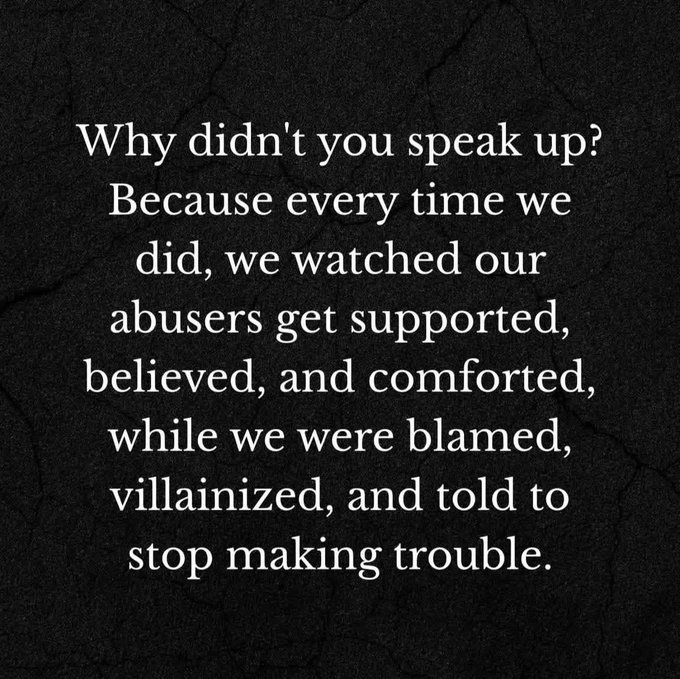
9. 🤐 Sometimes Survivors Are Silenced by Watching What Happened to the Last Woman
Institutional failure doesn’t affect only one person.
People watch.
Students watch how another student’s report was handled.
Employees watch what happened to the woman who complained.
Church members watch what happened to the woman who disclosed.
Athletes watch what happened when somebody reported the coach.
Families watch what happened to the relative who finally told.
Researchers have even examined secondary institutional betrayal, recognizing that witnessing an institution mistreat Survivors can affect people beyond the Survivor directly involved.
An institution is always teaching people something about disclosure.
The question is what.
10. 📢 “We Encourage Survivors to Come Forward” Is Only Half a Promise
Come forward to what?
A trained investigator?
A waiting list?
A voicemail?
A maze?
A person who understands stalking and coercive control?
Someone who thinks she is describing relationship drama?
An advocate who has enough time to help her?
A system capable of recognizing escalation?
Encouraging disclosure without building a strong response behind it can create a dangerous illusion.
The invitation to report is not the protection.
What happens after she reports is part of the protection.
11. 🪞 Stop Asking Only Why Survivors Don’t Report
Turn the question around.
What happens when they do?
👂🏾 Who listens?
📞 Who calls back?
📝 Who documents?
🔎 Who investigates?
🧩 Who connects the incidents?
🚨 Who recognizes escalation?
🤝🏾 Who stays beside her?
🏢 Who has enough staff to actually do the work?
⚖️ Who holds the institution accountable when its own system fails?
Perhaps Survivors have already given institutions enough advice about finding their voices.
Maybe institutions need to prove they have built somewhere safe for those voices to land.
👑 A Brochure Is Not a Safety System
A policy can look excellent.
A webpage can look compassionate.
A university can have an awareness campaign.
A workplace can require training.
A church can publish a safeguarding policy.
A hospital can put posters everywhere.
None of those things tells us what a Survivor will experience at 4:47 on a Friday afternoon when she says:
“I am afraid of this person.”
That is where the promise gets tested.
🌿 Do not advertise a doorway you have not adequately staffed.
🌿 Do not ask Survivors to report and then make them carry the report through the institution themselves.
🌿 Changing the language around dangerous behavior does not change the behavior.
🌿 A Survivor who repeatedly asks for help is not evidence that the reporting system worked. What happened after she asked is part of the evidence.
🌿 Safety is not what the brochure promises. Safety is what the institution does when somebody walks through the door.